ISRO to Launch Advanced Earth Observation Satellite EOS 09
Source:The Hindu ↗
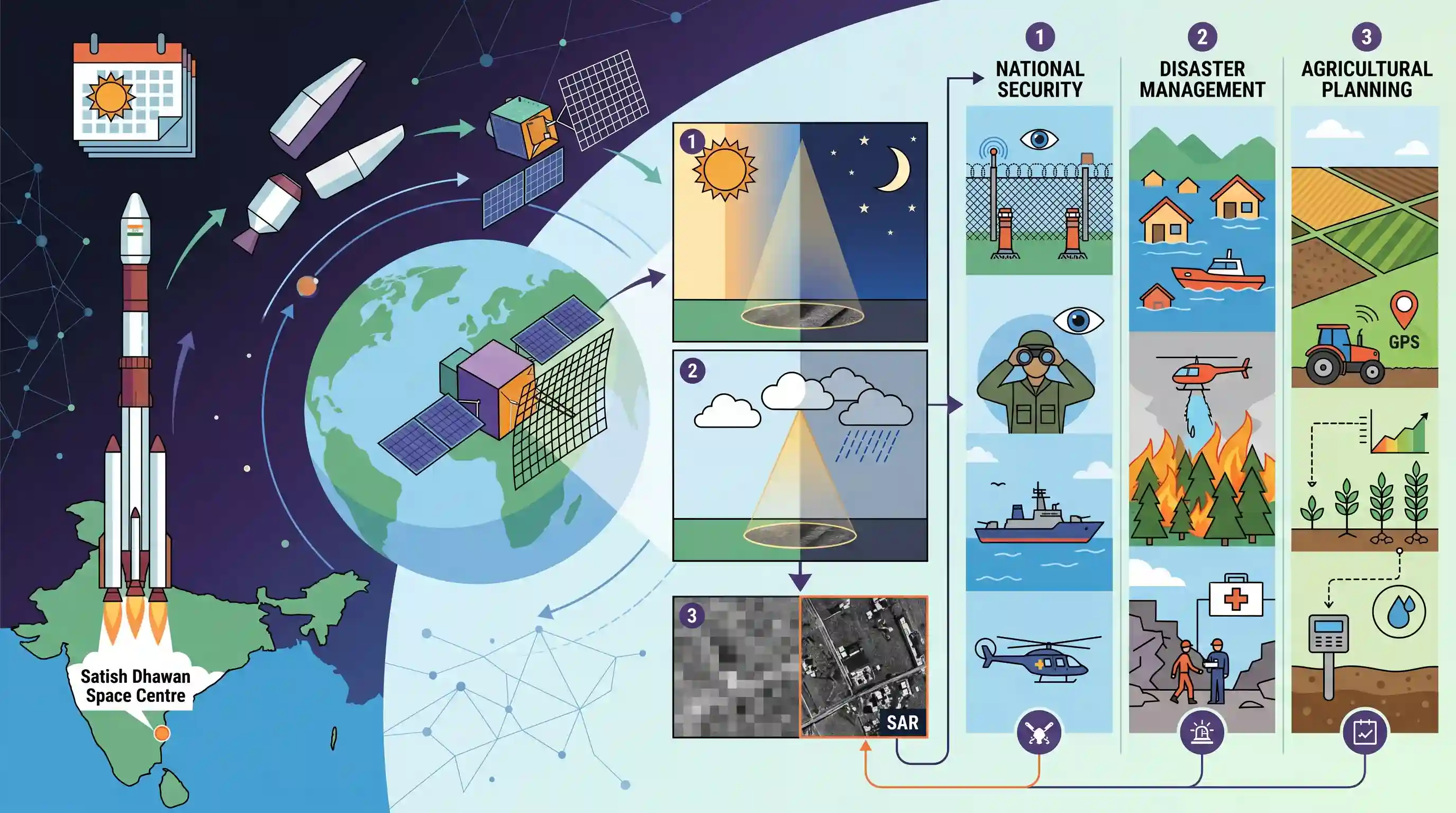
Why It Matters
The launch of EOS-09 significantly bolsters India's all-weather, day-and-night earth observation capabilities, which are critical for effective disaster management, proactive border surveillance, and efficient resource monitoring.
Summary
ISRO has scheduled the launch of its new Earth Observation Satellite, EOS-09 (RISAT-1B), using a Polar Satellite Launch Vehicle (PSLV) from Sriharikota on May 18. Equipped with a C-band synthetic aperture radar, the 1,710 kg satellite will provide uninterrupted, all-weather, high-resolution imaging to support national security, disaster management, and agricultural planning.
Key Points
- ISRO is set to launch the Earth Observation Satellite EOS-09 (RISAT-1B) weighing 1,710 kg aboard a PSLV rocket from Sriharikota on May 18, 2025.
- The satellite is equipped with a C-band synthetic aperture radar (SAR), allowing for all-weather, day-and-night high-resolution imaging.
- EOS-09's data will be critical for agriculture and forestry monitoring, disaster management, urban planning, and national security.
- It serves as a follow-on to RISAT-1 and complements data from India's existing Resourcesat, Cartosat, and RISAT-2B series satellites.
- Lawmakers from the Parliamentary Standing Committee on Science and Technology will be present to witness the launch.
Important Terms
ISRO (Indian Space Research Organisation)

India's primary space agency, established in 1969, responsible for space research and applications like remote sensing and communication. It operates under the administrative control of the Department of Space.
UPSC context
GS Paper 3: Science and Technology; tests knowledge of India's indigenous space capabilities and institutional framework.
Department of Space (DoS)
A government department reporting directly to the Prime Minister, responsible for administering India's space program and overseeing agencies like ISRO, NSIL, and IN-SPACe.
UPSC context
GS Paper 2/3: Governance and Space Policy; focuses on the administrative structure and executive control of scientific departments.
Polar Satellite Launch Vehicle (PSLV)
India's third-generation, four-stage launch vehicle, often called the 'Workhorse of ISRO.' It was the first Indian rocket to use liquid stages (Vikas engine).
UPSC context
GS Paper 3: Space Technology; frequently tested in Prelims (technical stages) and Mains (reliability and commercial significance).
Synthetic Aperture Radar (SAR)
An active remote sensing technology using microwave signals to create high-resolution images. It provides all-weather, day-and-night observation, essential for border surveillance and disaster management.
UPSC context
GS Paper 3: Technology and Internal Security; tests understanding of advanced imaging tech used for national surveillance and disaster monitoring.
Earth Observation Satellite (EOS)
Satellites equipped with remote sensing sensors to monitor Earth's physical, chemical, and biological systems. Applications include agriculture, forestry, and high-resolution mapping for security.
UPSC context
GS Paper 3: Science and Tech Applications; important for socio-economic development and disaster management themes.
Parliamentary Standing Committee on Science and Technology
A permanent parliamentary body that scrutinizes the policies, budgets (Demands for Grants), and functioning of the Department of Space to ensure executive accountability.
UPSC context
GS Paper 2: Polity/Parliament; tests the mechanism of legislative oversight over specialized technical departments.
Prelims Trap
EOS-09 uses passive optical sensors that require clear skies and sunlight for high-resolution imaging.
SAR is an active remote sensing technology that emits microwave pulses. This allows it to penetrate clouds and capture images at night, unlike passive optical sensors.
Static Concepts Connected
What are the primary differences between PSLV and GSLV?
- Payload and Orbit: PSLV primarily places Earth Observation satellites into Sun-Synchronous or Low Earth Orbits. GSLV is designed to place heavier communication satellites into Geosynchronous Transfer Orbits.
- Stage Configuration: PSLV is a 4-stage launch vehicle (Solid-Liquid-Solid-Liquid). GSLV is a 3-stage vehicle that utilizes an indigenous Cryogenic Upper Stage.
How does Active Remote Sensing differ from Passive Remote Sensing?
- Energy Source: Active sensors (like SAR) emit their own energy (microwaves) to scan targets. Passive sensors rely on detecting natural energy (like reflected sunlight or thermal radiation).
- Weather Dependency: Active sensors can penetrate cloud cover and operate during day or night. Passive optical sensors are heavily obstructed by clouds, fog, and darkness.
Cross-Topic Patterns
Remote Sensing in Precision Agriculture
SAR data from the EOS series directly integrates into digital agriculture initiatives, enabling soil moisture tracking and real-time crop yield predictions vital for schemes like PMFBY.
Dual-Use Space Assets for Internal Security
The RISAT series exemplifies dual-use capabilities, aiding civilian disaster management (flood mapping) while simultaneously providing persistent, all-weather surveillance for border security and military logistics.

Expect a 2026 prelims question on active vs passive remote sensing, linking SAR's cloud penetration capabilities to precision agriculture.
Linked PYQs · 2
Linked PYQs · 2
- 2019PrelimsGS1
For the measurement/estimation of which of the following are satellite images/remote sensing data used? 1. Chlorophyll content in the vegetation of a specific location 2. Greenhouse gas emissions from rice paddies of a specific location 3. Land surface temperatures of a specific location Select the correct answer using the code given below.
- 2018PrelimsGS1
With reference to India's satellite launch vehicles, consider the following statements: 1. PSLVs launch the satellites useful for Earth resources monitoring whereas GSLVs are designed mainly to launch communication satellites. 2. Satellites launched by PSLV appear to remain permanently fixed in the same position in the sky, as viewed from a particular location on Earth. 3. GSLV Mk III is a four-staged launch vehicle with the first and third stages using solid rocket motors; and the second and fourth stages using liquid rocket engines. Which of the statements given above is/are correct?
