ISRO Commercial Launch of US Built Communication Satellite
Source:The Hindu ↗
Why It Matters
Demonstrates India's strategic shift from a developing space program to a global commercial launch provider, capable of handling heavy payloads for advanced nations. It also highlights the deepening bilateral scientific cooperation between India and the United States (e.g., NISAR).
Summary
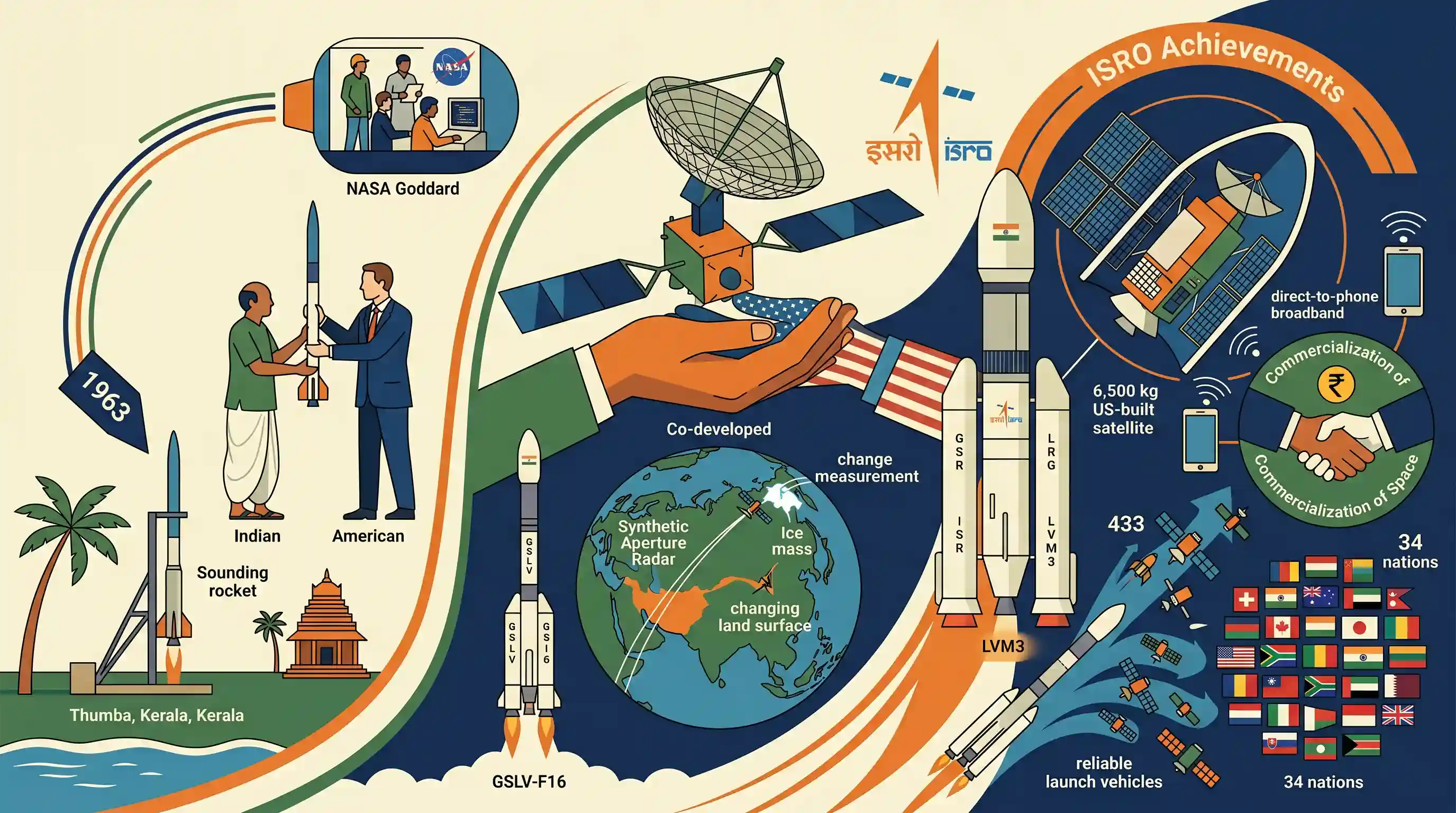
The Indian Space Research Organisation (ISRO) is set to launch a 6,500 kg US-built communication satellite using its heavy-lift capabilities, marking a significant step in space commercialization. Alongside this commercial milestone, the highly anticipated NASA-ISRO Synthetic Aperture Radar (NISAR) mission is scheduled to fly on a GSLV-F16 rocket. These developments underscore the drastic evolution of India's space program—from launching a tiny US-supplied sounding rocket in 1963 to deploying heavy foreign commercial payloads and co-developing advanced earth-observation systems today. ISRO's reliable launch vehicles have so far placed 433 satellites from 34 nations into orbit.
Key Points
- ISRO is preparing to launch a 6,500 kg communication satellite manufactured by the United States, highlighting India's growing heavy-lift commercial capabilities.
- The NASA-ISRO Synthetic Aperture Radar (NISAR) earth observation mission is scheduled for launch aboard a GSLV-F16 rocket in mid-2025.
- India's space journey has evolved from receiving its first sounding rocket from the US in 1963 to acting as a commercial launch provider for massive American satellites today.
- To date, ISRO has successfully launched 433 satellites from 34 different countries, cementing its position in the global space economy.
Important Terms
NISAR (NASA-ISRO Synthetic Aperture Radar)

A joint Earth-observation mission between NASA and ISRO using dual-frequency (L and S-band) radar to monitor global land and ice surfaces with high precision.
UPSC context
GS Paper III (Space Tech); tests knowledge of international space collaborations and advanced remote-sensing applications.
ISRO (Indian Space Research Organisation)
India's primary space agency under the Department of Space, responsible for indigenous satellite development, planetary exploration, and operating launch vehicles like PSLV and LVM3.
UPSC context
GS Paper III (Science & Tech); fundamental for understanding India’s technological self-reliance and space governance.
NSIL (NewSpace India Limited)
The commercial arm of ISRO, a Central Public Sector Enterprise (CPSE) that manages commercial satellite launches and promotes private sector participation in the Indian space industry.
UPSC context
GS Paper III (Space Economy); relevant for topics on space sector reforms and global commercial competitiveness.
LVM3 (Launch Vehicle Mark 3)
ISRO’s heaviest launch vehicle (formerly GSLV Mk-III), capable of carrying 4,000 kg to Geosynchronous Transfer Orbit (GTO). Used for heavy commercial payloads and deep-space missions.
UPSC context
GS Paper III (Space Tech); tests knowledge of India's heavy-lift capabilities and launch vehicle evolution.
GSLV (Geosynchronous Satellite Launch Vehicle)
A three-stage rocket with an indigenous cryogenic upper stage. The GSLV-F16 variant was specifically utilized to deploy the NISAR satellite into a sun-synchronous orbit.
UPSC context
GS Paper III (Science & Tech); crucial for understanding the technical specifications of India's medium-to-heavy lift rockets.
Synthetic Aperture Radar (SAR)
A remote sensing technology that creates high-resolution images of the Earth's surface by using the motion of the radar antenna; it works in all weather and lighting.
UPSC context
GS Paper III (Space Tech); a core concept for Earth observation, disaster management, and environmental monitoring.
Space Commercialization
The shift toward private sector involvement and profit-driven activities in the space sector, moving away from purely government-funded scientific or strategic exploration.
UPSC context
GS Paper III (Economy/Science); focuses on the emerging "New Space" era and India's global market share.
Prelims Trap
GSLV launch vehicles are exclusively designed to place satellites into Geosynchronous Transfer Orbits (GTO).
GSLV-F16 breaks this traditional rule by placing the NISAR Earth-observation satellite into a Sun-Synchronous Polar Orbit (SSPO), disproving the 'GTO-only' assumption.
Static Concepts Connected
What distinguishes a Sun-Synchronous Polar Orbit (SSPO)?
- Altitude & Path: Satellites travel from pole to pole at altitudes of 600-800 km, while the Earth rotates beneath them.
- Constant Illumination: The satellite passes over a specific latitude at the exact same local solar time, ensuring consistent lighting conditions for images.
- Primary Utility: Primarily used for Earth observation, spy satellites, and weather forecasting (e.g., NISAR, Cartosat).
How does Synthetic Aperture Radar (SAR) differ from optical remote sensing?
- Active Sensor: Unlike optical sensors that rely on sunlight, SAR transmits its own microwave pulses and measures the echoes, making it functional day and night.
- Weather Independence: SAR's longer microwave wavelengths can penetrate clouds, fog, and smoke, offering uninterrupted all-weather Earth observation.
- Multi-Band Penetration: Different bands (like NISAR's L-band and S-band) penetrate materials differently, allowing detailed mapping of vegetation biomass, ice sheets, and soil moisture.
Cross-Topic Patterns
Space Commercialization + iCET synergy
India's transition from receiving US sounding rockets to launching US heavy payloads underscores NSIL's growing global market share and the deepening Indo-US Initiative on Critical and Emerging Technology (iCET).
NISAR + GS-3 Disaster Management
NISAR's ability to measure Earth's changing ecosystems and surface deformation at sub-centimeter levels will directly feed into GS-3 disaster management for Himalayan landslides and glacial lake outbursts.

Expect a 2026 Prelims question mixing GSLV's novel use for polar orbits (SSPO), NISAR's dual-band capabilities, and NSIL's commercial role.
Linked PYQs · 2
Linked PYQs · 2
- 2016MainsGS3
Discuss India's achievements in the field of Space Science and Technology. How the application of this technology has helped India in its socio-economic development?
- 2018PrelimsGS1
With reference to India's satellite launch vehicles, consider the following statements: 1. PSLVs launch the satellites useful for Earth resources monitoring whereas GSLVs are designed mainly to launch communication satellites. 2. Satellites launched by PSLV appear to remain permanently fixed in the same position in the sky, as viewed from a particular location on Earth. 3. GSLV Mk III is a four-staged launch vehicle with the first and third stages using solid rocket motors; and the second and fourth stages using liquid rocket engines. Which of the statements given above is/are correct?
