पृथ्वी अवलोकन उपग्रह मिशन और प्रक्षेपण यान वापसी
स्रोत:द हिंदू ↗
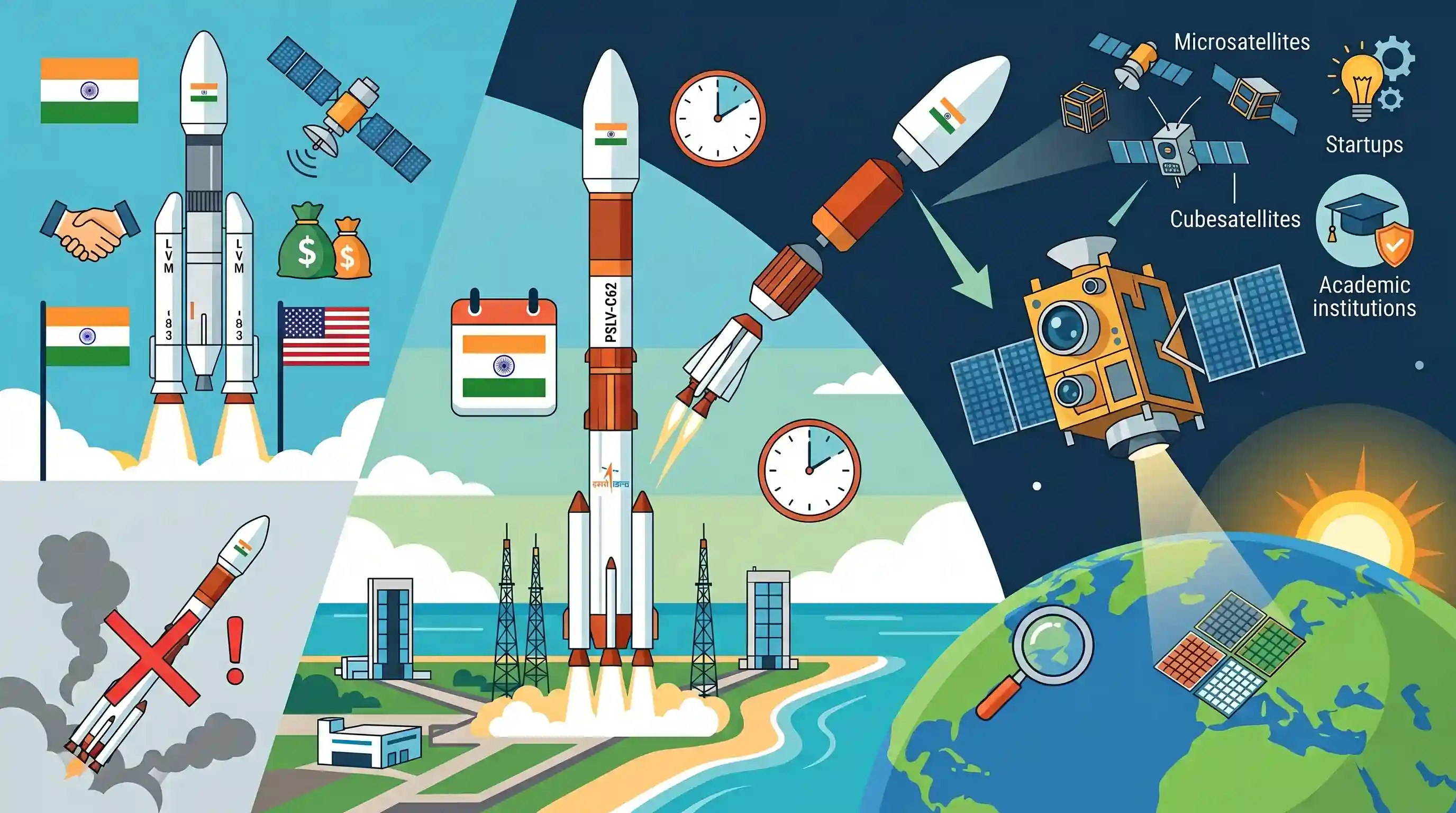
क्यों मायने रखता है
Understanding ISRO's launch vehicles (PSLV vs GSLV/LVM-3) and the specific applications of Earth Observation Satellites (EOS) is critical for GS-3 Space Technology. The inclusion of private payloads underscores India's evolving space policy.
सारांश
The Indian Space Research Organisation (ISRO) will begin 2026 with the launch of the PSLV-C62 mission on January 12 from the Satish Dhawan Space Centre in Sriharikota. The mission's primary payload is the EOS-N1, an earth observation satellite designed for strategic imaging. This launch is highly anticipated as it signifies the return of the Polar Satellite Launch Vehicle (PSLV) after a glitch during its previous flight in May 2025. Alongside the EOS-N1, the rocket will carry multiple payloads from startups and academic institutions. The mission comes on the heels of ISRO successfully launching a US commercial satellite via the LVM-3 rocket.
मुख्य बिंदु
- ISRO is scheduled to launch the PSLV-C62 mission carrying the EOS-N1 satellite on January 12, 2026, marking its first mission of the year.
- The EOS-N1 is an earth imaging satellite built primarily for strategic and surveillance purposes.
- The launch marks the return of ISRO's workhorse, the PSLV, after it suffered a technical glitch during the PSLV-C61/EOS-09 mission in May 2025.
- यह मिशन स्पेस स्टार्टअप्स और शैक्षणिक संस्थानों के सेकेंडरी पेलोड (secondary payloads) को भी साथ ले जाएगा, जो भारत में निजी अंतरिक्ष अन्वेषण के बढ़ते इकोसिस्टम को रेखांकित करता है।
- यह प्रक्षेपण ISRO के सबसे भारी रॉकेट, LVM-3 द्वारा अमेरिका स्थित BlueBird Block-2 सैटेलाइट की सफल तैनाती के बाद हुआ है।
महत्वपूर्ण शब्द
Polar Satellite Launch Vehicle (PSLV)

ISRO's 'workhorse' third-generation launch vehicle; a four-stage rocket (solid and liquid stages) used primarily for Sun-Synchronous Polar Orbits.
UPSC context
GS Paper 3: Space Technology. Tests knowledge of launch vehicle generations and India's satellite delivery capabilities.
LVM-3 (लॉन्च व्हीकल मार्क-3)
India’s heaviest launch vehicle (formerly GSLV Mk-III), a three-stage rocket designed to carry 4-ton class satellites to GTO and heavy payloads to LEO.
UPSC context
GS पेपर 3: प्रौद्योगिकी। भारत की हैवी-लिफ्ट आत्मनिर्भरता, वाणिज्यिक बाजार में प्रवेश और गगनयान मिशन के लिए महत्वपूर्ण।
EOS-N1 (अन्वेषा)
An advanced hyperspectral Earth observation satellite (nicknamed 'Anvesha') built by DRDO for strategic surveillance, border monitoring, and environmental tracking.
UPSC context
GS Paper 3: Internal Security/Science. Relevant for dual-use technology and space-based intelligence/surveillance (ISR).
NewSpace India Limited (NSIL)
अंतरिक्ष विभाग के तहत ISRO की वाणिज्यिक शाखा, जिसे निजी क्षेत्र की भागीदारी को बढ़ाने और वाणिज्यिक उपग्रह प्रक्षेपणों को संभालने का दायित्व सौंपा गया है।
UPSC context
GS Paper 3: Economy/Science. Focuses on the commercialization of space and NewSpace sector reforms.
हाइपरस्पेक्ट्रल इमेजिंग
Advanced imaging technology that collects data across hundreds of narrow spectral bands, allowing identification of materials and camouflaged objects from space.
UPSC context
GS पेपर 3: विज्ञान एवं प्रौद्योगिकी। कृषि और रक्षा में रिमोट सेंसिंग के अनुप्रयोगों की समझ का परीक्षण करता है।
सतीश धवन अंतरिक्ष केंद्र (SDSC)
आंध्र प्रदेश के श्रीहरिकोटा में स्थित भारत का मुख्य स्पेसपोर्ट, जो ISRO के सभी उपग्रह प्रक्षेपणों के लिए बुनियादी ढांचा प्रदान करता है।
UPSC context
GS Paper 3: Scientific Institutions. Key geographical and strategic asset for India's space program.
प्रारंभिक ट्रैप
निरंतर रणनीतिक निगरानी के लिए पृथ्वी अवलोकन उपग्रहों (EOS) को भू-तुल्यकालिक कक्षाओं (Geosynchronous orbits) में स्थापित किया जाता है।
EOS are typically placed in Low Earth Orbit (LEO) or Sun-Synchronous Orbit (SSO) to provide close-range, high-resolution imaging, not Geosynchronous orbits.
संबंधित अवधारणाएँ
PSLV और LVM-3 चरणों की संरचना (stage composition) और पेलोड क्षमताओं के मामले में एक-दूसरे से किस प्रकार भिन्न हैं?
- PSLV Stages: चार चरण जिसमें बारी-बारी से ठोस और तरल प्रणोदन का उपयोग होता है। यह उपग्रहों को सूर्य-तुल्यकालिक कक्षाओं (SSO) में तैनात करने के लिए ISRO का 'वर्कहॉर्स' है।
- LVM-3 के चरण: Three stages: twin solid strap-ons, a liquid core, and a cryogenic upper stage. Designed for heavy payloads.
- पेलोड सीमाएं: PSLV carries ~1.75 tonnes to SSO. LVM-3 can carry up to 4 tonnes to GTO or 8 tonnes to LEO.
What is the functional difference between NSIL and IN-SPACe?
- NSIL: ISRO's commercial arm under DoS. It handles launch contracts, satellite building, and technology transfer to private industries.
- IN-SPACe: An independent nodal agency under DoS that authorizes, promotes, and regulates the space activities of private startups and academia.
अंतर-विषय पैटर्न
Dual-Use Space Assets + Security
The EOS-N1 highlights the growing overlap between ISRO's civilian space program and military/strategic surveillance requirements for border management.
Space Privatization (GS-3)
Carrying startup payloads alongside strategic assets shows the practical rollout of the 2023 Indian Space Policy, emphasizing private ecosystem integration.

2026 की Prelims में PSLV/LVM-3 के चरणों के प्रणोदकों (propellants) और NSIL बनाम IN-SPACe के अलग-अलग अधिदेशों (mandates) के बीच तुलना करने वाले एक बहु-कथनीय (multi-statement) प्रश्न की अपेक्षा करें।
संबद्ध PYQ · 3
संबद्ध PYQ · 3
- 2018PrelimsGS1
With reference to India's satellite launch vehicles, consider the following statements: 1. PSLVs launch the satellites useful for Earth resources monitoring whereas GSLVs are designed mainly to launch communication satellites. 2. Satellites launched by PSLV appear to remain permanently fixed in the same position in the sky, as viewed from a particular location on Earth. 3. GSLV Mk III is a four-staged launch vehicle with the first and third stages using solid rocket motors; and the second and fourth stages using liquid rocket engines. Which of the statements given above is/are correct?
- 2016MainsGS3
Discuss India's achievements in the field of Space Science and Technology. How the application of this technology has helped India in its socio-economic development?
- 2023MainsGS3
What is the main task of India's third moon mission which could not be achieved in its earlier mission? List the countries that have achieved this task. Introduce the subsystems in the spacecraft launched and explain the role of the Virtual Launch Control Centre' at the Vikram Sarabhai Space Centre which contributed to the successful launch from Sriharikota.
