Earth Observation Satellite mission and launch vehicle return
Source:The Hindu ↗
Why It Matters
Understanding ISRO's launch vehicles (PSLV vs GSLV/LVM-3) and the specific applications of Earth Observation Satellites (EOS) is critical for GS-3 Space Technology. The inclusion of private payloads underscores India's evolving space policy.
Summary
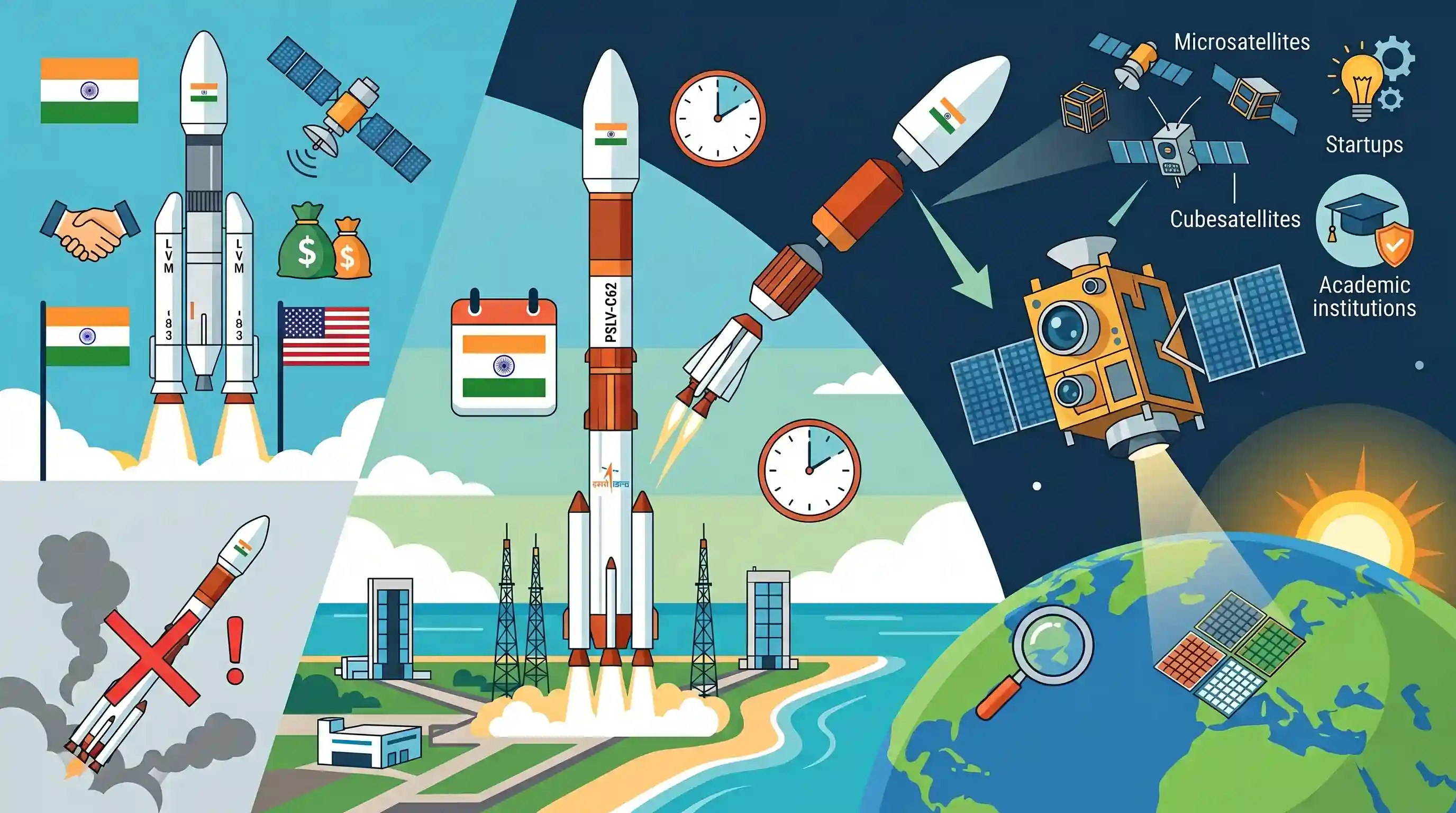
The Indian Space Research Organisation (ISRO) will begin 2026 with the launch of the PSLV-C62 mission on January 12 from the Satish Dhawan Space Centre in Sriharikota. The mission's primary payload is the EOS-N1, an earth observation satellite designed for strategic imaging. This launch is highly anticipated as it signifies the return of the Polar Satellite Launch Vehicle (PSLV) after a glitch during its previous flight in May 2025. Alongside the EOS-N1, the rocket will carry multiple payloads from startups and academic institutions. The mission comes on the heels of ISRO successfully launching a US commercial satellite via the LVM-3 rocket.
Key Points
- ISRO is scheduled to launch the PSLV-C62 mission carrying the EOS-N1 satellite on January 12, 2026, marking its first mission of the year.
- The EOS-N1 is an earth imaging satellite built primarily for strategic and surveillance purposes.
- The launch marks the return of ISRO's workhorse, the PSLV, after it suffered a technical glitch during the PSLV-C61/EOS-09 mission in May 2025.
- The mission will also carry secondary payloads from space startups and academia, highlighting the growing ecosystem of private space exploration in India.
- The launch follows the successful deployment of the US-based BlueBird Block-2 satellite by ISRO's heaviest rocket, LVM-3.
Important Terms
Polar Satellite Launch Vehicle (PSLV)

ISRO's 'workhorse' third-generation launch vehicle; a four-stage rocket (solid and liquid stages) used primarily for Sun-Synchronous Polar Orbits.
UPSC context
GS Paper 3: Space Technology. Tests knowledge of launch vehicle generations and India's satellite delivery capabilities.
LVM-3 (Launch Vehicle Mark-3)
India’s heaviest launch vehicle (formerly GSLV Mk-III), a three-stage rocket designed to carry 4-ton class satellites to GTO and heavy payloads to LEO.
UPSC context
GS Paper 3: Technology. Important for India's heavy-lift self-reliance, commercial market entry, and Gaganyaan mission.
EOS-N1 (Anvesha)
An advanced hyperspectral Earth observation satellite (nicknamed 'Anvesha') built by DRDO for strategic surveillance, border monitoring, and environmental tracking.
UPSC context
GS Paper 3: Internal Security/Science. Relevant for dual-use technology and space-based intelligence/surveillance (ISR).
NewSpace India Limited (NSIL)
The commercial arm of ISRO under the Department of Space, mandated to scale up private sector participation and handle commercial satellite launches.
UPSC context
GS Paper 3: Economy/Science. Focuses on the commercialization of space and NewSpace sector reforms.
Hyperspectral Imaging
Advanced imaging technology that collects data across hundreds of narrow spectral bands, allowing identification of materials and camouflaged objects from space.
UPSC context
GS Paper 3: Science & Tech. Tests understanding of remote sensing applications in agriculture and defense.
Satish Dhawan Space Centre (SDSC)
India's primary spaceport located in Sriharikota, Andhra Pradesh, providing the infrastructure for all of ISRO's satellite launches.
UPSC context
GS Paper 3: Scientific Institutions. Key geographical and strategic asset for India's space program.
Prelims Trap
"Earth Observation Satellites (EOS) are placed in Geosynchronous orbits for continuous strategic surveillance."
EOS are typically placed in Low Earth Orbit (LEO) or Sun-Synchronous Orbit (SSO) to provide close-range, high-resolution imaging, not Geosynchronous orbits.
Static Concepts Connected
How do PSLV and LVM-3 differ in stage composition and payload capabilities?
- PSLV Stages: Four stages with alternating solid and liquid propulsion. It is ISRO's workhorse for deploying satellites into Sun-Synchronous Orbits (SSO).
- LVM-3 Stages: Three stages: twin solid strap-ons, a liquid core, and a cryogenic upper stage. Designed for heavy payloads.
- Payload Limits: PSLV carries ~1.75 tonnes to SSO. LVM-3 can carry up to 4 tonnes to GTO or 8 tonnes to LEO.
What is the functional difference between NSIL and IN-SPACe?
- NSIL: ISRO's commercial arm under DoS. It handles launch contracts, satellite building, and technology transfer to private industries.
- IN-SPACe: An independent nodal agency under DoS that authorizes, promotes, and regulates the space activities of private startups and academia.
Cross-Topic Patterns
Dual-Use Space Assets + Security
The EOS-N1 highlights the growing overlap between ISRO's civilian space program and military/strategic surveillance requirements for border management.
Space Privatization (GS-3)
Carrying startup payloads alongside strategic assets shows the practical rollout of the 2023 Indian Space Policy, emphasizing private ecosystem integration.

Expect a 2026 multi-statement Prelims Q contrasting PSLV/LVM-3 stage propellants and the distinct mandates of NSIL vs IN-SPACe.
Linked PYQs · 3
Linked PYQs · 3
- 2018PrelimsGS1
With reference to India's satellite launch vehicles, consider the following statements: 1. PSLVs launch the satellites useful for Earth resources monitoring whereas GSLVs are designed mainly to launch communication satellites. 2. Satellites launched by PSLV appear to remain permanently fixed in the same position in the sky, as viewed from a particular location on Earth. 3. GSLV Mk III is a four-staged launch vehicle with the first and third stages using solid rocket motors; and the second and fourth stages using liquid rocket engines. Which of the statements given above is/are correct?
- 2016MainsGS3
Discuss India's achievements in the field of Space Science and Technology. How the application of this technology has helped India in its socio-economic development?
- 2023MainsGS3
What is the main task of India's third moon mission which could not be achieved in its earlier mission? List the countries that have achieved this task. Introduce the subsystems in the spacecraft launched and explain the role of the Virtual Launch Control Centre' at the Vikram Sarabhai Space Centre which contributed to the successful launch from Sriharikota.
