ISRO successfully tests thrust chamber for LOX methane engine
Source:The Hindu ↗
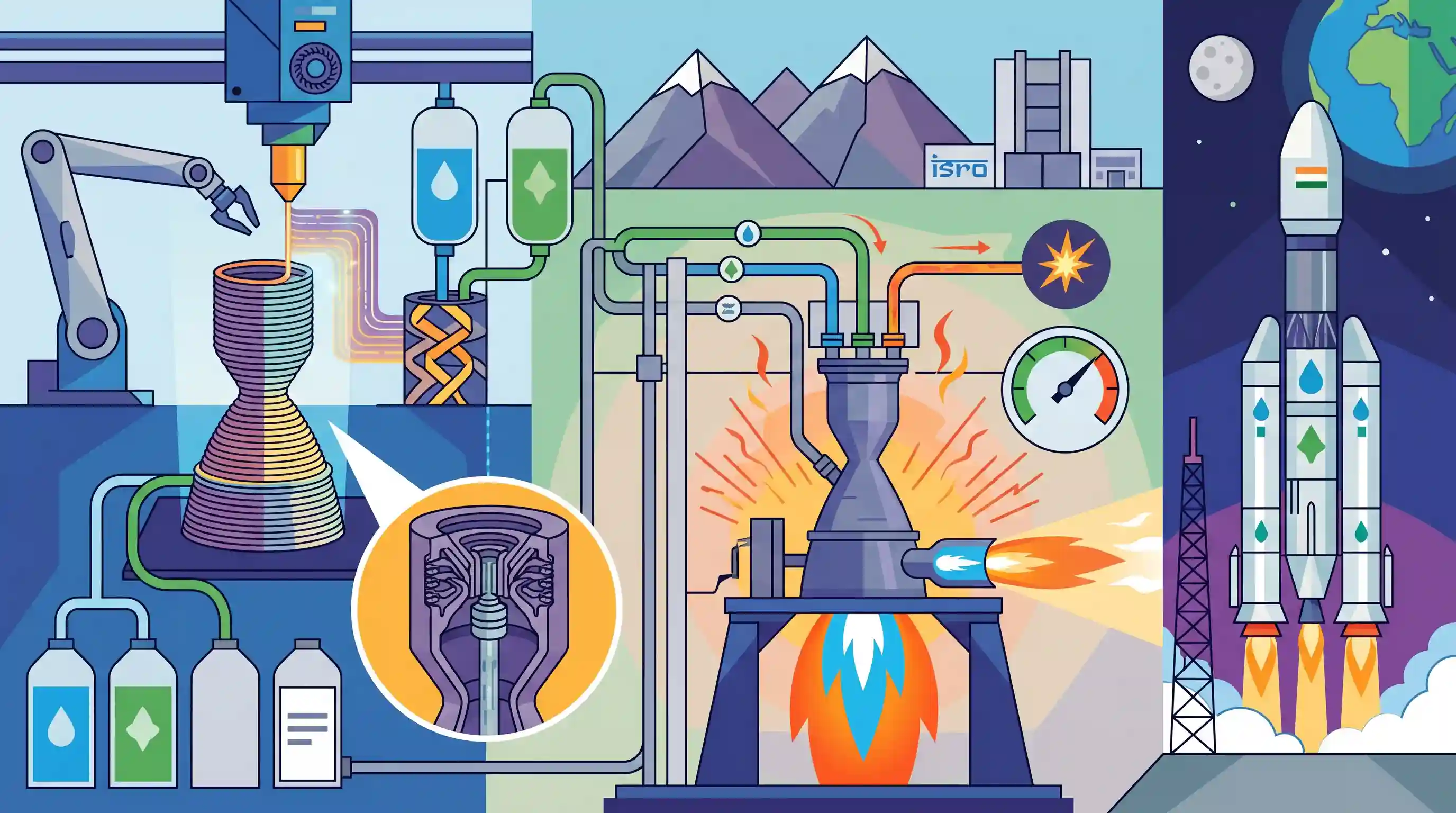
Why It Matters
Demonstrates India's progress in next-generation space technologies, specifically the transition to cleaner propellants like LOX-Methane and the adoption of cost-effective, rapid additive manufacturing (3D printing) for critical engine components.
Summary
ISRO has achieved a significant milestone in its future launch vehicle programme by successfully hot-testing a sub-scale thrust chamber for a Liquid Oxygen (LOX)-Methane engine. Conducted at the ISRO Propulsion Complex (IPRC) in Mahendragiri, the test validated the performance of a thrust chamber and single-element injector head built entirely through additive manufacturing (3D printing). The system achieved stable ignition and a chamber pressure of 56 bar, demonstrating the viability of integrating clean, efficient propellants and rapid manufacturing techniques into India's next generation of space launch vehicles.
Key Points
- ISRO successfully hot-tested a sub-scale thrust chamber for a LOX-Methane engine at the ISRO Propulsion Complex (IPRC) in Mahendragiri.
- The thrust chamber and single-element injector head were fabricated using additive manufacturing (3D printing) techniques.
- The test achieved stable ignition, flame sustenance, and a chamber pressure of 56 bar.
- This engine technology is being developed for induction into India's next generation of launch vehicles.
Important Terms
LOX-Methane Propellant

A high-performance liquid rocket propellant using liquid oxygen as an oxidizer and liquid methane as fuel, valued for reusability and cleaner combustion.
UPSC context
GS-III Science & Tech (Space); essential for understanding India's shift toward reusable and environmentally friendly launch technology.
Next Generation Launch Vehicle (NGLV)
ISRO's proposed modular, heavy-lift rocket (internally called 'Soorya') designed for partial reusability and a 30-tonne payload capacity to Low Earth Orbit.
UPSC context
GS-III Space technology; represents the future roadmap for Indian launch vehicles and heavy-lift capabilities.
Additive Manufacturing
A process of creating complex components layer-by-layer from digital designs, used by ISRO to rapidly produce lightweight and integrated engine parts.
UPSC context
GS-III Indigenization of Technology; tests knowledge of disruptive manufacturing techniques that enhance space mission efficiency.
ISRO Propulsion Complex (IPRC)
ISRO's premier testing facility in Mahendragiri, Tamil Nadu, dedicated to the assembly, integration, and validation of liquid and cryogenic propulsion systems.
UPSC context
GS-III Space Infrastructure; critical for understanding the physical centers supporting India's self-reliance in space.
Liquid Propulsion Systems Centre (LPSC)
The lead ISRO center for the design, development, and realization of liquid propulsion stages and auxiliary systems for launch vehicles and satellites.
UPSC context
GS-III Space Tech; tests understanding of ISRO’s institutional framework and R&D specialization.
Thrust Chamber
The critical engine component where fuel and oxidizer mix, ignite, and accelerate to generate the high-pressure exhaust required for thrust.
UPSC context
GS-III Space technology; fundamental component in engine design and the primary focus of ISRO’s latest performance tests.
Prelims Trap
ISRO's operational LVM3 rocket completely runs on the newly developed LOX-Methane green propulsion system.
LOX-Methane is being developed for the future Next Generation Launch Vehicle (NGLV), not the currently operational LVM3, which uses LOX/Liquid Hydrogen (Cryogenic) alongside solid/liquid stages.
Static Concepts Connected
What are the different types of liquid propellants used in launch vehicles?
- Cryogenic: Uses liquefied gases at ultra-low temperatures (e.g., Liquid Oxygen and Liquid Hydrogen) offering extremely high efficiency and specific impulse.
- Semi-Cryogenic: Combines one cryogenic oxidizer (like LOX) with a room-temperature fuel (like refined kerosene/Isrosene or Methane).
- Hypergolic: Propellants that spontaneously ignite upon mixing (e.g., Hydrazine and Nitrogen Tetroxide). They are highly reliable but often toxic.
How does Additive Manufacturing (3D printing) benefit aerospace engineering?
- Part Consolidation: Creates single-piece complex structures (like injector heads), eliminating multiple welded joints which are potential failure points and leakage sources.
- Weight Reduction: Enables topologically optimized geometries that reduce overall payload weight without compromising structural integrity.
- Rapid Prototyping: Significantly shortens the design-to-testing cycle and reduces material wastage compared to traditional subtractive machining.
Cross-Topic Patterns
Mars ISRU and Methane Propulsion
Methane is hailed as a future space fuel because it can be synthesized on Mars (via Sabatier reaction) using local CO2 and water, crucial for fueling return missions.
3D Printing in Private Space Sector
Both ISRO and private players like Agnikul Cosmos are actively testing 3D-printed rocket engines, showcasing a rapid shift toward indigenous, quick-turnaround additive manufacturing in India's space sector.

Expect a multi-statement question on NGLV contrasting its LOX-Methane green propellants with LVM3's LOX-LH2 and their reusability.
Linked PYQs · 3
Linked PYQs · 3
- 2018PrelimsGS1
"3D printing" has applications in which of the following? 1. Preparation of confectionery items 2. Manufacture of bionic ears 3. Automotive industry 4. Reconstructive surgeries 5. Data processing technologies Select the correct answer using the code given below:
- 2018PrelimsGS1
With reference to India's satellite launch vehicles, consider the following statements: 1. PSLVs launch the satellites useful for Earth resources monitoring whereas GSLVs are designed mainly to launch communication satellites. 2. Satellites launched by PSLV appear to remain permanently fixed in the same position in the sky, as viewed from a particular location on Earth. 3. GSLV Mk III is a four-staged launch vehicle with the first and third stages using solid rocket motors; and the second and fourth stages using liquid rocket engines. Which of the statements given above is/are correct?
- 2016MainsGS3
Discuss India's achievements in the field of Space Science and Technology. How the application of this technology has helped India in its socio-economic development?
