ISRO Launches NVS 03 Navigation Satellite for NavIC System
Source:Indian Express ↗
Why It Matters
The successful launch of NVS-03 marks a crucial step in strengthening India's indigenous NavIC constellation, offering vital strategic and socio-economic applications in navigation, disaster management, and positioning systems.
Summary
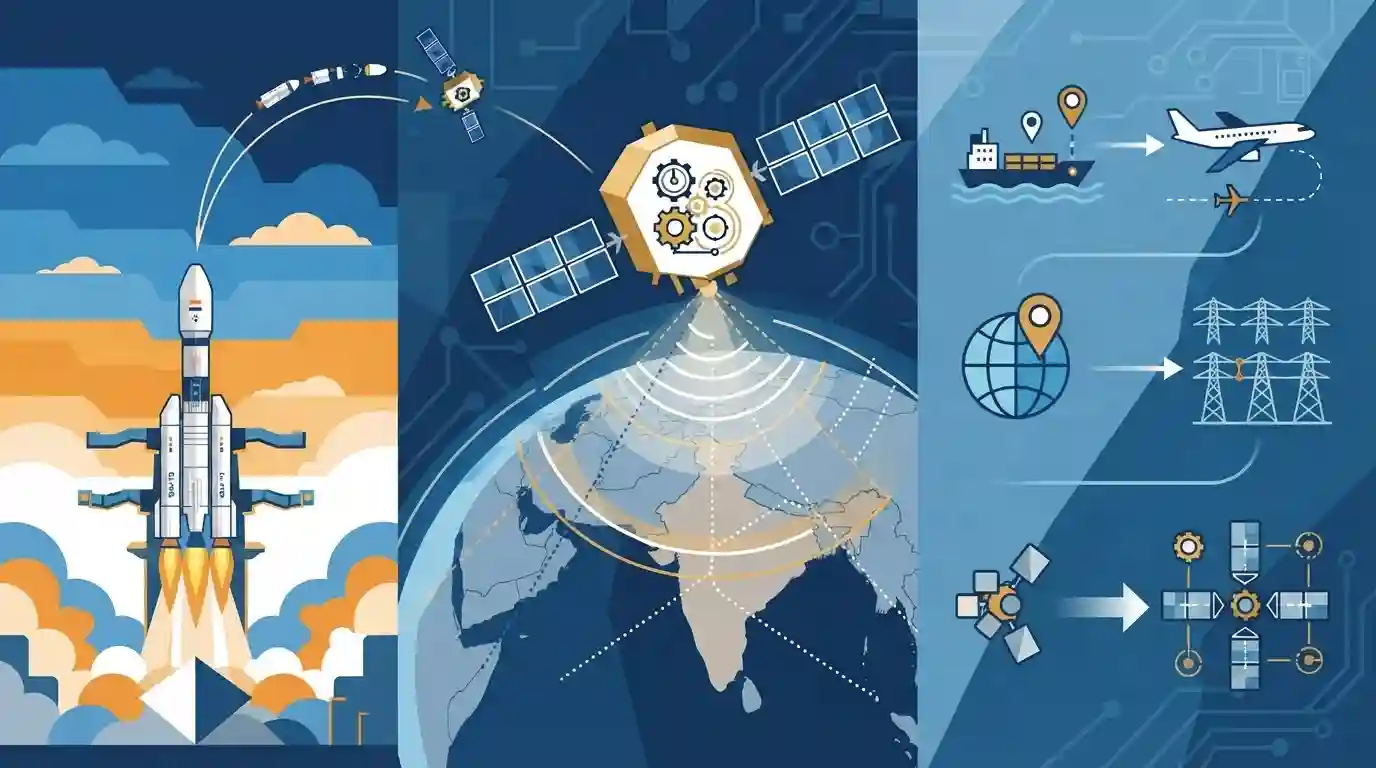
ISRO successfully launched the NVS-03 navigation satellite into its designated orbit, marking another milestone for India's independent regional navigation system, NavIC. As part of the second-generation satellite series, NVS-03 aims to bolster position, navigation, and timing services across the region, featuring enhanced capabilities and indigenous atomic clocks for critical civilian and strategic infrastructure.
Key Points
- ISRO successfully launched the NVS-03 navigation satellite into its designated orbit.
- NVS-03 is part of the second-generation NavIC (Navigation with Indian Constellation) series.
- The satellite enhances India's independent regional satellite navigation system, improving positioning, navigation, and timing services.
- Equipped with advanced payloads to ensure better accuracy and operational continuity for civilian and strategic applications.
Important Terms
NavIC

India's independent regional satellite navigation system (formerly IRNSS) designed to provide accurate position, navigation, and timing services over India and surrounding regions up to 1,500 km.
UPSC context
UPSC CSE Paper III (Science & Technology - Space Technology): Tests understanding of indigenous space programs, strategic autonomy, and national security infrastructure.
NVS-03
The third satellite in ISRO's second-generation NavIC series, featuring an indigenous rubidium atomic clock and L1 band support to enhance civilian and strategic positioning services.
UPSC context
UPSC CSE Paper III (Science & Technology - Achievements in Science & Tech): Tests awareness of recent space missions, indigenization, and critical technological milestones.
ISRO
India's national space agency responsible for planning, developing, and executing space exploration, satellite launches, and domestic space research programs.
UPSC context
UPSC CSE Paper III (Science & Technology): Evaluates institutional contributions to scientific advancement, socio-economic development, and strategic technological independence.
Prelims Trap
global positioning, navigation, and timing services across the world
Aspirants often assume NavIC is a global system like GPS. It is specifically a regional navigation satellite system covering India and an extended region of about 1,500 km.
Static Concepts Connected
What are the key features and frequency bands of India's regional navigation system (NavIC)?
- Regional Coverage: Covers India and a primary service area extending up to 1,500 km from its borders, operating under complete Indian control.
- Frequency Bands: Utilizes dual frequencies (L5 and S-band) and is introducing L1 frequency for civilian use and better smartphone compatibility.
- Atomic Clocks: Incorporates indigenous rubidium atomic clocks to maintain precise timing and orbital positioning accuracy.
Cross-Topic Patterns
NavIC + Telecom Standardization + Make in India
NavIC's integration into commercial mobile devices links space technology with national telecom and industrial standards under Make in India.
Atomic Clocks + Strategic Indigenization + Deep Tech
Indigenous atomic clocks on NVS satellites showcase deep tech R&D convergence between ISRO and India's atomic energy/defense research ecosystem.

NavIC coverage, frequency bands (L1, L5, S), and second-gen NVS improvements are high-probability statement targets in prelims.
Linked PYQs · 3
Linked PYQs · 3
- 2023PrelimsGS1
Which one of the following countries has its own Satellite Navigation System?
- 2015MainsGS3
What do you understand by 'Standard Positioning Systems' and 'Precision Positioning Systems' in the GPS era? Discuss the advantages India perceives from its ambitious IRNSS programme employing just seven satellites.
- 2016MainsGS3
Discuss India's achievements in the field of Space Science and Technology. How the application of this technology has helped India in its socio-economic development?
