ISRO Cryogenic Engine Boot Strap Mode Start and Launch Capability
Source:The Hindu ↗
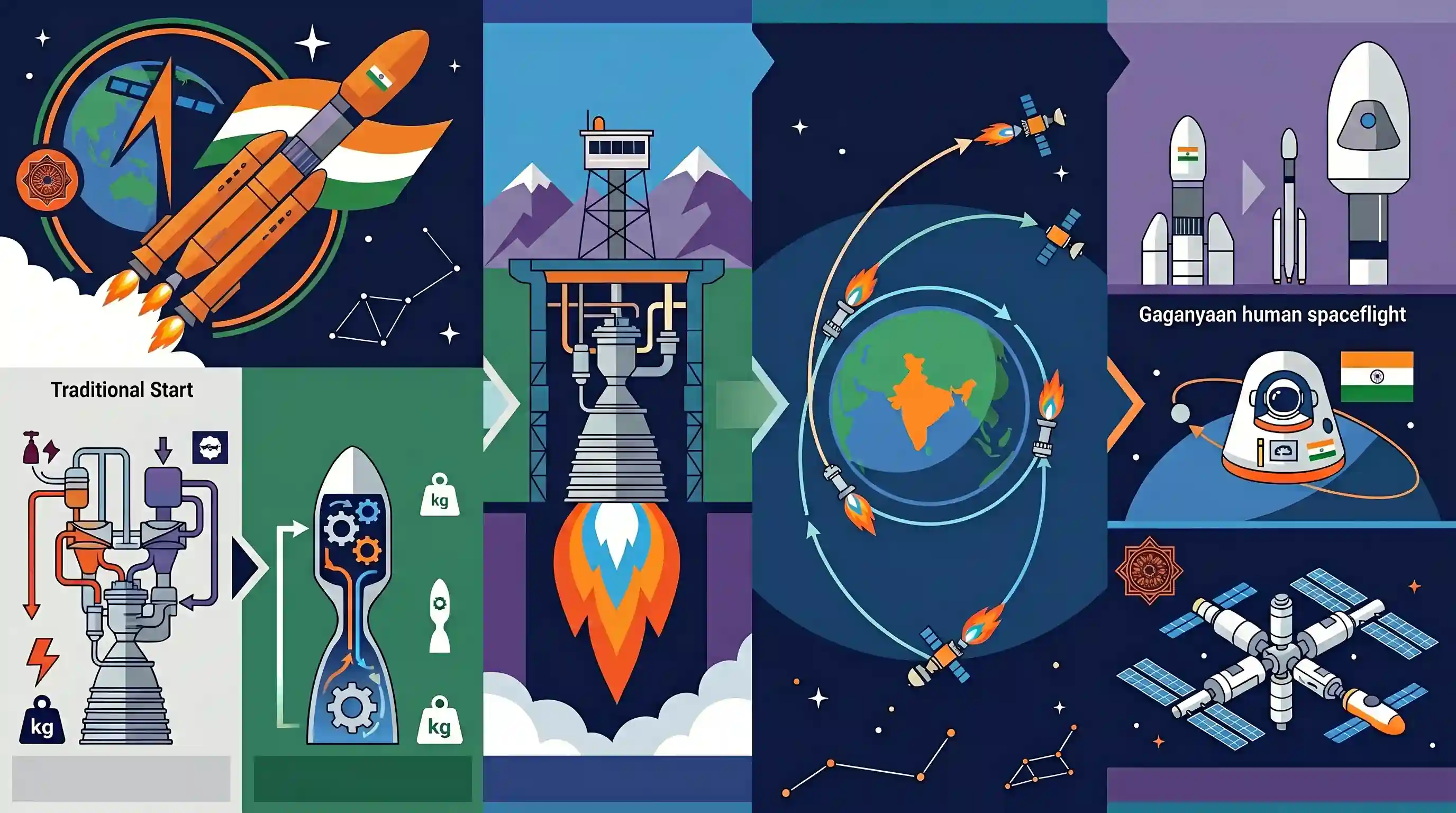
Why It Matters
Advancements in propulsion systems, such as the boot-strap start on the CE20 engine, directly translate to higher payload capacities and multi-orbit deployment capabilities. This indigenization is vital for India's self-reliance in space and the success of future heavy-lift missions like Gaganyaan.
Summary
The Indian Space Research Organisation (ISRO) has achieved a significant milestone by successfully demonstrating a 'boot-strap mode start' test on the CE20 cryogenic engine at the Mahendragiri High-Altitude Test facility. Traditionally, cryogenic engines rely on heavy auxiliary gas systems to start their turbo pumps. The boot-strap mode eliminates this need, allowing the engine to start autonomously. This technological leap enhances the engine's restart capabilities during flight, facilitating complex multi-orbit missions. Furthermore, saving weight by removing external start systems will increase the Launch Vehicle Mark-3's (LVM3) payload capacity, which is crucial for upcoming ambitious projects such as the Gaganyaan human spaceflight mission and the Bharatiya Antariksh Station.
Key Points
- ISRO successfully demonstrated a 'boot-strap mode start' on the CE20 cryogenic engine, which powers the upper stage of the Launch Vehicle Mark-3 (LVM3).
- The test took place at the High-Altitude Test (HAT) facility in the ISRO Propulsion Complex at Mahendragiri.
- A boot-strap start allows the engine to build up to steady operation using its own propellants rather than relying on external auxiliary gas start-up systems.
- This advancement significantly improves the engine's in-flight restart capabilities, which is essential for placing multiple satellites into varied orbits during a single mission.
- Eliminating the need for extra gas bottles for multiple restarts reduces overall rocket weight, directly increasing the payload-carrying capacity for future missions like Gaganyaan.
Important Terms
Boot-strap Mode

A self-sustaining start-up sequence where a rocket engine initiates ignition using its internal propellant flow and turbopump dynamics, eliminating heavy external auxiliary gas systems.
UPSC context
GS3/Science & Tech; tests knowledge of indigenous propulsion advancements and payload optimization for multi-orbit missions.
CE20 Cryogenic Engine
India's first fully indigenous 200 kN-class high-thrust engine powering the C25 upper stage of the LVM3 rocket; it utilizes liquid hydrogen and liquid oxygen.
UPSC context
GS3/Indigenization of Technology; critical for understanding heavy-lift launchers and deep-space mission capabilities.
Launch Vehicle Mark-3 (LVM3)
India's most powerful three-stage launch vehicle, formerly GSLV Mk III, capable of placing 4,000 kg into Geostationary Transfer Orbit (GTO).
UPSC context
GS3/Space Technology; fundamental for questions on India's satellite launch capacity and human-rated rockets.
Gaganyaan Mission
ISRO's maiden human spaceflight mission designed to send a crew to a 400 km Low Earth Orbit for three days before a safe return.
UPSC context
GS3/Science & Tech; tests awareness of critical safety systems, human-rating standards, and international space prestige.
Bharatiya Antariksh Station (BAS)
India's proposed modular space station envisioned to be operational by 2035, serving as a hub for microgravity research and long-duration habitation.
UPSC context
GS3/Indian Space Program; tests knowledge of India's long-term vision for a sustained presence in space.
Prelims Trap
"Boot-strap technology utilizes external high-pressure helium gas systems to restart the engine in space."
Boot-strap mode specifically eliminates the need for external gas. It uses the engine's own propellants to autonomously start, saving weight and enabling complex multi-orbit restarts.
Static Concepts Connected
What are the core characteristics of a Cryogenic Engine?
- Propellants: Utilizes super-cooled liquefied gases as propellants—typically Liquid Hydrogen (-253°C) as fuel and Liquid Oxygen (-183°C) as oxidizer.
- High Efficiency: Provides exceptionally high specific impulse (thrust efficiency) compared to solid or earth-storable liquid propellants, making it ideal for heavy payloads.
- Technological Complexity: Highly complex due to the challenges of maintaining ultra-low temperatures and managing thermal stresses during combustion.
What is the three-stage architecture of ISRO's Launch Vehicle Mark-3 (LVM3)?
- Solid Boosters: Two massive S200 solid strap-on boosters that provide the initial thrust during lift-off.
- Liquid Core Stage: The L110 core liquid stage, powered by two Vikas engines using earth-storable liquid propellants.
- Cryogenic Upper Stage: The C25 cryogenic upper stage, powered by the indigenous CE20 engine, which handles final orbital injection.
Cross-Topic Patterns
Indigenization boosting Gaganyaan payload capacities
Engine weight reduction via boot-strap technology translates directly to payload gain, a critical requirement for lifting the heavy orbital module of the upcoming Gaganyaan mission and Bharatiya Antariksh Station.
Commercial space market & multi-orbit insertion
In-flight restart capability makes ISRO's LVM3 highly competitive in the global commercial launch market (via NSIL) for deploying complex satellite constellations across varied orbits in a single mission.

Expect a 2026 multi-statement question linking CE20 cryogenic upgrades, LVM3 payload capacities, and specific Gaganyaan mission phases.
Linked PYQs · 3
Linked PYQs · 3
- 2018PrelimsGS1
With reference to India's satellite launch vehicles, consider the following statements: 1. PSLVs launch the satellites useful for Earth resources monitoring whereas GSLVs are designed mainly to launch communication satellites. 2. Satellites launched by PSLV appear to remain permanently fixed in the same position in the sky, as viewed from a particular location on Earth. 3. GSLV Mk III is a four-staged launch vehicle with the first and third stages using solid rocket motors; and the second and fourth stages using liquid rocket engines. Which of the statements given above is/are correct?
- 2016MainsGS3
Discuss India's achievements in the field of Space Science and Technology. How the application of this technology has helped India in its socio-economic development?
- 2023MainsGS3
What is the main task of India's third moon mission which could not be achieved in its earlier mission? List the countries that have achieved this task. Introduce the subsystems in the spacecraft launched and explain the role of the Virtual Launch Control Centre' at the Vikram Sarabhai Space Centre which contributed to the successful launch from Sriharikota.
