ISRO tests semicryogenic engine for heavy lift launch vehicles
Source:The Hindu ↗
Why It Matters
The development of semicryogenic engines is pivotal for ISRO's goal of increasing the payload capacity of its launch vehicles while remaining cost-effective (using refined kerosene and liquid oxygen). The upcoming NISAR mission is a high-profile international scientific partnership for advanced earth observation and climate monitoring.
Summary
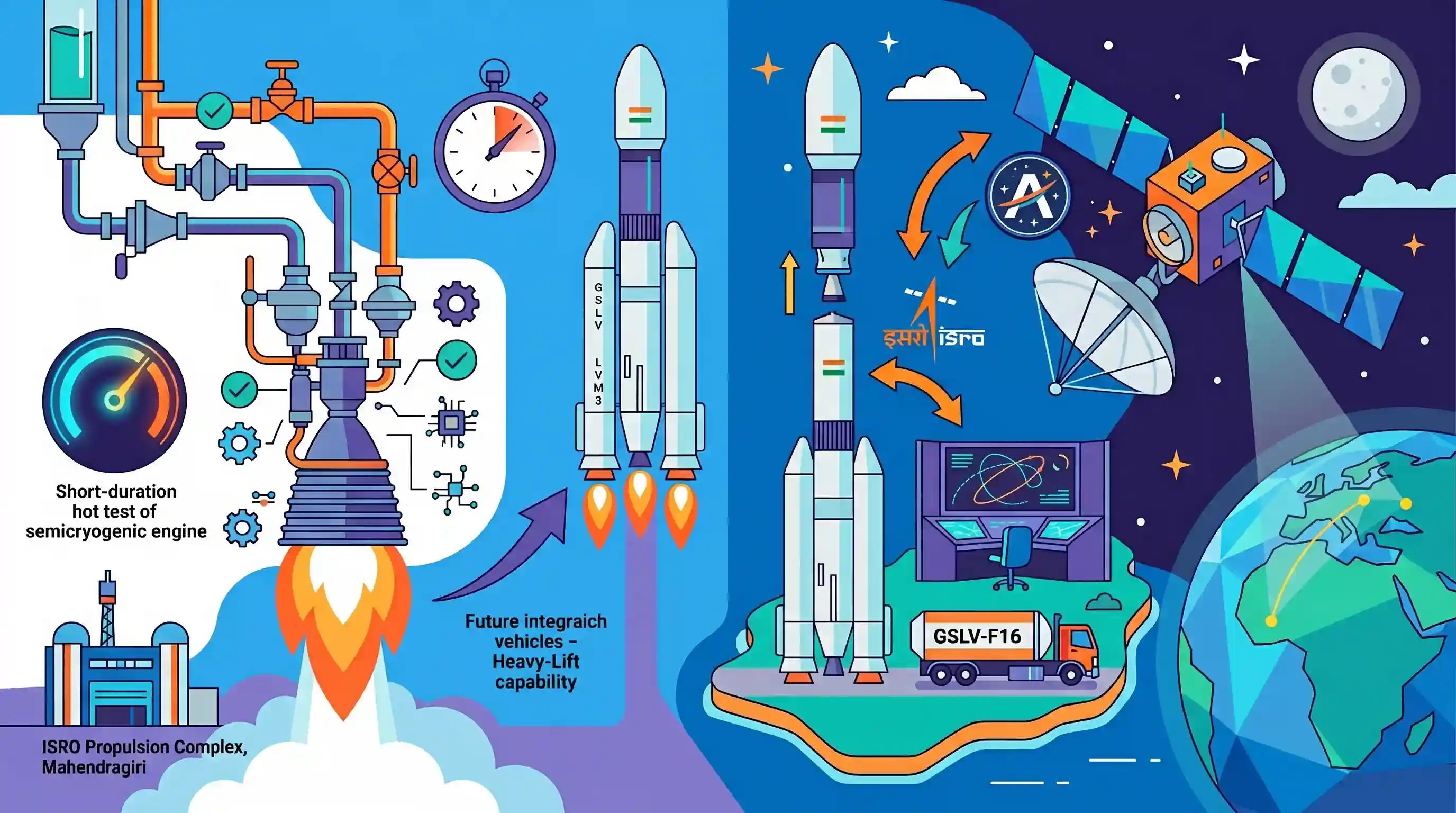
ISRO has successfully completed a second short-duration hot test of its semicryogenic engine at the ISRO Propulsion Complex in Mahendragiri, operating the Engine Power Head Test Article at 60% power for 3.5 seconds. This validates critical subsystems and paves the way for the engine's integration into future launch vehicles, which will boost India's heavy-lift space capabilities. Meanwhile, preparations for the landmark NASA-ISRO Synthetic Aperture Radar (NISAR) mission have begun, with the GSLV-F16 second stage flagged off to Sriharikota.
Key Points
- ISRO successfully conducted a short-duration hot test of a semicryogenic engine at the ISRO Propulsion Complex (IPRC) in Mahendragiri.
- The Engine Power Head Test Article operated up to 60% of its rated power level for 3.5 seconds, validating the design integrity of critical subsystems like turbo pumps and pre-burners.
- This successful test is a crucial milestone toward inducting semicryogenic engines into ISRO's future launch vehicles to enhance their payload capacities.
- Concurrently, the launch campaign for the NASA-ISRO Synthetic Aperture Radar (NISAR) satellite has commenced, with the GSLV-F16 rocket's second stage (GS2) flagged off to Sriharikota.
Important Terms
NISAR (NASA-ISRO Synthetic Aperture Radar)

A joint NASA-ISRO Earth-observation mission featuring dual-frequency (L-band and S-band) radar to monitor global land and ice changes with unprecedented precision.
UPSC context
GS-III (Space/Technology); key for understanding international collaboration and advanced remote sensing applications.
Semicryogenic Engine
A liquid rocket engine using Liquid Oxygen (LOX) and refined kerosene (RP-1), offering higher thrust and efficiency than traditional liquid engines for heavy-lift boosters.
UPSC context
GS-III (S&T); essential for future heavy-lift capabilities like LVM3 upgrades and NGLV.
GSLV-F16
The 18th flight of India's Geosynchronous Satellite Launch Vehicle, designated to deploy the 2,300+ kg NISAR satellite into a Sun-synchronous orbit.
UPSC context
GS-III (Space); tests knowledge of specific mission launch vehicles and ISRO's heavy-lift reliability.
Power Head Test Article (PHTA)
A critical pre-integrated hardware assembly of the semicryogenic engine, comprising the gas generator, turbopumps, and control systems, excluding the thrust chamber.
UPSC context
GS-III (S&T); specific technical term related to indigenous engine development and testing milestones.
ISRO Propulsion Complex (IPRC)
ISRO's specialized center in Tamil Nadu for testing and validating liquid and cryogenic propulsion systems for all launch vehicle stages.
UPSC context
Prelims (Geography/S&T); relevant for matching space facilities with their locations and functions.
Prelims Trap
"NISAR will be launched by GSLV-F16 because it is being placed in a Geosynchronous orbit."
False. Despite using the heavier GSLV vehicle to carry its massive payload, NISAR is an Earth observation satellite being placed in a Sun-Synchronous Polar Orbit (SSPO) at ~740 km, not GEO.
Static Concepts Connected
What distinguishes semi-cryogenic from fully cryogenic rocket engines?
- Fuel difference: Semi-cryo engines use refined kerosene (RP-1/Isrosene) as fuel, whereas cryogenic engines rely on liquid hydrogen (LH2). Both use Liquid Oxygen as the oxidizer.
- Storage requirements: Kerosene is stable at ambient temperatures, making handling easier and cheaper, whereas liquid hydrogen requires extreme super-cooling (-253°C).
- Performance metrics: Semi-cryogenic engines provide higher thrust density, while cryogenic engines offer higher specific impulse (maximum fuel efficiency).
What are the key features of Synthetic Aperture Radar (SAR) technology?
- Active remote sensing: It emits its own microwave pulses to gather echoes and construct images, unlike optical sensors that require sunlight.
- All-weather capability: Longer microwave wavelengths can easily penetrate clouds, fog, vegetation, and darkness, enabling uninterrupted 24/7 Earth observation.
Cross-Topic Patterns
NISAR in GS3 Disaster Management
NISAR's L and S band radars can measure crustal deformation with millimeter precision. This links directly to GS-3 disaster management for early warning on landslides, volcanic activity, and earthquakes.
NSIL and ISRO's strategic shift
As ISRO upgrades its heavy-lift LVM3 with semi-cryogenic stages for deep space and human spaceflight, routine Earth observation missions and legacy launch vehicles are rapidly being commercialized via NSIL.

Expect a 2026 Prelims statement mixing NISAR's SSPO orbit with its GSLV launch vehicle, testing the 'GSLV is only for GEO' misconception.
Linked PYQs · 2
Linked PYQs · 2
- 2016MainsGS3
Discuss India's achievements in the field of Space Science and Technology. How the application of this technology has helped India in its socio-economic development?
- 2018PrelimsGS1
With reference to India's satellite launch vehicles, consider the following statements: 1. PSLVs launch the satellites useful for Earth resources monitoring whereas GSLVs are designed mainly to launch communication satellites. 2. Satellites launched by PSLV appear to remain permanently fixed in the same position in the sky, as viewed from a particular location on Earth. 3. GSLV Mk III is a four-staged launch vehicle with the first and third stages using solid rocket motors; and the second and fourth stages using liquid rocket engines. Which of the statements given above is/are correct?
