ISRO Conducts Hot Tests of Gaganyaan Propulsion System
Source:The Hindu ↗
Why It Matters
The Gaganyaan mission is a landmark project for India's space program. Understanding its subsystems, such as the Service Module Propulsion System (SMPS), is essential for UPSC candidates as it highlights India's self-reliance (Atmanirbhar Bharat) in critical space technologies like crewed spaceflight and orbital maneuvering.
Summary
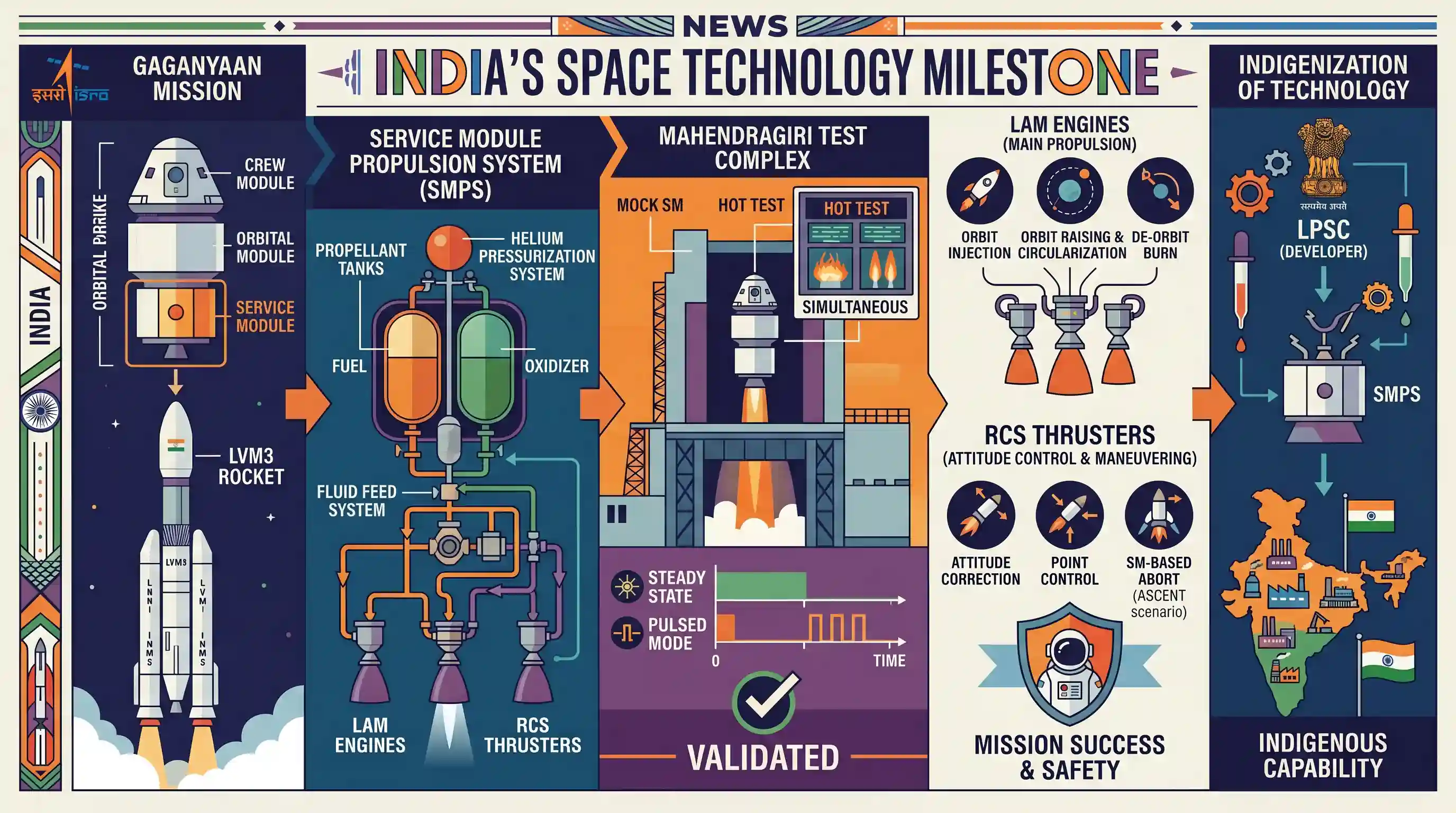
ISRO has achieved a significant milestone in its Gaganyaan mission by successfully conducting hot tests of the Service Module Propulsion System (SMPS) at Mahendragiri. The tests validated the integrated performance of the Liquid Apogee Motor (LAM) engines and Reaction Control System (RCS) thrusters, both crucial for orbital maneuvering and abort capabilities. Developed by the Liquid Propulsion System Centre, the SMPS is integral to the safety and success of India's upcoming human spaceflight mission to Low Earth Orbit.
Key Points
- ISRO successfully conducted hot tests of the Gaganyaan Service Module Propulsion System (SMPS) at the ISRO Propulsion Complex in Mahendragiri.
- The tests involved continuous and simultaneous operation of Reaction Control System (RCS) thrusters and Liquid Apogee Motor (LAM) engines to validate system performance.
- The SMPS, a critical component of the Gaganyaan Orbital Module, comprises five 440-N LAM engines and sixteen 100-N RCS thrusters developed by the Liquid Propulsion System Centre (LPSC).
- The propulsion system is essential for crucial orbital maneuvering and ensuring safety during potential abort scenarios.
- This test marks a significant milestone in validating the indigenous technology required for India's first crewed spaceflight to Low Earth Orbit.
Important Terms
Gaganyaan Mission

India's first human spaceflight mission aiming to send a crew of three to a 400 km Low Earth Orbit (LEO) for three days and return them safely to Earth.
UPSC context
GS Paper III: Science & Technology. Tests knowledge of India's indigenous space capabilities, human spaceflight challenges, and international standing in space exploration.
Service Module Propulsion System (SMPS)
A bi-propellant system essential for the Gaganyaan orbital module, providing thrust for orbit raising, maneuvering, and critical abort capabilities during the mission's ascent and orbital phases.
UPSC context
GS Paper III: Science & Technology. Focuses on indigenization of technology and the development of safety-critical systems for high-stakes space missions.
Liquid Propulsion Systems Centre (LPSC)
A lead ISRO center specialized in the design and development of liquid and cryogenic propulsion systems for launch vehicles and spacecraft, including the Gaganyaan propulsion modules.
UPSC context
GS Paper III: Science & Technology. Relevant for understanding the institutional framework of India's space program and its specialized R&D centers.
ISRO Propulsion Complex (IPRC)
ISRO’s specialized facility in Mahendragiri, Tamil Nadu, dedicated to the assembly, integration, and testing of liquid propulsion systems and large-scale rocket engines.
UPSC context
GS Paper III: Science & Technology. Important for regional geography of science and the infrastructure supporting India's strategic space autonomy.
Liquid Apogee Motor (LAM)
A high-thrust engine used for major orbital maneuvers, including orbit circularization and de-boosting, critical for the spacecraft's transit and eventual return to Earth.
UPSC context
GS Paper III: Science & Technology. Tests understanding of specific propulsion technologies required for complex orbital mechanics and deep-space missions.
Reaction Control System (RCS)
A system of small thrusters used to control a spacecraft’s attitude (orientation) and stability through precise pulses, ensuring the vehicle maintains the correct position during flight.
UPSC context
GS Paper III: Science & Technology. Relevant for technical details of spacecraft maneuvering and crew safety during reentry and docking.
Prelims Trap
The Gaganyaan Crew Escape System relies on the Liquid Apogee Motor (LAM) for emergency rapid ejection.
False. The Crew Escape System (CES) uses quick-acting solid rocket motors for rapid ejection. LAM uses liquid propellants for slower, sustained orbital maneuvering.
Static Concepts Connected
What are the different types of propulsion in ISRO's Human-Rated LVM3 (HLVM3)?
- Solid Boosters (S200): Provide massive initial thrust during lift-off using highly reliable solid propellants (like HTPB).
- Liquid Core Stage (L110): Uses earth-storable liquid propellants to provide sustained, stable mid-flight acceleration.
- Cryogenic Upper Stage (C25): A highly efficient upper stage utilizing liquid oxygen and liquid hydrogen at extremely low temperatures.
What distinguishes Low Earth Orbit (LEO) from Geostationary Orbit (GEO)?
- LEO Characteristics: Located between 160 to 2,000 km altitude. Orbits take 90-120 minutes. Ideal for human spaceflight (like Gaganyaan) due to lower radiation and energy requirements.
- GEO Characteristics: Located at approximately 35,786 km above the equator. The 24-hour orbital period matches Earth's rotation, making it ideal for communication satellites.
Cross-Topic Patterns
Gaganyaan recovery & Ocean Currents
Crew module recovery involves the Indian Navy in the Bay of Bengal/Arabian Sea, making ocean state forecasting and sea-surface current tracking critical to the mission.
Space Tech & Strategic Indigenization
Mastering propulsion components like RCS and LAM reduces dependence on foreign vendors, aligning with Atmanirbhar Bharat and shielding India from global technology-denial regimes.

Expect a 2026 prelims question contrasting the functions of solid escape systems vs liquid orbital maneuvering engines in Gaganyaan.
Linked PYQs · 2
Linked PYQs · 2
- 2017MainsGS3
India has achieved remarkable successes in unmanned space missions including the Chandrayaan and Mars Orbitter Mission, but has not ventured into manned space missions. What are the main obstacles to launching a manned space mission, both in terms of technology and logistics? Examine critically.
- 2023MainsGS3
What is the main task of India's third moon mission which could not be achieved in its earlier mission? List the countries that have achieved this task. Introduce the subsystems in the spacecraft launched and explain the role of the Virtual Launch Control Centre' at the Vikram Sarabhai Space Centre which contributed to the successful launch from Sriharikota.
