ISRO Conducts Hot Tests of Gaganyaan Service Module Propulsion
Source:The Hindu ↗
Why It Matters
The success of these propulsion tests is a vital milestone in India's Gaganyaan mission. It demonstrates indigenous technological readiness in developing complex Service Module propulsion systems, which are strictly necessary to ensure precise orbital maneuvering and crew safety during potential launch abort scenarios.
Summary
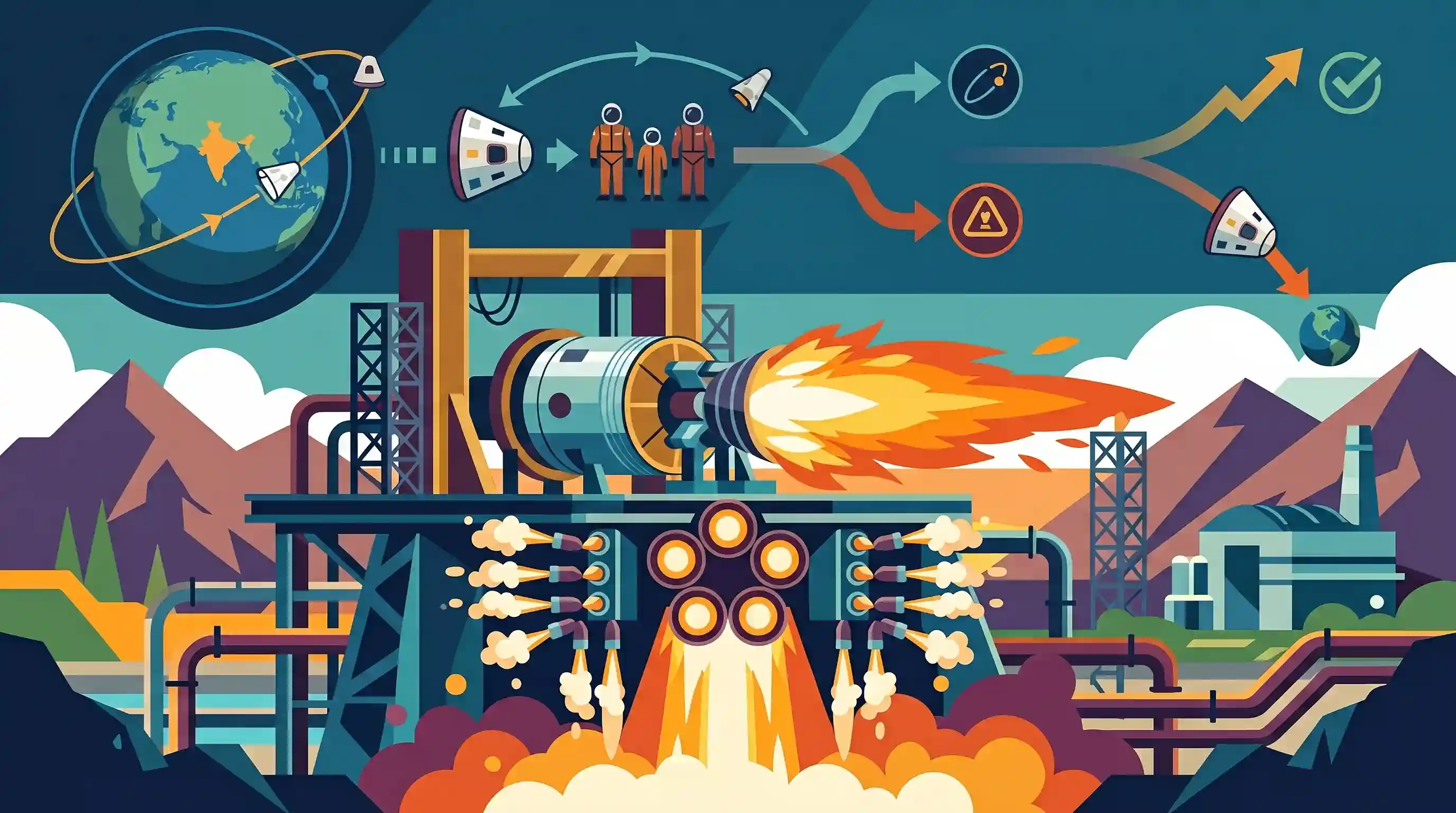
The Indian Space Research Organisation (ISRO) has successfully conducted two crucial hot tests of the Gaganyaan Service Module Propulsion System (SMPS) at its Mahendragiri facility. Led by the Liquid Propulsion System Centre (LPSC), the tests validated the test article configuration by demonstrating the simultaneous operation of five Liquid Apogee Motor (LAM) engines and 16 Reaction Control System (RCS) thrusters. The SMPS is a critical subsystem required for orbital maneuvering and abort scenarios in the Gaganyaan mission, which aims to demonstrate India's capability to launch humans into low Earth orbit.
Key Points
- ISRO successfully conducted two short-duration hot tests of the Gaganyaan Service Module Propulsion System (SMPS) at the Propulsion Complex in Mahendragiri.
- The hot tests aimed to validate the test article configuration, demonstrating the simultaneous operation of Liquid Apogee Motor (LAM) engines and Reaction Control System (RCS) thrusters.
- ISRO's Liquid Propulsion System Centre (LPSC) is spearheading the technology development for the SMPS.
- The SMPS is a critical component for the Gaganyaan Orbital Module, essential for orbital maneuvering and executing specific abort scenarios.
- The overall Gaganyaan programme seeks to demonstrate India's indigenous capability to launch a crewed spacecraft into low Earth orbit.
Important Terms
Gaganyaan Programme

India's first human spaceflight mission aiming to launch a 3-member crew to a 400 km Low Earth Orbit for three days and return them safely via splashdown.
UPSC context
GS Paper III: Science and Technology. Essential for topics on indigenous space technology and India's global space stature.
Service Module Propulsion System (SMPS)
A bi-propellant propulsion system in the Gaganyaan Orbital Module used for orbit raising, circularization, on-orbit control, and critical abort maneuvers during the mission.
UPSC context
GS Paper III: Space Technology. Tests understanding of critical spacecraft subsystems and their operational roles.
Liquid Propulsion System Centre (LPSC)
An ISRO center responsible for the design and development of liquid and cryogenic propulsion systems, including the Gaganyaan mission's Service Module and Crew Module systems.
UPSC context
GS Paper III: Science and Technology. Tests knowledge of India's premier scientific institutions and their specific mandates.
Liquid Apogee Motor (LAM)
A specialized rocket engine providing the primary propulsive force for orbital maneuvers, such as injection and de-boosting, in ISRO's interplanetary and human spaceflight missions.
UPSC context
GS Paper III: Space Technology. Technical term relevant for questions on satellite and crew module maneuvering.
Reaction Control System (RCS)
A network of small thrusters used for precise 3-axis attitude control (pitch, yaw, and roll) and maneuvering during various phases of spaceflight.
UPSC context
GS Paper III: Space Technology. Important for understanding spacecraft stability and navigation mechanisms.
Prelims Trap
Gaganyaan's Service Module houses astronauts and utilizes LAM engines to insert the spacecraft into a Geosynchronous Earth Orbit.
Gaganyaan targets Low Earth Orbit (~400km), not GEO. Additionally, astronauts reside in the Crew Module, while the unpressurized Service Module provides propulsion and is discarded before reentry.
Static Concepts Connected
What is the function of the Liquid Apogee Motor (LAM) in ISRO missions?
- Orbit Raising: Primarily fires to raise satellites from an elliptical Geostationary Transfer Orbit (GTO) into a circular Geostationary Orbit (GEO).
- Interplanetary Insertion: Crucial for precise braking and orbit insertion maneuvers in deep space missions like Mangalyaan and Chandrayaan.
- Crewed Maneuvering: Adapted for the Gaganyaan Service Module to perform precise orbital corrections and facilitate emergency abort scenarios.
How do the Crew Module and Service Module differ in human spaceflight?
- Crew Module: A pressurized, climate-controlled habitat where astronauts live and work, equipped with thermal protection systems (heat shields) to survive atmospheric reentry.
- Service Module: An unpressurized section housing propulsion (LAM/RCS), power systems, and life-support storage. It provides thrust but is deliberately discarded prior to reentry.
Cross-Topic Patterns
Gaganyaan + NavIC integration
For precise orbital tracking, maneuvering, and safe reentry, the Gaganyaan mission will rely extensively on India's indigenous NavIC constellation rather than solely on foreign GPS systems.
Microgravity research in LEO
Beyond technology demonstration, Gaganyaan connects to GS-3 applied sciences, enabling unique microgravity experiments in medicine, fluid dynamics, and material sciences within a Low Earth Orbit environment.

A 2026 Prelims question will likely ask candidates to differentiate ISRO facilities (IPRC vs LPSC) or distinguish Service vs Crew modules.
Linked PYQs · 2
Linked PYQs · 2
- 2017MainsGS3
India has achieved remarkable successes in unmanned space missions including the Chandrayaan and Mars Orbitter Mission, but has not ventured into manned space missions. What are the main obstacles to launching a manned space mission, both in terms of technology and logistics? Examine critically.
- 2018PrelimsGS1
With reference to India's satellite launch vehicles, consider the following statements: 1. PSLVs launch the satellites useful for Earth resources monitoring whereas GSLVs are designed mainly to launch communication satellites. 2. Satellites launched by PSLV appear to remain permanently fixed in the same position in the sky, as viewed from a particular location on Earth. 3. GSLV Mk III is a four-staged launch vehicle with the first and third stages using solid rocket motors; and the second and fourth stages using liquid rocket engines. Which of the statements given above is/are correct?
