ISRO Completes Critical Safety Tests for Manned Space Mission
Source:The Hindu ↗
Why It Matters
Human spaceflight demands extremely high safety and redundancy margins. Successfully testing crucial survival, separation, and flotation mechanisms directly addresses the structural, technical, and logistical obstacles of manned space missions—frequently tested themes in both UPSC Prelims and Mains.
Summary
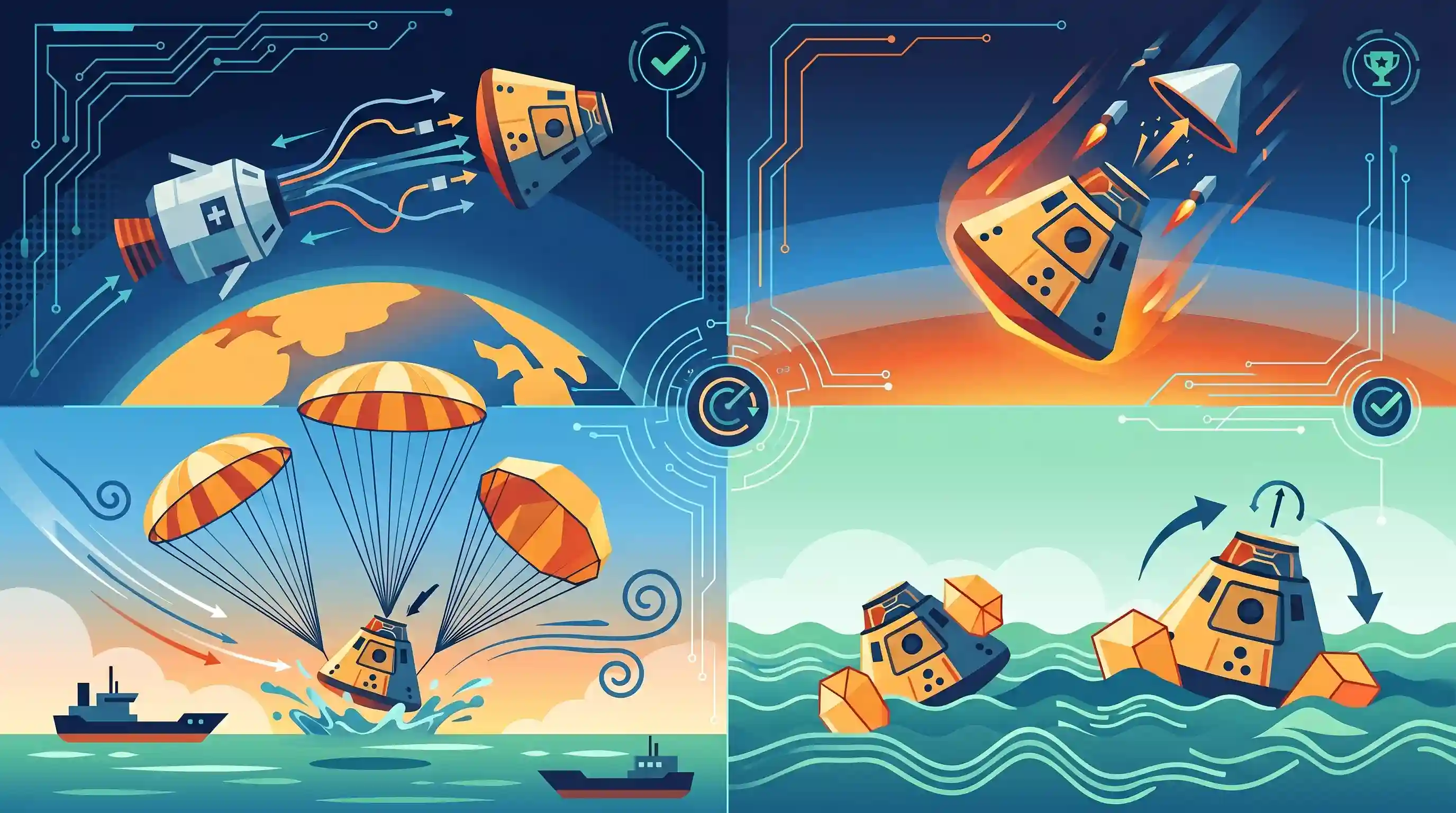
On July 12, 2026, ISRO successfully conducted three major system-level tests for the Gaganyaan mission: the Crew Module Uprighting System (CMUS), the Umbilical Mechanism Separation (CSU-2), and the Apex Cover Separation. These tests are essential safety and recovery milestones designed to protect the crew, ensure module stability, and enable deceleration during and after atmospheric re-entry.
Key Points
- The Indian Space Research Organisation (ISRO) successfully conducted three vital system-level tests for the Gaganyaan crew module systems on July 12, 2026.
- The first test validated the Crew Module Uprighting System (CMUS), which ensures the crew module stays upright after a sea splashdown. This cold-gas-based system uses high-pressure bottles to inflate flotation devices.
- The second test evaluated the Umbilical Mechanism Separation, which links the habitable crew module with the service module (propulsion/power). The test simulated the clean separation of CSU-2 (the service module side link) prior to Earth re-entry.
- The third test validated the Apex Cover Separation, ensuring structural integrity when the protective cover is discarded to allow parachute deployment for module deceleration.
Important Terms
Gaganyaan

India's first human spaceflight mission, designed by ISRO to send a crew of up to three astronauts to low Earth orbit for up to seven days and return them safely.
UPSC context
GS Paper III (Science and Technology); tests knowledge of space exploration, indigenous technology development, and human spaceflight challenges.
Indian Space Research Organisation (ISRO)
India's national space agency, established in 1969 under the Department of Space, responsible for space research, planetary exploration, and development of indigenous space applications.
UPSC context
GS Paper III (Science and Technology); tests awareness of national scientific institutions, indigenous technological achievements, and space programs.
Crew Module (CM)
The spacecraft capsule in the Gaganyaan mission designed with a pressurized double-walled inner structure to house astronauts, life support systems, and interfaces during orbital flight and atmospheric re-entry.
UPSC context
GS Paper III (Science and Technology); tests understanding of human spaceflight systems, spacecraft architecture, and safety protocols.
Service Module (SM)
An unpressurized module attached to the Gaganyaan crew module that contains the thermal, propulsion, power, and avionics systems, providing orbital control and power before separation during descent.
UPSC context
GS Paper III (Science and Technology); tests understanding of spacecraft design, propulsion systems, and mission-critical support modules.
Crew Module Uprighting System (CMUS)
A cold-gas-based flotation system designed to inflate balloons upon splashdown, ensuring the Gaganyaan crew module returns to and maintains an upright position in the sea for safe astronaut recovery.
UPSC context
GS Paper III (Science and Technology); tests familiarity with recovery operations, mission safety standards, and indigenous emergency engineering.
Prelims Trap
The Gaganyaan Orbital Module comprises pressurized Crew and Service Modules to ensure life support.
Only the Crew Module is pressurized for the astronauts. The Service Module is entirely unpressurized as it houses propulsion, power, and thermal control hardware.
Static Concepts Connected
What is the propulsion structure of India's Human-Rated LVM3 (HLVM3)?
- Solid Boosters: Two S-200 strap-on boosters utilizing solid propellant for high initial liftoff thrust.
- Liquid Core: L-110 stage powered by twin human-rated Vikas engines using liquid propellants.
- Cryogenic Stage: C-25 upper stage utilizing high-efficiency liquid hydrogen (fuel) and liquid oxygen (oxidizer).
What is an Environmental Control and Life Support System (ECLSS)?
- Atmospheric Control: Regulates oxygen replenishment, pressure, and actively scrubs carbon dioxide from the crew cabin.
- Thermal Management: Maintains stable cabin temperatures and relative humidity for crew comfort and electronics protection.
- Water Recovery: Manages liquid waste processing, humidity condensate reclamation, and delivery of potable drinking water.
Cross-Topic Patterns
Space recovery & maritime security
Indian Navy's role in Gaganyaan splashdown recovery tests operational coordination and deep-sea medical evacuation capabilities under search-and-rescue protocols.
Indigenous space tech & strategic autonomy
Developing proprietary systems like CMUS and CSU-2 secures India’s sovereign space access, insulating the civil space program from volatile geopolitical dual-use export controls.

Gaganyaan's HLVM3 propellant stages, pressurized/unpressurized module division, and Vyommitra are high-probability 2026 Prelims targets.
Linked PYQs · 2
Linked PYQs · 2
- 2017MainsGS3
India has achieved remarkable successes in unmanned space missions including the Chandrayaan and Mars Orbitter Mission, but has not ventured into manned space missions. What are the main obstacles to launching a manned space mission, both in terms of technology and logistics? Examine critically.
- 2025PrelimsGS1
Consider the following space missions : I. Axiom-4 II. SpaDeX III. Gaganyaan How many of the space missions given above encourage and support micro-gravity research?
