Indigenisation of Technology and Scientific Temper Promotion
Source:The Hindu ↗
Why It Matters
Highlighting the focus of India's premier scientific institutions (ISRO, DRDO) on fostering scientific temper and indigenisation of technology, which is a vital part of the GS3 syllabus regarding self-reliance in S&T.
Summary
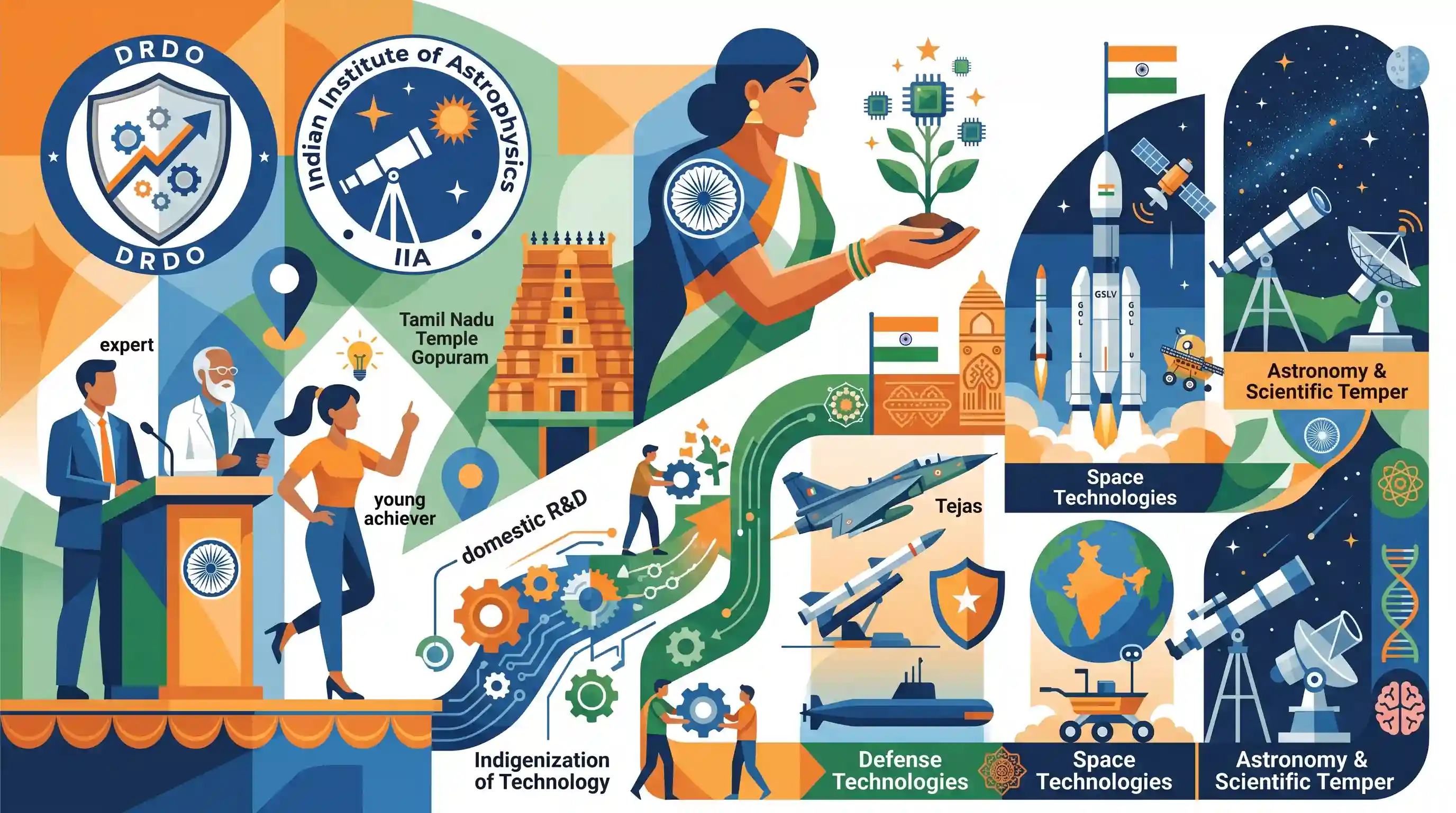
At the 'Youth Astronomy and Space Science Congress 2025' held in Sivakasi, Tamil Nadu, leading scientists from DRDO and the Indian Institute of Astrophysics urged young achievers to focus on indigenous research. The experts highlighted India's growing self-reliance in critical sectors, pointing to successes in developing fully indigenous fighter aircraft and space technology. The event aimed to promote scientific temper and inspire the next generation to contribute to domestic R&D, strengthening India's capabilities in astronomy, space, and defense technologies.
Key Points
- The Youth Astronomy and Space Science Congress 2025 in Sivakasi served as a platform to inspire students toward scientific pursuits.
- Scientists from DRDO and the Indian Institute of Astrophysics emphasized the importance of indigenous research to reduce reliance on foreign technologies.
- India's success in developing fully indigenous fighter aircraft and space missions was highlighted to demonstrate domestic R&D potential.
- The event reflects the broader national objective of cultivating scientific temper among youth and advancing indigenisation in critical sectors like space and defence.
Important Terms
Indigenization of Technology

Developing and manufacturing equipment within a country using local skills and resources to reduce foreign dependence. It is a core pillar of the Atmanirbhar Bharat initiative in defense and space.
UPSC context
GS Paper 3: Science and Technology; crucial for evaluating India's strategic autonomy, defense modernization, and 'Make in India' successes.
Scientific Temper
An attitude of logical, evidence-based thinking and rational inquiry. Article 51A(h) of the Indian Constitution lists the development of scientific temper as a Fundamental Duty of every citizen.
UPSC context
GS Paper 2: Polity/Fundamental Duties; also relevant for GS Paper 4 (Ethics) regarding rational decision-making and social reform.
ISRO (Indian Space Research Organisation)
India's national space agency under the Department of Space, responsible for space exploration and satellite technology. It leads major missions like Chandrayaan and the Gaganyaan human spaceflight program.
UPSC context
GS Paper 3: Science & Technology; focuses on India’s space achievements and growing global role in the commercial satellite market.
DRDO (Defence Research and Development Organisation)
The R&D wing of the Ministry of Defence, focused on achieving self-reliance in military technology. It develops critical hardware like the Agni missiles, Tejas aircraft, and Arjun tanks.
UPSC context
GS Paper 3: Science & Technology/Defence; central to topics on indigenization of defense production and strategic security.
Indian Institute of Astrophysics (IIA)
An autonomous research institution under the Department of Science and Technology, specializing in astronomy and astrophysics. It operates major observatories, including the high-altitude Indian Astronomical Observatory at Hanle.
UPSC context
GS Paper 3: Science & Technology; relevant for institutional research frameworks and major international astronomical collaborations.
Tamil Nadu Astronomy and Science Society (TASS)
A regional organization in Tamil Nadu that works to popularize astronomy and science among students. It organizes the Youth Astronomy and Space Science Congress (YASSC) to foster curiosity.
UPSC context
Prelims: Current Affairs; highlights the role of regional societies and civil society in promoting scientific education and outreach.
Prelims Trap
"The Indian Institute of Astrophysics (IIA) functions directly under the Department of Space alongside ISRO."
IIA is an autonomous research institute functioning under the Department of Science and Technology (DST), not the Department of Space (DoS).
Static Concepts Connected
What is the constitutional mandate for promoting scientific temper in India?
- Article 51A(h): Citizens are constitutionally obligated to develop scientific temper, humanism, and the spirit of inquiry and reform.
- 42nd Amendment Act: Added to Part IVA of the Constitution in 1976, acting upon the recommendations of the Swaran Singh Committee.
- Enforceability: While non-justiciable and unenforceable via court writs, this duty serves as a guiding principle for state policy and citizen behavior.
What are the core design features of India's indigenous LCA Tejas?
- Indigenous Design: Designed by DRDO's Aeronautical Development Agency (ADA) and manufactured by Hindustan Aeronautics Limited (HAL).
- Aerodynamic Profile: It is the smallest and lightest multi-role supersonic fighter globally, featuring a unique tailless compound delta-wing configuration.
- Composite Materials: Extensive use of carbon-fibre composites makes the aircraft ultra-light while maintaining necessary structural strength.
Cross-Topic Patterns
Ministry mapping of S&T autonomous bodies
The Indian Institute of Astrophysics (IIA) operates under DST, while the Physical Research Laboratory (PRL) falls under DoS. Ministry mapping of autonomous S&T bodies is a high-yield Prelims theme.
Observatories as S&T heritage
Historic sites like Kodaikanal Solar Observatory (Evershed Effect) or modern ones like Hanle Dark Sky Reserve link current space capabilities directly to India’s rich scientific heritage.

Expect a 2026 Prelims match-the-pair question linking S&T research institutes (IIA, ARIES, PRL) to their parent ministries (DST vs DoS).
Linked PYQs · 3
Linked PYQs · 3
- 2016MainsGS3
Discuss India's achievements in the field of Space Science and Technology. How the application of this technology has helped India in its socio-economic development?
- 2019MainsGS3
What is India's plan to have its own space station and how will it benefit our space programme?
- 2017MainsGS3
India has achieved remarkable successes in unmanned space missions including the Chandrayaan and Mars Orbitter Mission, but has not ventured into manned space missions. What are the main obstacles to launching a manned space mission, both in terms of technology and logistics? Examine critically.
