ISRO Role and Private Sector Participation in Space Ecosystem
Source:Indian Express ↗
Why It Matters
This article highlights the institutional and cultural transition within ISRO as India opens its space sector to private players, balancing workforce anxieties with the national goal of expanding India's footprint in the global space economy.
Summary
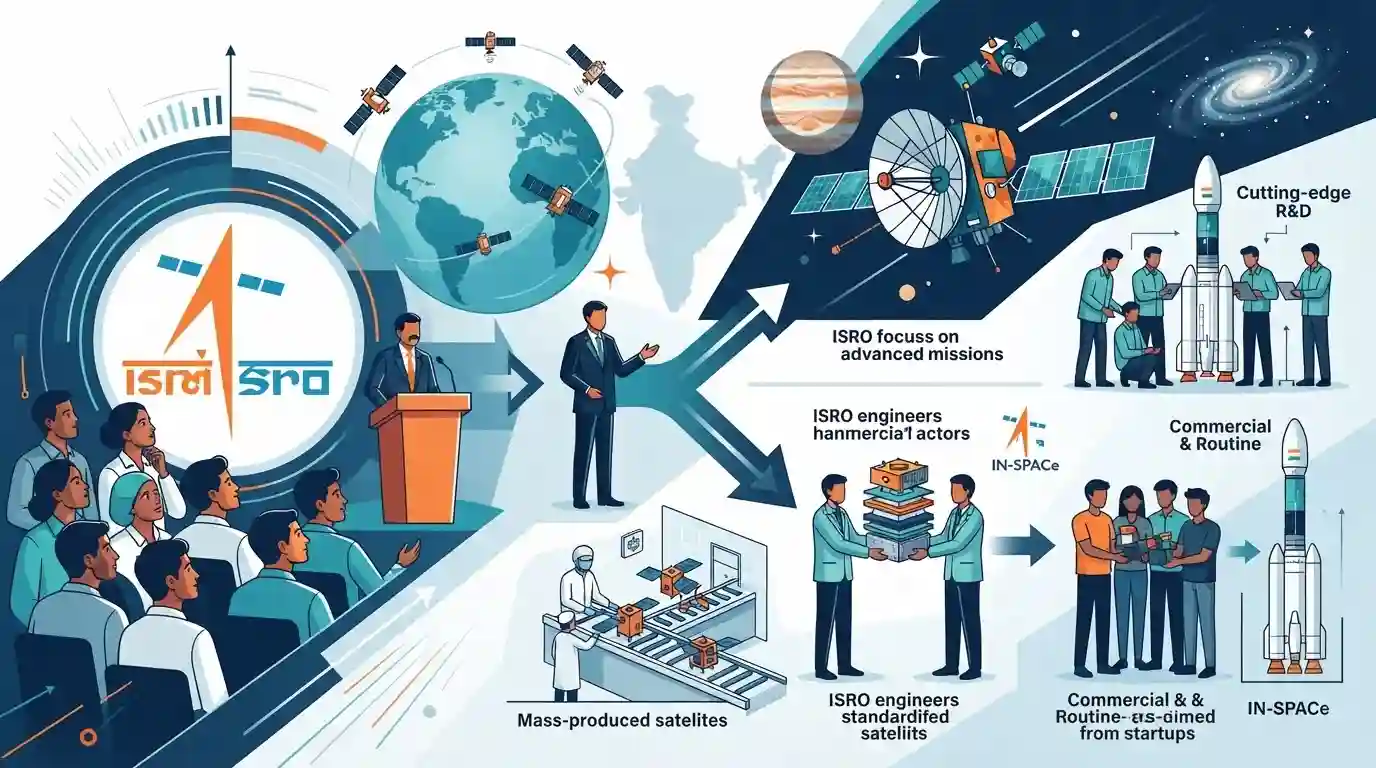
ISRO leadership addressed internal staff queries clarifying that the rapid expansion of private sector participation in India's space ecosystem will not diminish ISRO's importance or role. Instead, the transition allows ISRO to focus on cutting-edge research, deep space exploration, and complex scientific missions, while commercial and routine manufacturing responsibilities are shared with private startups and industry players facilitated by frameworks like IN-SPACe.
Key Points
- ISRO addressed staff concerns regarding the expansion of the private sector in India's space ecosystem, assuring employees that the growing private participation will not shrink ISRO's role.
- The expanding space ecosystem focuses on shifting routine manufacturing and operational tasks to private industry and startups via IN-SPACe and NSIL.
- ISRO's role is pivoting more toward research and development, deep-space exploration, interplanetary missions, and advanced scientific milestones rather than commercial routine production.
- The reforms aim to scale up India's share in the global space economy by leveraging private sector agility and capital alongside public sector expertise.
Important Terms
Indian Space Policy

An overarching framework released by the Government of India in 2023 that permits private Non-Governmental Entities (NGEs) to engage in end-to-end space activities across the value chain, shifting ISRO toward advanced research.
UPSC context
UPSC GS Paper III (Science & Technology - Space Policy and Private Sector Reforms). Tests understanding of India's evolving space governance framework.
IN-SPACe
An autonomous single-window nodal agency under the Department of Space created to promote, authorize, and oversee private sector participation in India's space ecosystem.
UPSC context
UPSC GS Paper III (Science & Technology). Essential for questions regarding institutional reforms and regulatory bodies facilitating commercial space activities.
ISRO
India's national space agency responsible for planning, executing, and overseeing major space exploration missions, scientific research, and advanced aerospace technological developments.
UPSC context
UPSC GS Paper III (Science & Technology - Space). Evaluates the core mandate of India's premier space agency amidst changing public-private dynamics.
NewSpace India Limited (NSIL)
A Public Sector Undertaking under the Department of Space acting as the commercial arm of ISRO, responsible for commercializing space technologies, launch vehicles, and satellite services.
UPSC context
UPSC GS Paper III (Science & Technology). Important for understanding the commercialization of space infrastructure and PSUs in the space sector.
Static Concepts Connected
What is the institutional architecture governing India's space sector and private participation?
- IN-SPACe Role:: Autonomous single-window nodal agency under the Department of Space to promote, authorize, and regulate non-government entities (NGEs) in space activities.
- NSIL Mandate:: Commercial arm of ISRO under the Department of Space, tasked with driving commercializing space assets, demand-driven launch services, and tech transfers.
- Indian Space Policy:: Legal framework allowing up to 74% FDI via automatic route for satellite manufacturing, data products, and ground segment.
Cross-Topic Patterns
ISRO Reforms & Defense Public Sector Restructuring
The restructuring of ISRO mirrors public sector reforms in defense (corporatization of Ordnance Factories), shifting routine production to private industry while keeping core R&D under state control.
Space FDI Liberalization & Make in India
Liberalizing FDI up to 74% automatic route for satellites connects space sector reforms directly with India's broader capital account management and high-tech manufacturing push.

IN-SPACe vs NSIL functional distinction and FDI caps in satellites frequently appear in matching or multi-statement Prelims questions.
Linked PYQs · 1
Linked PYQs · 1
- 2026PrelimsGS1
Consider the following statements with regard to involvement of private entities in India's space programme : 1. The Indian National Space Promotion and Authorisation Centre (IN-SPACe) is an autonomous agency formed to facilitate participation of private entities. 2. Agnikul Cosmos launched the world's first flight using 3D-printed rocket engine. 3. Skyroot Aerospace has developed liquid fuel for GSLV. Which of the statements given above is/are correct ?
