PSLV Launch Failures Impact on NavIC and Private Space Sector
Source:Indian Express ↗
Why It Matters
It demonstrates the vulnerabilities in India's critical space infrastructure, specifically the NavIC constellation, and illustrates how technical failures in core launch vehicles like PSLV can cascade into delays for the commercialization of the space sector and technology transfer to private entities.
Summary
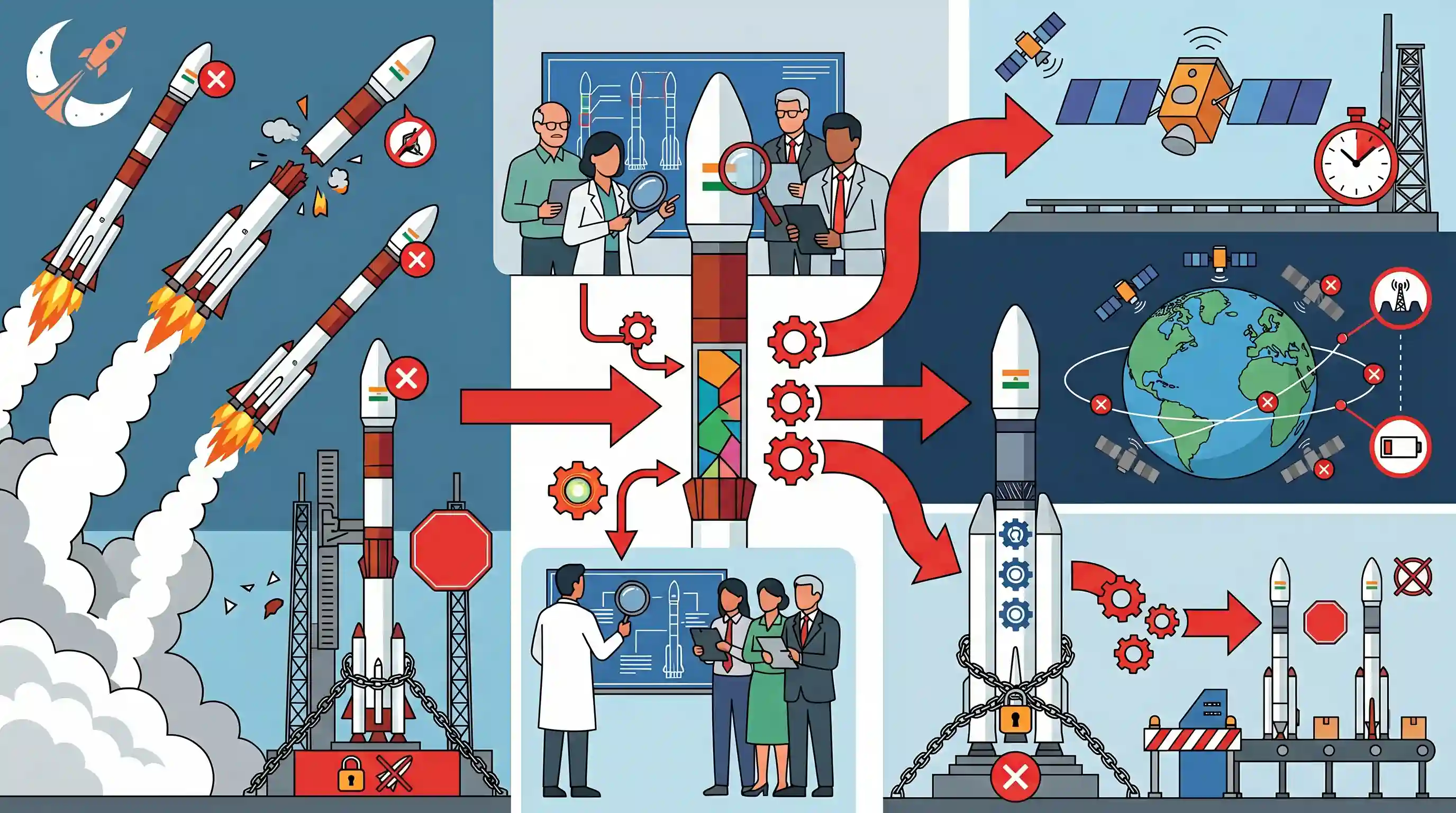
Successive failures of ISRO's Polar Satellite Launch Vehicle (PSLV) missions have forced a temporary grounding of the workhorse rocket, triggering widespread delays across India's space program. A national expert committee is currently investigating issues traced to the PSLV's third stage. This grounding directly impacts the NavIC regional navigation system, as the delayed launch of the NVS-3 satellite leaves the constellation operating below its minimum required capacity. Furthermore, the crisis stalls the maiden launch of a privately manufactured PSLV by HAL and L&T, and delays the Small Satellite Launch Vehicle (SSLV) program, which shares components with the PSLV, thereby hindering planned technology transfers to the private sector.
Key Points
- ISRO's PSLV launch vehicles have been grounded following consecutive mission failures in 2025 (PSLV-C61) and 2026 (PSLV-C62).
- A national expert committee headed by Prof. K. Vijayraghavan is investigating the failures, which trace back to the third stage of the PSLV rocket.
- The grounding delays the launch of the NVS-3 satellite, critically impacting the NavIC regional navigation constellation which is currently operating with only three satellites instead of the required minimum of four.
- The development also delays the maiden flight of an entirely privately manufactured PSLV built by HAL and L&T.
- The Small Satellite Launch Vehicle (SSLV) programme is also stalled as its third stage is derived from the PSLV, delaying ISRO's plans to transfer SSLV technology to the private sector via NSIL and IN-SPACe.
Important Terms
NavIC

India's independent regional satellite navigation system providing positioning and timing services over the Indian landmass and a region 1,500 km around it.
UPSC context
GS III: Science & Technology. Crucial for strategic autonomy and disaster management; tests knowledge of indigenous PNT systems.
PSLV
ISRO's versatile, four-stage 'workhorse' rocket utilizing solid and liquid propellants; primarily used for launching Earth observation and navigation satellites.
UPSC context
GS III: Science & Technology. Core component of India's space program; tests understanding of launch vehicle evolution and reliability.
SSLV
A three-stage all-solid launch vehicle designed for rapid, low-cost deployment of small satellites (up to 500kg) into Low Earth Orbit.
UPSC context
GS III: Science & Technology. Targets the global small-satellite market; tests knowledge of commercial space sector indigenization.
IN-SPACe
An autonomous 'single-window' nodal agency under the Department of Space that regulates and promotes private sector participation in Indian space activities.
UPSC context
GS III: Economy/Space Policy. Represents the shift toward privatization; tests understanding of regulatory frameworks in emerging sectors.
NSIL
The commercial arm of ISRO tasked with transferring space technologies to industry, scaling rocket production, and marketing space-based services globally.
UPSC context
GS III: Economy. Facilitates the demand-based model of space activity; tests knowledge of the commercialization of state technology.
NVS Series
The second generation of NavIC satellites, featuring indigenous rubidium atomic clocks and L1 band signals for enhanced accuracy and smartphone compatibility.
UPSC context
GS III: Science & Technology. Modernization of the IRNSS constellation; tests awareness of technical improvements in strategic infrastructure.
Prelims Trap
"IN-SPACe serves as the commercial arm of ISRO responsible for transferring SSLV and PSLV technologies to the private sector."
NSIL is ISRO's commercial arm that handles technology transfers. IN-SPACe is the regulatory and promotional body that authorizes private space activities.
Static Concepts Connected
How do the structural and functional designs of PSLV and SSLV differ?
- Stage Configuration: PSLV features four stages alternating between solid and liquid. SSLV utilizes three solid stages and a liquid Velocity Trimming Module (VTM) for orbital insertion.
- Payload & Orbit: PSLV carries up to 1,750 kg to Sun-Synchronous Orbits. SSLV is optimized for launch-on-demand small payloads up to 500 kg to Low Earth Orbit.
- Turnaround Time: PSLV requires weeks for assembly and integration, whereas SSLV is designed for rapid 72-hour turnaround with minimal launch infrastructure.
What are the orbital parameters and minimum requirements of the NavIC constellation?
- Constellation Design: The full regional system comprises 7 satellites: 3 in geostationary orbit and 4 in geosynchronous orbit, covering India plus a 1,500 km radius.
- Minimum Operational Threshold: While 7 satellites provide optimal regional coverage, accurate 3D positioning and timing services require a minimum of four functional satellites simultaneously.
Cross-Topic Patterns
NavIC & Critical Infrastructure Security
Delays in NavIC launches impact timing services critical for power grids, telecom, and financial networks, linking space asset redundancy directly to India's internal security and disaster management resilience.
Space Privatization & Strategic Autonomy
The grounding highlights the systemic risk of relying solely on ISRO for launches, underscoring the urgency of the 2020 Space Sector reforms to build parallel private capacity (HAL/L&T).

A multi-statement question contrasting PSLV/SSLV stage mechanics and the regulatory boundaries of NSIL vs IN-SPACe is highly likely in 2026.
Linked PYQs · 3
Linked PYQs · 3
- 2018PrelimsGS1
With reference to India's satellite launch vehicles, consider the following statements: 1. PSLVs launch the satellites useful for Earth resources monitoring whereas GSLVs are designed mainly to launch communication satellites. 2. Satellites launched by PSLV appear to remain permanently fixed in the same position in the sky, as viewed from a particular location on Earth. 3. GSLV Mk III is a four-staged launch vehicle with the first and third stages using solid rocket motors; and the second and fourth stages using liquid rocket engines. Which of the statements given above is/are correct?
- 2018PrelimsGS1
With reference to the Indian Regional Navigation Satellite System (IRNSS), consider the following statements: 1. IRNSS has three satellites in geostationary and four satellites in geosynchronous orbits. 2. IRNSS covers entire India and about 5500 sq. km beyond its borders. 3. India will have its own satellite navigation system with full global coverage by the middle of 2019. Which of the statements given above is/are correct?
- 2016MainsGS3
Discuss India's achievements in the field of Space Science and Technology. How the application of this technology has helped India in its socio-economic development?
