Private Sector Participation and Space Policy Reforms in India
Source:Indian Express ↗
Why It Matters
Space privatisation is a cornerstone of India's high-tech economic expansion, directly contributing to commercial space capabilities, startup growth, and employment generation in advanced scientific domains.
Summary
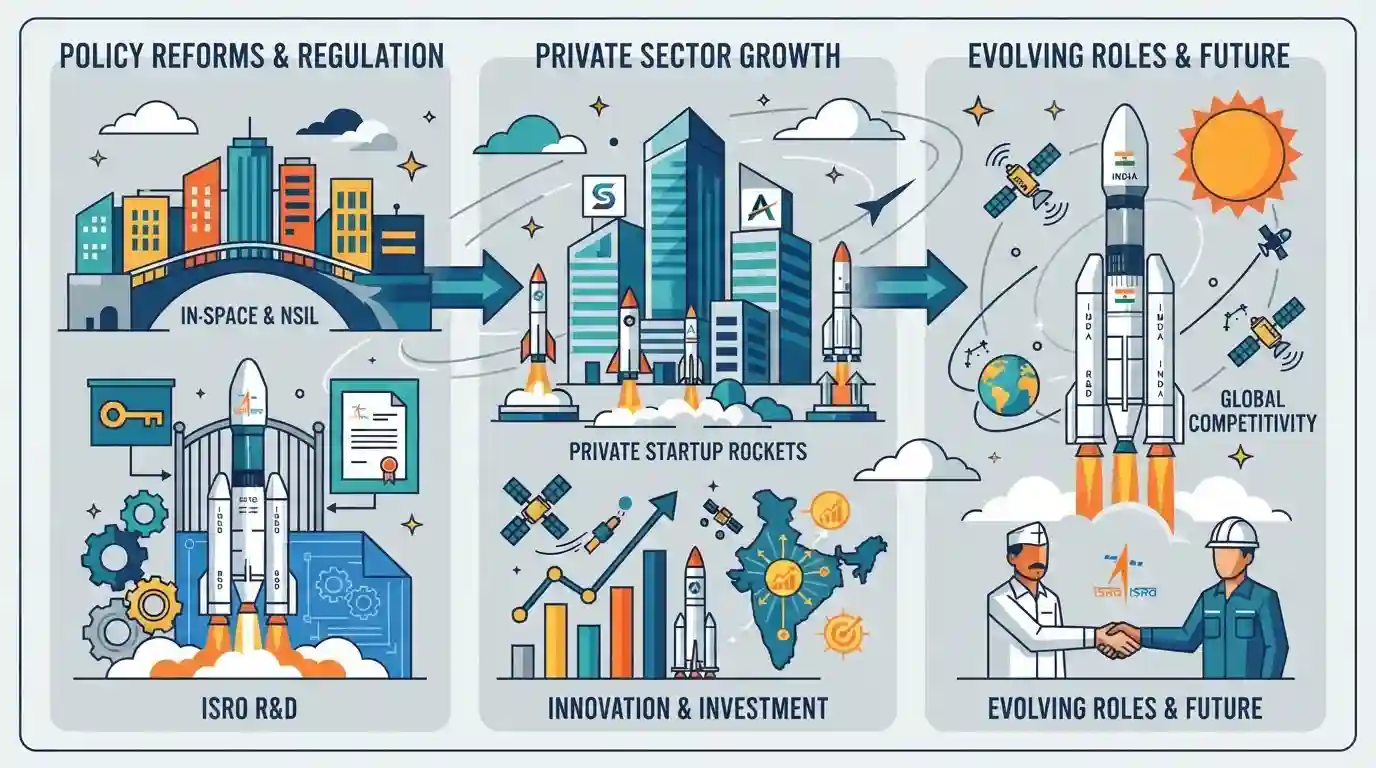
The article discusses the ongoing transformation of India's space sector through privatisation and increased private sector participation, driven by policy reforms, the establishment of IN-SPACe and NSIL, and the growth of private space startups. It highlights how these changes are reshaping India's space economy, technological landscape, and ISRO's evolving role.
Key Points
- India's space sector is undergoing a massive paradigm shift from a purely state-run model managed by ISRO to a vibrant commercial ecosystem enabled by private sector participation.
- The creation of IN-SPACe as a single-window nodal agency and NSIL as the commercial arm has empowered private entities and startups to build launch vehicles, satellites, and applications.
- Private sector involvement aims to boost India's share in the global space economy, drive technological innovation, and allow ISRO to focus more on advanced research, interplanetary missions, and strategic space capabilities.
- Challenges remain regarding regulatory clarity, technology transfer, funding, and testing infrastructure accessibility for private players.
Important Terms
Indian Space Policy

The overarching framework approved in 2023 to institutionalize private sector participation across India's entire space value chain, demarcating clear roles for ISRO, IN-SPACe, NSIL, and non-governmental entities.
UPSC context
GS Paper III (Science & Technology - Space). Tests understanding of policy reforms opening high-tech sectors to private enterprise.
IN-SPACe
An autonomous, single-window nodal agency under the Department of Space established to promote, authorize, and supervise non-governmental entities in conducting space activities in India.
UPSC context
GS Paper III (Science & Technology). Important for institutional mechanisms regulating public-private partnerships in space exploration.
NewSpace India Limited (NSIL)
The commercial arm of ISRO, responsible for marketing space products, transferring technologies, commercializing launch vehicles, and driving revenue generation from India's space assets.
UPSC context
GS Paper III (Economy/S&T). Tests knowledge of commercialization models for public sector undertakings in advanced technology.
Skyroot Aerospace
A leading Indian private aerospace startup that develops small-lift launch vehicles (like Vikram series) to provide cost-effective satellite launch services globally.
UPSC context
GS Paper III (Science & Technology - Space). Illustrates the rise of private entrepreneurship and startup ecosystems in high-tech sectors.
Agnikul Cosmos
An IIT Madras-incubated space tech startup specializing in customizable, 3D-printed rocket engines (Agnibaan) designed for rapid and flexible small-satellite launches.
UPSC context
GS Paper III (S&T / Innovation). Highlights indigenous deep-tech innovation and academic-industry collaboration in India's space sector.
Prelims Trap
IN-SPACe serves as the commercial arm while NSIL acts as the single-window nodal regulatory agency for private space activities.
Aspirants often confuse IN-SPACe as the commercial arm and NSIL as the regulator, when their roles are precisely reversed.
Static Concepts Connected
What are the institutional roles and mandates of IN-SPACe and NSIL in India's space sector?
- IN-SPACe Mandate:: Autonomous regulator, established under the Department of Space to authorize, promote, and supervise private space activities and share ISRO facilities.
- NSIL Role:: Commercial PSU incorporated in 2019 to spearhead commercialization, technology transfers, and industry-led production of launch vehicles like PSLV and SSLV.
Cross-Topic Patterns
Space Reform + Defense Indigenization Synergy
The shift from state monopoly to private production mirrors defense indigenization policies like IDDM, leveraging private capital for high-tech self-reliance.
Deep-Tech Startups + National Space Policy
Private space startups rely heavily on venture funding and deep-tech incubators, intersecting with India's National Deep Tech Startup Policy (NDTSP).

Expect a statement-based prelims question on the distinct mandates of IN-SPACe (regulator/promoter) vs NSIL (commercial arm).
Linked PYQs · 2
Linked PYQs · 2
- 2016MainsGS3
Discuss India's achievements in the field of Space Science and Technology. How the application of this technology has helped India in its socio-economic development?
- 2026PrelimsGS1
Consider the following statements with regard to involvement of private entities in India's space programme : 1. The Indian National Space Promotion and Authorisation Centre (IN-SPACe) is an autonomous agency formed to facilitate participation of private entities. 2. Agnikul Cosmos launched the world's first flight using 3D-printed rocket engine. 3. Skyroot Aerospace has developed liquid fuel for GSLV. Which of the statements given above is/are correct ?
