Private sector participation in India space economy policy
Source:Indian Express ↗
આ શા માટે મહત્વનું છે
Understanding the commercialization of space and private sector participation is vital for GS3 (Science & Technology / Economy) as India expands its footprint in the global aerospace and satellite market.
સારાંશ
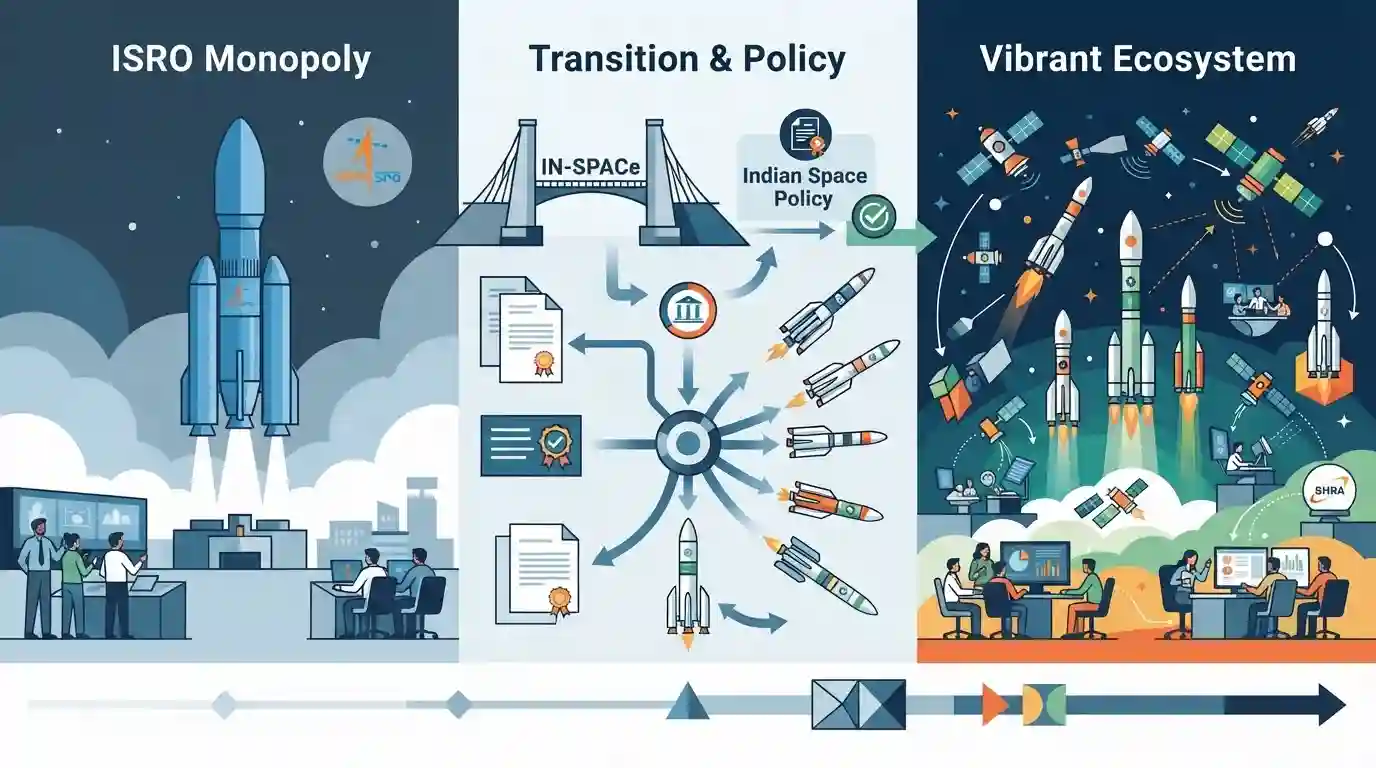
The article discusses the ongoing transformation and privatization of India's space sector, detailing the transition from an ISRO-centric monopoly to a vibrant ecosystem driven by private players, startups, and policy reforms under IN-SPACe and the Indian Space Policy.
મુખ્ય મુદ્દા
- The shift in India's space sector from a state-monopoly model to a private-inclusive framework aimed at boosting the commercial space economy.
- The role of IN-SPACe as an autonomous single-window nodal agency facilitating non-governmental entities (NGEs) access to space infrastructure and authorization.
- The commercialization of ISRO technologies and the transfer of mature launch vehicles (like SSLV) to private industry.
- Overcoming regulatory, financial, and technological hurdles to scale India's footprint in the global space market.
મહત્વપૂર્ણ શબ્દો
Indian Space Policy

India's overarching framework that institutionalizes private sector participation across the entire space value chain, transforming ISRO's role and opening up manufacturing, launches, and applications to non-governmental entities.
UPSC context
UPSC CSE Mains Paper 3 (Science & Technology - Space Tech, Govt Policies). Frequently tested for space reforms and private sector engagement.
IN-SPACe
An autonomous single-window nodal agency under the Department of Space established to promote, authorize, and supervise space activities by non-governmental entities (NGEs) in India.
UPSC context
UPSC CSE Mains Paper 3 (S&T / Institutional Bodies). Important for questions on space governance, public-private partnerships, and regulatory frameworks.
NewSpace India Limited (NSIL)
The commercial arm of ISRO and a Public Sector Undertaking tasked with commercializing space technologies, building launch vehicles through industry, and handling commercial satellite launches.
UPSC context
UPSC CSE Mains Paper 3 (Space Tech / Economy). Tests institutional mechanisms for commercializing public R&D and boosting India's space economy share.
ISRO
India's national space agency responsible for research and development of advanced space technologies, planetary exploration, and fulfilling strategic national space missions.
UPSC context
UPSC CSE Mains Paper 3 (Science & Technology - Awareness in Space). Core topic for institutional capabilities, milestones, and technological advancements.
પ્રિલિમ્સ ટ્રેપ
NSIL acts as the autonomous single-window nodal agency authorizing private entities to use space infrastructure.
Aspirants often confuse IN-SPACe with NSIL. IN-SPACe is the regulatory/authorization single-window agency, whereas NSIL is the commercial arm handling tech transfer and market contracts.
સંલગ્ન સ્થિર ખ્યાલો
What are the respective institutional mandates of IN-SPACe, NSIL, and ISRO under the Indian Space Policy 2023?
- IN-SPACe Role: Regulatory Body: IN-SPACe acts as an autonomous single-window nodal agency under Dept of Space to promote, authorize, and supervise NGEs.
- NSIL Role: Commercial Arm: NSIL acts as the public sector undertaking responsible for commercializing space technologies, marketing launches, and industry tech transfers.
- ISRO Focus: R&D Focus: ISRO focuses on deep space exploration, advanced research, planetary missions, and strategic national capabilities.
આંતર-વિષય પેટર્ન
Space Reform + Public R&D Transfer
Space sector commercialisation aligns with the National IPR Policy and Defence Production reforms, focusing on technology transfer from public R&D labs to private manufacturers.

IN-SPACe vs NSIL institutional mandate distinction will likely appear in a multi-statement prelims question.
સંલગ્ન PYQ · 1
સંલગ્ન PYQ · 1
- 2026PrelimsGS1
Consider the following statements with regard to involvement of private entities in India's space programme : 1. The Indian National Space Promotion and Authorisation Centre (IN-SPACe) is an autonomous agency formed to facilitate participation of private entities. 2. Agnikul Cosmos launched the world's first flight using 3D-printed rocket engine. 3. Skyroot Aerospace has developed liquid fuel for GSLV. Which of the statements given above is/are correct ?
