Private Sector Participation in India Space Sector Policy
Source:Indian Express ↗
हे का महत्त्वाचे आहे
Crucial for GS3 Science & Technology and Economic Development, as space commercialization, private sector reforms, and Atmanirbhar Bharat reshape India's high-tech manufacturing and global market share.
सारांश
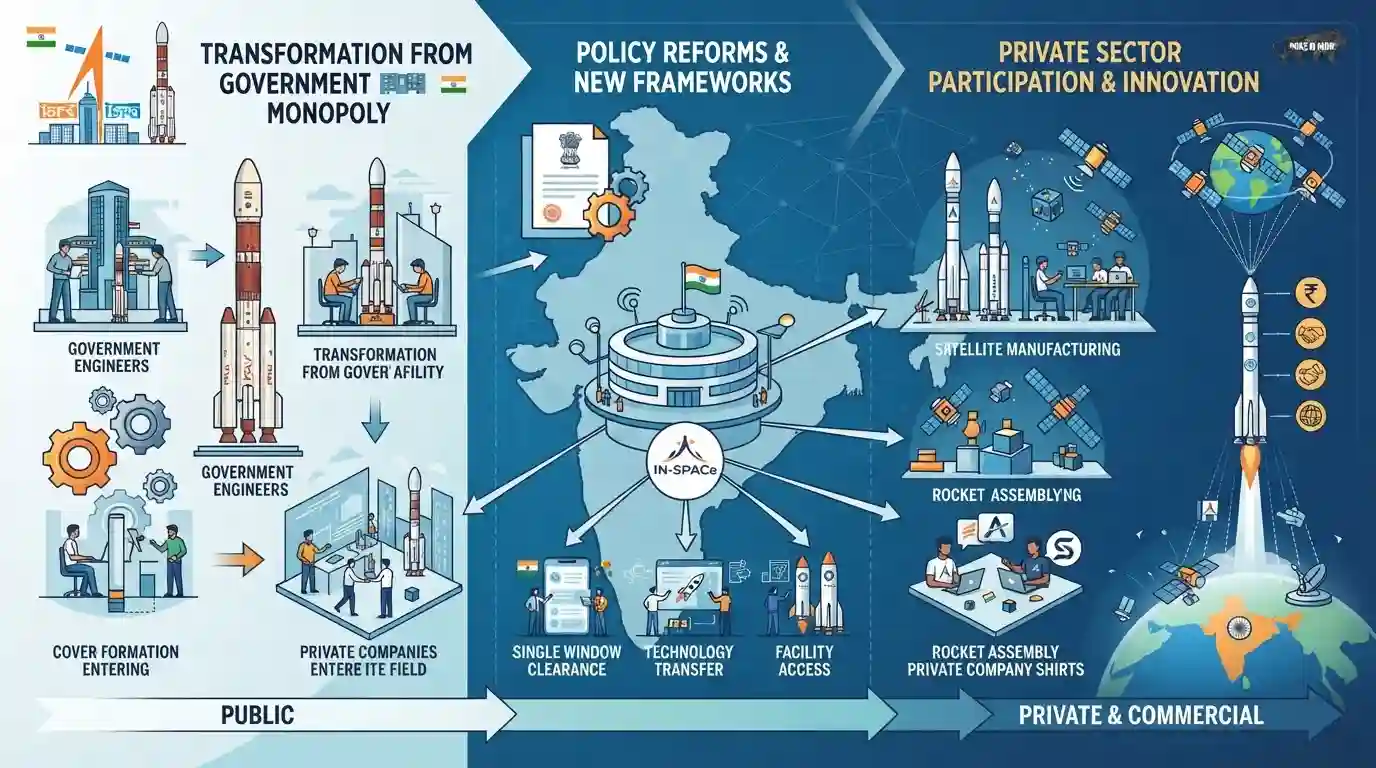
The article discusses the ongoing transformation and privatization dynamics within India's space sector, detailing the role of private enterprises, policy reforms, and institutional bodies like IN-SPACe in fostering a competitive commercial space ecosystem.
मुख्य मुद्दे
- India's space sector is undergoing a historic shift from an ISRO-centric model to an open architecture allowing robust private sector participation.
- The Indian Space Policy and institutional mechanisms like IN-SPACe act as facilitators, regulators, and promoters for non-governmental entities (NGEs).
- Private space startups are driving innovation in launch vehicles, 3D-printed rocket engines, and satellite technology, boosting India's share in the global space economy.
- Challenges remain regarding technology transfer, level playing field, long-term funding, and regulatory clarity for commercial space operations.
महत्त्वाच्या संज्ञा
Indian Space Policy

An apex umbrella policy framework approved by the Indian government that liberalizes the space sector, enabling private enterprises to participate across the entire space value chain from satellite manufacturing to launch services.
UPSC context
UPSC Mains GS Paper III (Science & Technology - Space). Tests policy reforms, private sector participation, and the commercialization of India's space sector.
IN-SPACe
An autonomous single-window nodal agency under the Department of Space established to authorize, promote, and supervise non-governmental entities in carrying out space activities in India.
UPSC context
UPSC Mains GS Paper III (Science & Technology - Space). Evaluates institutional frameworks enabling private sector collaboration and regulatory oversight.
NewSpace India Limited (NSIL)
The commercial arm of the Department of Space responsible for commercializing space technologies, launch vehicles, and satellite systems developed by ISRO on a commercial basis.
UPSC context
UPSC Mains GS Paper III (Science & Technology). Tests institutional mechanisms for technology transfer and commercializing public sector research in space.
ISRO
India's premier national space agency tasked with research and development of advanced space technologies, planetary exploration, human spaceflight missions, and foundational space science.
UPSC context
UPSC Prelims & Mains GS Paper III (Science & Technology). Tests India's premier space achievements, institutional evolution, and changing mandate towards R&D.
पूर्वपरीक्षा सापळा
IN-SPACe acts as the commercial arm and primary public sector aggregator for marketing ISRO's space assets.
IN-SPACe is a regulator and single-window facilitator for NGEs, whereas NSIL is the commercial arm and public sector aggregator for technology transfer and operational production. They are frequently interchanged in exam questions.
संबंधित स्थिर संकल्पना
What are the distinct institutional roles of ISRO, IN-SPACe, and NSIL under the Indian Space Policy?
- ISRO Role: Focuses on research and development, deep-space exploration, interplanetary missions, and advanced technology realization.
- IN-SPACe Mandate: Acts as an autonomous single-window nodal agency to authorize, promote, and regulate non-governmental entities (NGEs).
- NSIL Function: Functions as the commercial arm (CPSE) of the Department of Space for technology transfer and market-driven production.
आंतर-विषय नमुने
Space Privatisation & Defense Indigenisation Parallels
Private sector participation in space mirrors defense indigenisation policies, where public sector monopoly is replaced by co-development, technology transfer, and private startups acting as prime contractors.
Deep-Tech Funding and Space Startups
The shift toward commercial space assets and venture funding parallels deep-tech startup policies under the National Quantum Mission and semiconductor incentives.

IN-SPACe vs NSIL institutional mandate overlap and the division of labour with ISRO are high-probability statement-based prelims traps.
संबंधित PYQ · 1
संबंधित PYQ · 1
- 2026PrelimsGS1
Consider the following statements with regard to involvement of private entities in India's space programme : 1. The Indian National Space Promotion and Authorisation Centre (IN-SPACe) is an autonomous agency formed to facilitate participation of private entities. 2. Agnikul Cosmos launched the world's first flight using 3D-printed rocket engine. 3. Skyroot Aerospace has developed liquid fuel for GSLV. Which of the statements given above is/are correct ?
