Private Sector Participation and Space Policy Reforms in India
Source:Indian Express ↗
Why It Matters
Crucial for GS3 Science and Technology syllabus regarding indigenous technology development, commercialisation of space, and policy reforms enabling private industry participation.
Summary
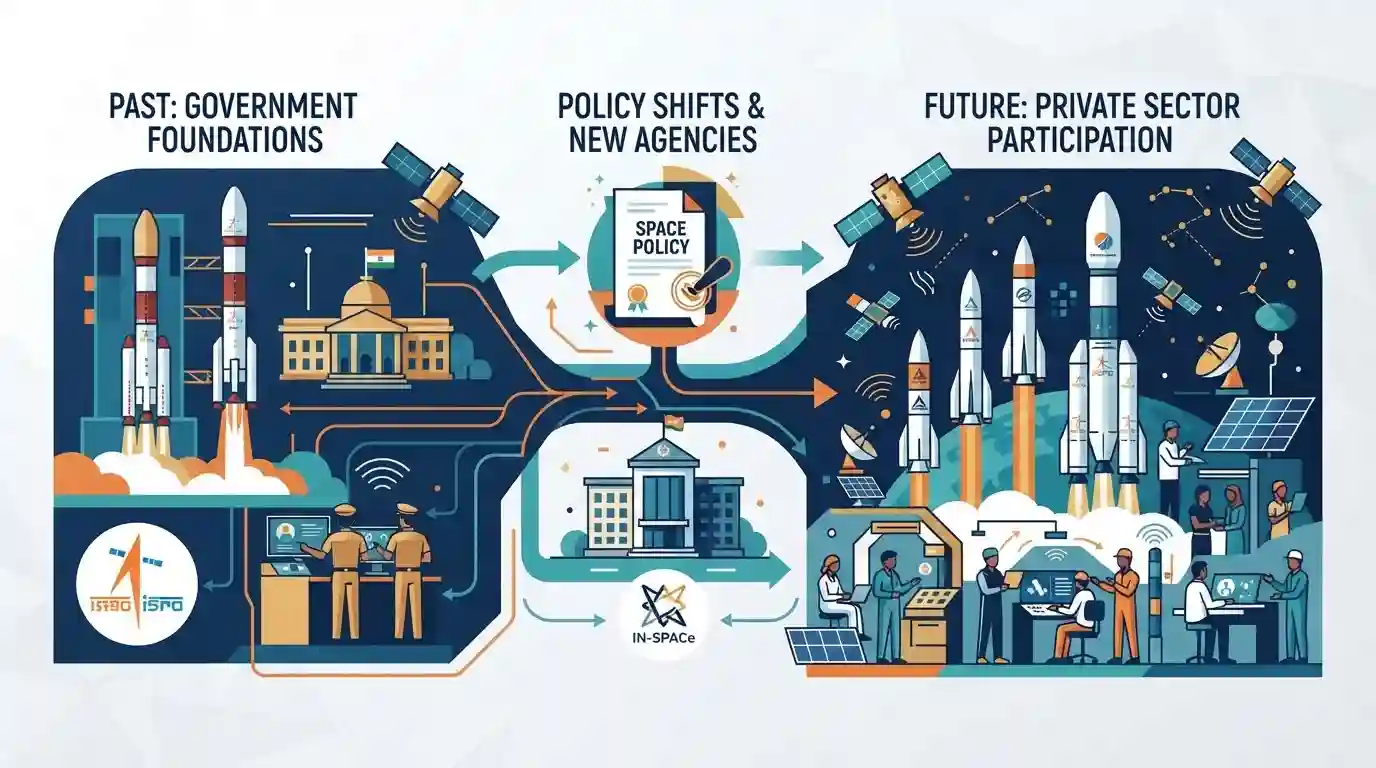
The article discusses the ongoing evolution and privatisation of India's space sector, driven by policy shifts, the establishment of agencies like IN-SPACe, and the expanding role of private sector entities in rocket manufacturing, launches, and space applications alongside ISRO.
Key Points
- India is transitioning its space sector from a state-monopolised model to a vibrant commercial ecosystem involving private players.
- The Indian Space Policy and bodies like IN-SPACe and NSIL aim to foster private manufacturing, launch services, and space-based applications.
- Private space start-ups in India are scaling up capabilities in launch vehicles, satellite building, and payload deployment, reducing the burden on ISRO.
- Regulatory frameworks are evolving to balance commercial growth, national security, and international obligations.
Important Terms
Indian Space Policy

India's overarching framework approved in 2023 to enable private sector participation across the entire space value chain, including satellite manufacturing, launches, and applications.
UPSC context
UPSC GS Paper 3: Science & Technology - Awareness in the fields of Space, Policy shifts, and Private participation.
IN-SPACe
India's single-window autonomous nodal agency under the Department of Space established to promote, authorize, and supervise non-governmental entities in space activities.
UPSC context
UPSC GS Paper 3: Institutional reforms and government bodies enabling private sector involvement in high-tech domains.
NSIL
The central public sector enterprise and commercial arm of ISRO tasked with commercializing space technologies, launch vehicles, and satellite data on a demand-driven basis.
UPSC context
UPSC GS Paper 3: Commercialization of space assets and public sector enterprises driving India's space economy.
ISRO
India's national space agency responsible for research, development, and execution of space exploration missions, now shifting focus toward advanced technology and R&D.
UPSC context
UPSC GS Paper 3: Achievements of Indians in science & tech, space missions, and institutional evolution.
Prelims Trap
IN-SPACe serves as the commercial arm of ISRO tasked with spearheading commercial space operations and technology transfers.
Aspirants often confuse IN-SPACe with NSIL, assuming both are commercial manufacturing arms. In reality, IN-SPACe is an autonomous single-window nodal agency for authorisation and promotion, whereas NSIL is the commercial arm and CPSE handling operational spin-offs and production.
Static Concepts Connected
What are the distinct institutional mandates of IN-SPACe, NSIL, and ISRO under India's space governance architecture?
- IN-SPACe Mandate: Autonomous regulator and single-window nodal agency under the Department of Space to promote, authorise, and supervise non-governmental entities (NGEs).
- NSIL Role: Commercial arm of ISRO and CPSE mandated to spearhead commercial space operations, transfer technologies, and mass-produce launch vehicles like PSLV and SSLV.
- ISRO Focus: National space agency focused primarily on R&D, deep-space exploration, interplanetary missions, and strategic national security payloads.
Cross-Topic Patterns
Space Privatisation vs Defence Indigenisation
The shift of ISRO from manufacturing to deep-space research parallels defence indigenisation where DPSUs share production burdens with private industry under iDEX and positive indigenisation lists.
Space Economy FDI & FEMA Linkages
Targeting a $44 billion space economy by 2033 requires robust FDI norms (currently up to 100% under automatic route for certain sub-segments) intersecting with FEMA regulations and capital account convertibility.

Expect a statement-based prelims question distinguishing the specific mandates of IN-SPACe (regulator/promoter) vs NSIL (commercial arm/CPSE).
Linked PYQs · 2
Linked PYQs · 2
- 2016MainsGS3
Discuss India's achievements in the field of Space Science and Technology. How the application of this technology has helped India in its socio-economic development?
- 2026PrelimsGS1
Consider the following statements with regard to involvement of private entities in India's space programme : 1. The Indian National Space Promotion and Authorisation Centre (IN-SPACe) is an autonomous agency formed to facilitate participation of private entities. 2. Agnikul Cosmos launched the world's first flight using 3D-printed rocket engine. 3. Skyroot Aerospace has developed liquid fuel for GSLV. Which of the statements given above is/are correct ?
