ISRO and NASA Moon Base Cooperation and Space Tech
Source:Indian Express ↗
Why It Matters
Understanding bilateral and multilateral space collaborations like ISRO-NASA lunar missions is vital for India's evolving space capabilities and deep space aspirations.
Summary
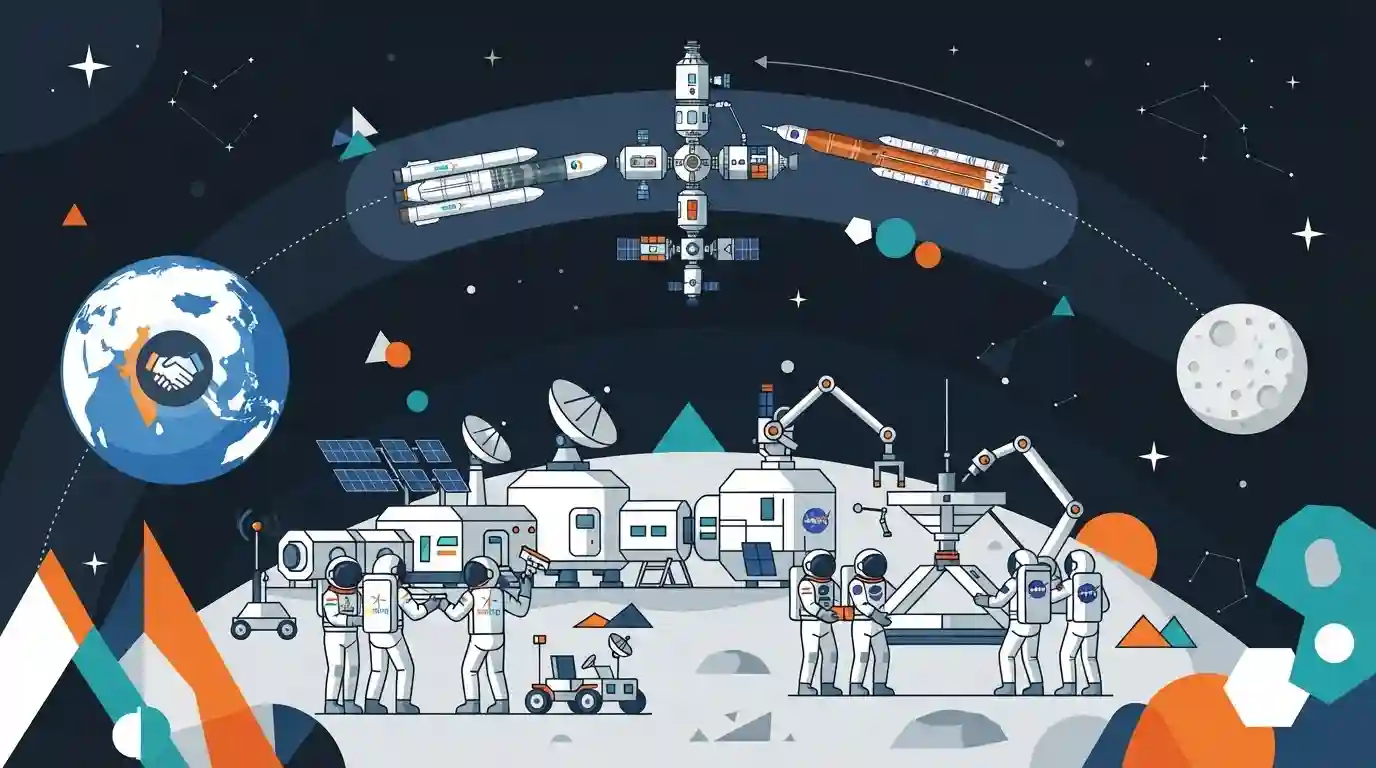
The article examines the strategic and technological aspects of joint space cooperation between ISRO and NASA for establishing future Moon base programmes, highlighting the significance of international partnerships in deep space exploration.
Key Points
- ISRO and NASA are collaborating on lunar exploration and future crewed base programmes on the Moon.
- International cooperation in space technology enhances cost-sharing, resource pooling, and scientific data exchange.
- Deep space missions and sustainable lunar presence present technological challenges in life support, power generation, and communication.
Important Terms
ISRO

India's national space agency responsible for planning, executing, and managing space exploration, satellite launch vehicles, and socio-economic developmental applications.
UPSC context
UPSC GS Paper III (Science & Technology - Space). Tests awareness of India's space achievements, international collaborations, and deep space missions.
NASA
The independent federal agency of the United States government responsible for the civilian space program, aeronautics research, and deep space exploration.
UPSC context
UPSC GS Paper III (Science & Technology - Space). Tests bilateral space diplomacy and joint global technological initiatives.
Prelims Trap
India is a founding signatory of the US-led Artemis Accords for lunar exploration.
Aspirants often assume India is a founding member of the Artemis Accords because of high-profile bilateral space agreements, but India only signed it in June 2023 during the US state visit.
Static Concepts Connected
What are the key principles and legal nature of the Outer Space Treaty of 1967?
- No Sovereignty: Non-appropriation principle bars any nation from claiming sovereignty over celestial bodies like the Moon.
- Demilitarisation: Prohibits placing nuclear weapons or weapons of mass destruction in Earth orbit or on celestial bodies.
- State Liability: States bear international responsibility for national space activities whether carried out by governmental or non-governmental entities.
Cross-Topic Patterns
Artemis Accords & Strategic Autonomy
India's signing of the Artemis Accords directly intersects with its long-standing foreign policy of strategic autonomy and multilateral technology access.
Lunar South Pole & Outer Space Treaty
Lunar South Pole exploration ties deep-space technology milestones directly to critical minerals extraction and Antarctic governance geopolitical parallels.

Artemis Accords, Indian Space Station (2035), and crewed lunar landing (2040) targets are high-yield match lists for prelims.
Linked PYQs · 2
Linked PYQs · 2
- 2023MainsGS3
What is the main task of India's third moon mission which could not be achieved in its earlier mission? List the countries that have achieved this task. Introduce the subsystems in the spacecraft launched and explain the role of the Virtual Launch Control Centre' at the Vikram Sarabhai Space Centre which contributed to the successful launch from Sriharikota.
- 2019MainsGS3
What is India's plan to have its own space station and how will it benefit our space programme?
