ISRO Schedules Multiple Commercial and Scientific Launch Missions
Source:The Hindu ↗
Why It Matters
India's ambitious space goals, including human spaceflight (Gaganyaan) and expanding commercial launch capabilities (LVM3, Kulasekarapattinam spaceport), are key parts of the GS-III Science and Technology syllabus regarding awareness in the field of Space.
Summary
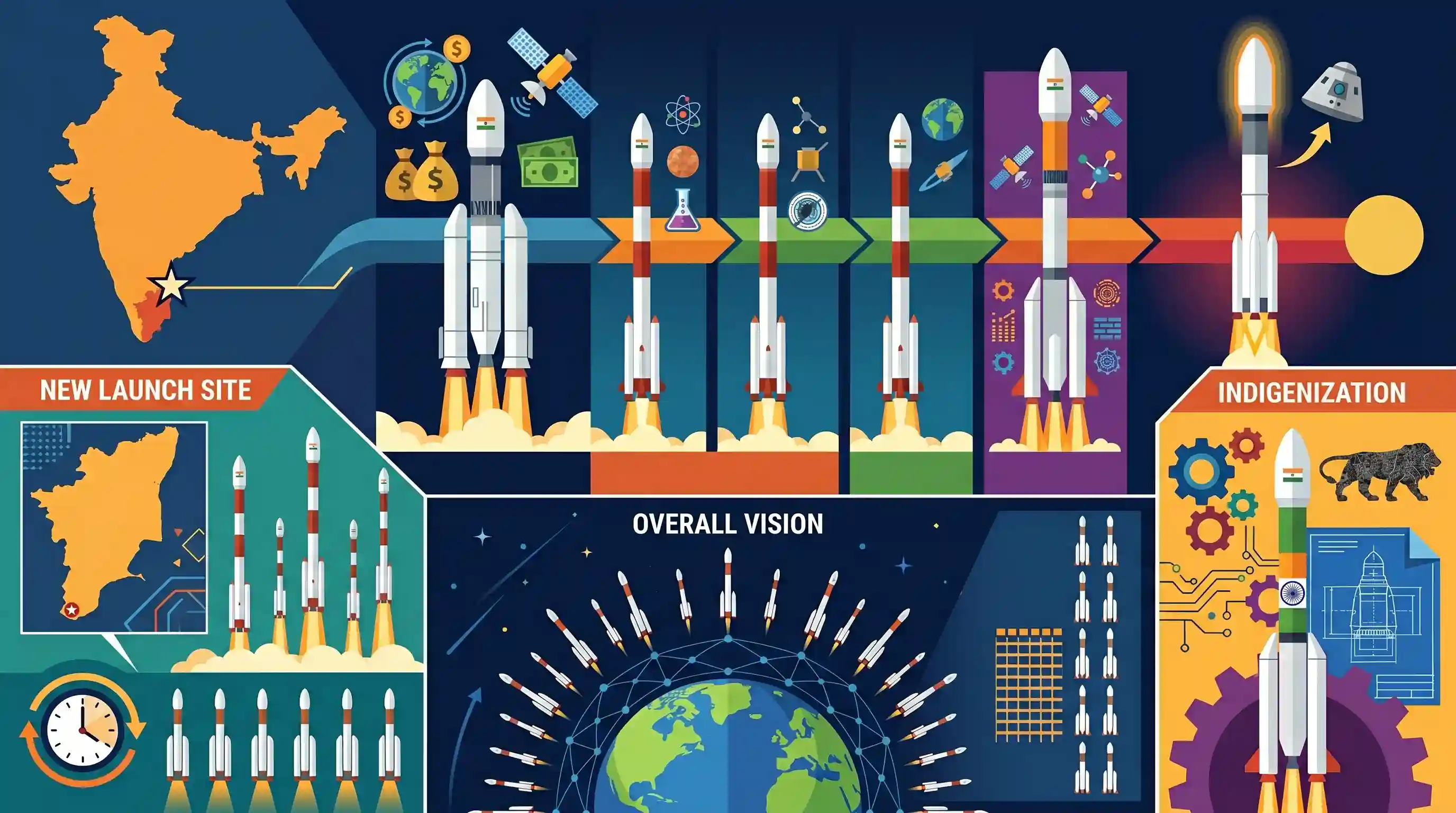
The Indian Space Research Organisation (ISRO) has scheduled seven launch missions from Sriharikota by March 2026. These include commercial launches using the LVM3-M5, three PSLV missions, and the GSLV-F17. Notably, the Gaganyaan project is progressing, with hardware integration underway and the first uncrewed mission targeted for March 2026. Furthermore, a new launch site at Kulasekarapattinam in Tamil Nadu will soon facilitate small satellite launches every three weeks, aligning with ISRO's vision to conduct 50 missions over the next five years.
Key Points
- ISRO has scheduled seven launch missions from the Satish Dhawan Space Centre (SDSC) by March 2026.
- The LVM3-M5 vehicle will be utilized to launch a commercial communication satellite for a private client.
- Three PSLV missions, alongside the PSLV-N1 technology development mission and GSLV-F17, are targeted by the end of the financial year.
- The Gaganyaan human spaceflight project is in an advanced stage, with the first uncrewed (G1) mission scheduled for March 2026.
- A new launch site at Kulasekarapattinam in Tamil Nadu will enable small satellite launches every three weeks.
Important Terms
Gaganyaan Project

India's first human spaceflight mission aiming to send a 3-member crew to low Earth orbit for 3 days; the first uncrewed test flight (G1) is targeted for March 2026.
UPSC context
GS Paper 3: Science & Tech (Space). Tests knowledge of indigenous technology, human spaceflight challenges, and India's long-term space goals.
LVM3-M5 / CMS-03 Mission
ISRO's heaviest three-stage launch vehicle, formerly GSLV Mk-III; the M5 mission successfully launched CMS-03, the heaviest communication satellite ever launched from Indian soil (4,410 kg).
UPSC context
GS Paper 3: Indigenization of technology. Significant for demonstrating heavy-lift capability and reducing dependency on foreign launch services.
Kulasekarapattinam Spaceport
A new spaceport in Tamil Nadu dedicated to Small Satellite Launch Vehicles (SSLV); its location allows direct southward launches, eliminating the fuel-intensive 'dogleg maneuver' required at Sriharikota.
UPSC context
GS Paper 3: Infrastructure and Economic Development. Key for India's aim to capture the global small satellite launch market.
PSLV-N1
The first PSLV mission realized through an industry consortium (NSIL); it aims to launch the EOS-10 satellite for oceanographic studies and highlights the privatization of Indian space activities.
UPSC context
GS Paper 3: Space Technology/Privatization. Tests understanding of NewSpace India Limited (NSIL) and private sector participation in space.
GSLV-F17
A three-stage vehicle with an indigenous cryogenic upper stage; the F17 mission is scheduled to launch the EOS-05 Earth observation satellite for strategic applications.
UPSC context
GS Paper 3: Science & Tech. Focuses on the development of indigenous cryogenic engine technology and strategic satellite deployments.
SSLV (Small Satellite Launch Vehicle)
A 3-stage all-solid vehicle designed for quick, low-cost launches of small satellites (up to 500 kg) into Low Earth Orbit (LEO) with minimal launch infrastructure requirements.
UPSC context
GS Paper 3: Science & Tech/Industrial Development. Relevant for India's commercial space strategy and "launch-on-demand" capabilities.
Prelims Trap
"Gaganyaan will launch astronauts into a Geosynchronous Transfer Orbit (GTO) using the LVM3 launch vehicle."
While LVM3 is traditionally used for placing heavy satellites into GTO, the Gaganyaan mission will place astronauts into Low Earth Orbit (LEO) at ~400 km.
Static Concepts Connected
Why is the new spaceport built at Kulasekarapattinam?
- Dogleg Maneuver Avoidance: Sriharikota launches must steer east then south to avoid dropping debris on Sri Lanka, wasting fuel. Kulasekarapattinam allows direct southward trajectories.
- Payload efficiency: Bypassing the dogleg maneuver saves significant fuel, thereby increasing the effective payload-carrying capacity for Small Satellite Launch Vehicles (SSLVs).
How does LVM3 differ from PSLV structurally and functionally?
- Stages and Propulsion: PSLV is a 4-stage vehicle (alternating solid and liquid). LVM3 is a 3-stage heavy-lift vehicle (solid strap-ons, liquid core, and a cryogenic upper stage).
- Purpose and Orbits: PSLV primarily deploys lighter satellites to Low Earth or Sun-Synchronous Polar Orbits. LVM3 lifts 4-tonne heavy communication satellites to high-altitude Geosynchronous Transfer Orbits.
Cross-Topic Patterns
NSIL and Commercial Spaceflight
LVM3's commercial payload delivery highlights the operationalization of India's Space Policy 2023, separating ISRO's R&D focus from NSIL's commercial launch mandates.
Gaganyaan's Humanoid & AI Integration
The uncrewed G1 mission testing the half-humanoid 'Vyommitra' bridges space technology with robotics and AI, which UPSC often tests as combined application questions.

Expect a 2026 Prelims statement contrasting the orbits (LEO vs GTO) of Gaganyaan vs standard LVM3 launches, alongside spaceport geography.
Linked PYQs · 3
Linked PYQs · 3
- 2018PrelimsGS1
With reference to India's satellite launch vehicles, consider the following statements: 1. PSLVs launch the satellites useful for Earth resources monitoring whereas GSLVs are designed mainly to launch communication satellites. 2. Satellites launched by PSLV appear to remain permanently fixed in the same position in the sky, as viewed from a particular location on Earth. 3. GSLV Mk III is a four-staged launch vehicle with the first and third stages using solid rocket motors; and the second and fourth stages using liquid rocket engines. Which of the statements given above is/are correct?
- 2025PrelimsGS1
Consider the following space missions : I. Axiom-4 II. SpaDeX III. Gaganyaan How many of the space missions given above encourage and support micro-gravity research?
- 2017MainsGS3
India has achieved remarkable successes in unmanned space missions including the Chandrayaan and Mars Orbitter Mission, but has not ventured into manned space missions. What are the main obstacles to launching a manned space mission, both in terms of technology and logistics? Examine critically.
