ISRO Launch Manifest and Commercial Space Program Roadmap
Source:The Hindu ↗
Why It Matters
ISRO's transition towards industry-built launch vehicles (via NSIL) and crewed spaceflight (Gaganyaan) represents a paradigm shift in India's space sector. Familiarity with specific launch vehicles (LVM3, PSLV, SSLV), advanced propulsion systems, and private sector integration is highly relevant for GS3 Science & Technology and Prelims factual questions.
Summary
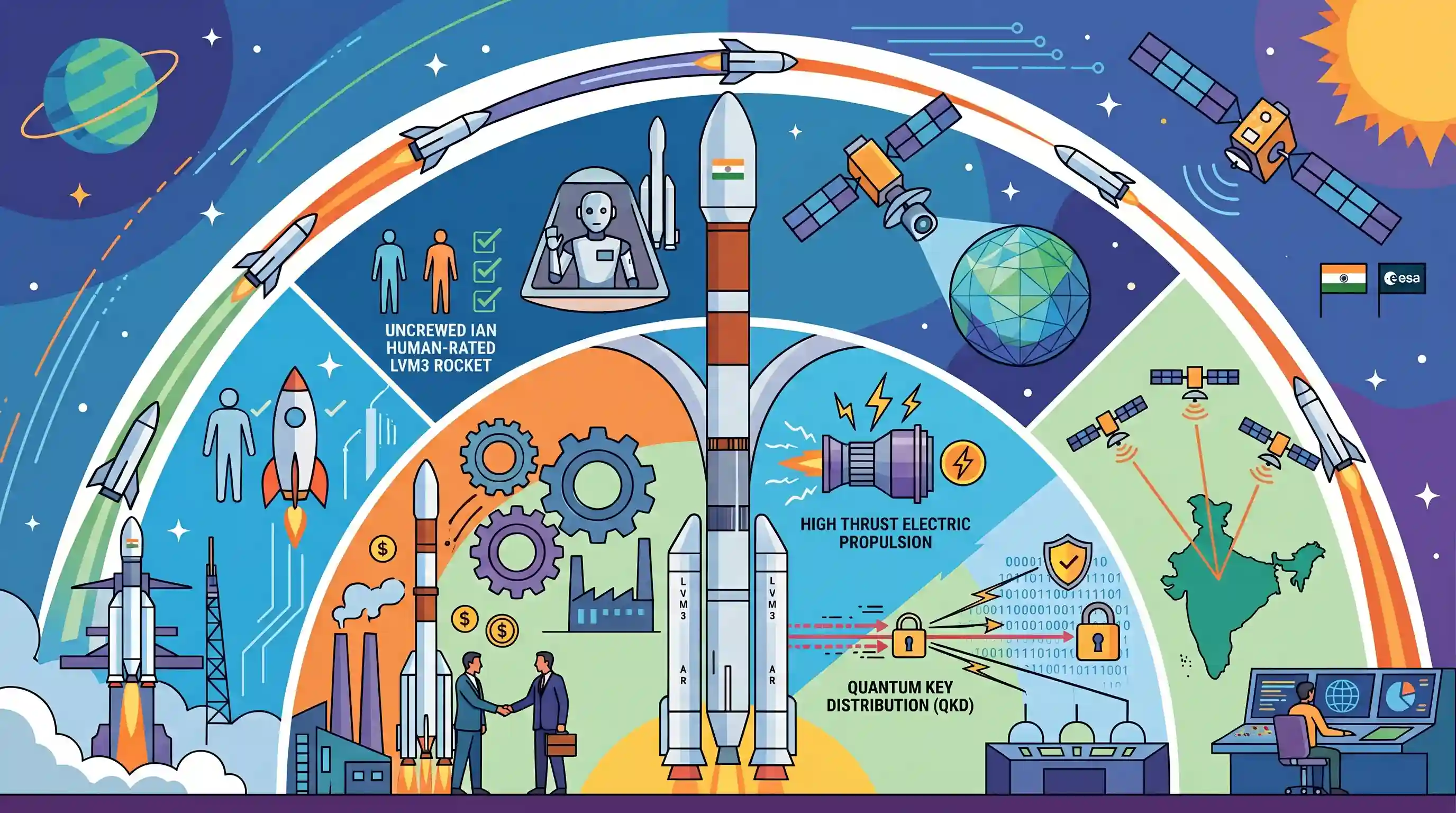
The Indian Space Research Organisation (ISRO) is set to execute seven major launch missions by March 2026, marking a significant phase in India's space program. Key highlights include the first uncrewed test flight of the Gaganyaan mission using a human-rated LVM3 rocket carrying the robot 'Vyommitra'. Additionally, the period will witness the launch of India's first industry-manufactured PSLV—built by the HAL-L&T consortium under NewSpace India Limited (NSIL)—which underscores the growing commercialization and private sector participation in Indian space endeavors. Missions will also test next-generation technologies like High Thrust Electric Propulsion and Quantum Key Distribution, while deploying critical satellites for Earth observation, navigation (NavIC), and international collaborations like ESA's PROBA-3.
Key Points
- ISRO has scheduled 7 significant launches by March 2026, encompassing a diverse array of scientific, commercial, and technological demonstration missions.
- The first uncrewed flight of the Gaganyaan mission will utilize a human-rated LVM3 rocket and carry the humanoid robot 'Vyommitra' to space.
- India's first industry-built PSLV, constructed by a consortium of HAL and L&T under NSIL, will deploy payloads including Oceansat and a joint Indo-Mauritius satellite.
- Advanced space technologies such as High Thrust Electric Propulsion (HTEP), Traveling Wave Tube (TWT) amplifiers, and Quantum Key Distribution will be validated via the TDS-01 satellite.
- Upcoming launches also feature NVS-02 to strengthen the NavIC constellation, the Indian Data Relay Satellite System (IDRSS), and the European Space Agency's PROBA-3 mission aboard a PSLV-XL.
Important Terms
Gaganyaan Mission

India’s maiden human spaceflight programme aiming to send a 3-member crew to Low Earth Orbit (400 km) for 3 days and return them safely to Earth.
UPSC context
GS Paper III (Science & Tech); tests knowledge of indigenization and landmark space milestones.
Vyommitra
ISRO’s half-humanoid robot designed for uncrewed Gaganyaan test flights to validate life-support systems and monitor module parameters before human occupancy.
UPSC context
GS Paper III (S&T); focuses on robotics and safety protocols in human spaceflight.
NewSpace India Limited (NSIL)
The commercial arm of ISRO responsible for promoting Indian space services and facilitating private sector participation in satellite manufacturing and launch services.
UPSC context
GS Paper III (Economy/S&T); critical for topics on space reforms and commercialization.
HAL-L&T Consortium
A strategic industrial partnership between Hindustan Aeronautics Ltd and Larsen & Toubro for the end-to-end production of the PSLV rocket.
UPSC context
GS Paper III (S&T/Economy); illustrates private sector transition from suppliers to lead integrators.
PROBA-3 Mission
A dual-satellite European Space Agency mission launched by ISRO to demonstrate high-precision formation flying for solar corona observation.
UPSC context
GS Paper III (S&T); tests awareness of international space collaborations and scientific technology demonstrators.
Dhruva Space
A prominent Indian private space startup providing full-stack satellite solutions and integrated launch services, representing the growing 'NewSpace' industry.
UPSC context
GS Paper III (S&T/Economy); relevant for the role of startups in the indigenous space ecosystem.
Prelims Trap
"PROBA-3 is a joint ISRO-ESA solar mission to study the Sun's corona alongside Aditya-L1."
PROBA-3 is purely an ESA mission. ISRO's involvement is strictly commercial—providing the PSLV-XL launch vehicle to put the European satellites into orbit.
Static Concepts Connected
How does Electric Propulsion differ from Chemical Propulsion in satellites?
- Mechanism: Uses electrical energy (often solar) to ionize and accelerate a noble gas (like Xenon) rather than combusting chemical fuels.
- Efficiency & Weight: Provides high specific impulse, requiring much less propellant. This drastically reduces overall satellite weight, allowing for heavier mission payloads.
- Thrust Profile: Generates very low thrust. It cannot launch rockets from Earth but is highly efficient for slow orbit-raising and deep-space station-keeping.
What are the distinct mandates of NSIL and IN-SPACe?
- NSIL: The commercial arm of DOS. It builds launch vehicles through industry (e.g., HAL-L&T PSLV), commercializes ISRO technologies, and provides launch services.
- IN-SPACe: The single-window, independent nodal agency that promotes, regulates, and authorizes private space sector activities and infrastructure-sharing in India.
Cross-Topic Patterns
Solar observation synergy
ESA's PROBA-3 creates an artificial eclipse for corona study, complementing India's Aditya-L1 which continuously observes the sun from the L1 Lagrange point.
NavIC's civilian push
The upcoming NVS-02 launch continues the NavIC upgrade cycle, adding civilian L1 frequency bands to increase compatibility with global consumer GPS chipsets.

Electric propulsion, QKD, and the functional distinction between NSIL and IN-SPACe are highly probable targets for Prelims 2026.
Linked PYQs · 4
Linked PYQs · 4
- 2018PrelimsGS1
With reference to India's satellite launch vehicles, consider the following statements: 1. PSLVs launch the satellites useful for Earth resources monitoring whereas GSLVs are designed mainly to launch communication satellites. 2. Satellites launched by PSLV appear to remain permanently fixed in the same position in the sky, as viewed from a particular location on Earth. 3. GSLV Mk III is a four-staged launch vehicle with the first and third stages using solid rocket motors; and the second and fourth stages using liquid rocket engines. Which of the statements given above is/are correct?
- 2025PrelimsGS1
Consider the following space missions : I. Axiom-4 II. SpaDeX III. Gaganyaan How many of the space missions given above encourage and support micro-gravity research?
- 2016MainsGS3
Discuss India's achievements in the field of Space Science and Technology. How the application of this technology has helped India in its socio-economic development?
- 2019MainsGS3
What is India's plan to have its own space station and how will it benefit our space programme?
