Gaganyaan Uncrewed Flight Mission and Human Spaceflight Programme
Source:Indian Express ↗
Why It Matters
The Gaganyaan mission represents a monumental leap for India's space program, transitioning from robotic and planetary exploration to human spaceflight capability, requiring advanced life-support systems and rigorous crew safety measures.
Summary
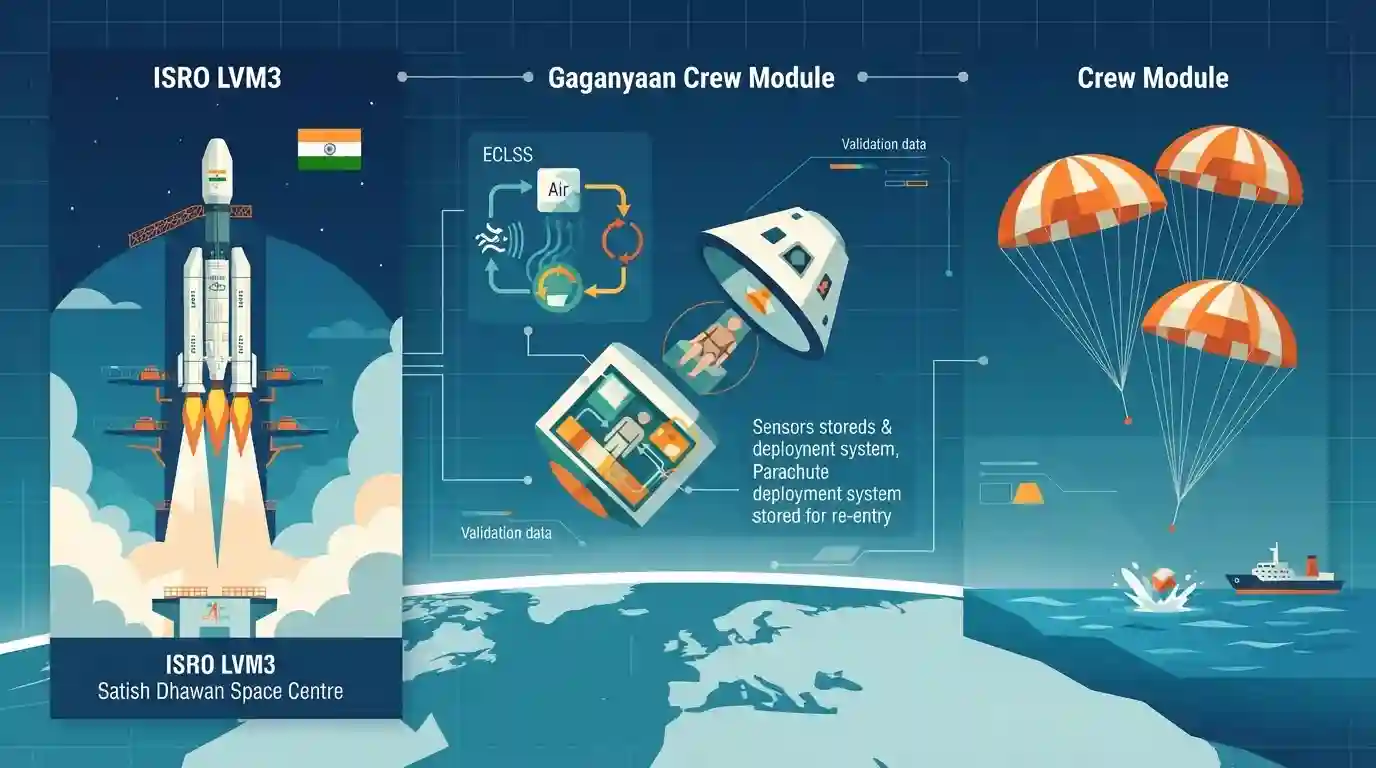
ISRO has advanced its flagship Gaganyaan human spaceflight programme with the launch of an uncrewed test flight mission. This milestone is critical for validating human-rated launch vehicle systems, crew safety, environmental control, and life support systems prior to sending astronauts into space.
Key Points
- ISRO launched its uncrewed Gaganyaan test flight mission marking a crucial stepping stone toward India's maiden human spaceflight programme.
- The uncrewed mission tests critical systems including human-rated launch vehicles, life support systems, and crew module re-entry and recovery.
- Demonstrates technological capabilities in complex aerospace engineering and human spaceflight safety protocols.
Important Terms
Gaganyaan Programme

India's flagship human spaceflight initiative aimed at demonstrating orbital capability by sending a crew to low Earth orbit and safely returning them to Earth.
UPSC context
UPSC Mains GS Paper III: Achievements of Indians in science & technology; indigenization of technology and developing space tech.
ISRO
India's national space agency under the Department of Space, responsible for national space-based applications, launch vehicles, and deep-space exploratory missions.
UPSC context
UPSC Mains GS Paper III: Science and Technology — awareness in space tech, institutional frameworks, and national technological achievements.
Prelims Trap
Standard LVM3 rockets are deployed without modification for Gaganyaan uncrewed test missions.
Aspirants often assume uncrewed test flights use standard LVM3; however, Gaganyaan specifically requires the Human-Rated LVM3 (HLVM3) with enhanced safety and redundancy systems.
Static Concepts Connected
What are the key components and orbital parameters of ISRO's Gaganyaan Mission?
- Human Rating: HLVM3 Rocket: Uses Human-Rated LVM3 engineered for ultra-high safety standards and system redundancy.
- Mission Scope: Orbital Target: Sends a crew of three to a Low Earth Orbit (LEO) of 400 km for 3 days.
- Emergency Gear: Safety Systems: Features a dedicated Crew Escape System (CES) to pull the module away during launch anomalies.
Cross-Topic Patterns
Space Indigenization + Launch Vehicle Evolution
Gaganyaan's reliance on HLVM3 builds directly on the heavy-lift technology mastered during Chandrayaan-3 and commercial satellite launches, cementing PSLV/LVM3 self-reliance.
Space Tech + International Space Treaties
Human spaceflight safety protocols tie aerospace engineering directly to international space debris mitigation guidelines and outer space treaties.

Human-rated LVM3, Crew Escape System specs, and Low Earth Orbit parameters for Gaganyaan are high-yield for Prelims statements.
Linked PYQs · 3
Linked PYQs · 3
- 2023MainsGS3
What is the main task of India's third moon mission which could not be achieved in its earlier mission? List the countries that have achieved this task. Introduce the subsystems in the spacecraft launched and explain the role of the Virtual Launch Control Centre' at the Vikram Sarabhai Space Centre which contributed to the successful launch from Sriharikota.
- 2017MainsGS3
India has achieved remarkable successes in unmanned space missions including the Chandrayaan and Mars Orbitter Mission, but has not ventured into manned space missions. What are the main obstacles to launching a manned space mission, both in terms of technology and logistics? Examine critically.
- 2016MainsGS3
Discuss India's achievements in the field of Space Science and Technology. How the application of this technology has helped India in its socio-economic development?
