ISRO Launches Uncrewed Gaganyaan Test Flight
Source:Indian Express ↗
Why It Matters
The Gaganyaan mission is India's flagship human spaceflight initiative, demonstrating national capability in advanced space technologies, life support systems, and human-rated launch vehicles, which are essential for future deep space ambitions.
Summary
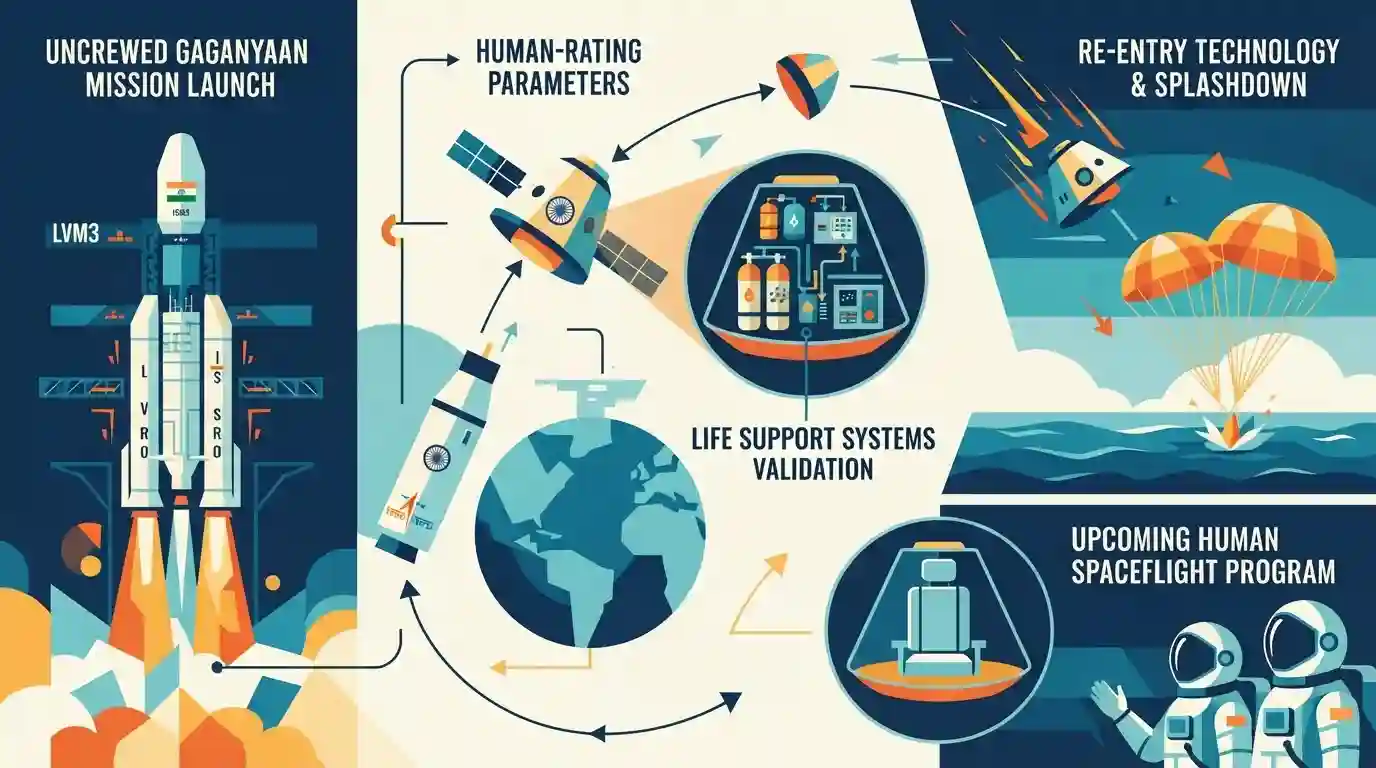
ISRO successfully launched the uncrewed Gaganyaan mission, serving as a critical testing phase for India's upcoming human spaceflight program. The mission aims to validate human-rating parameters, life support systems, and re-entry technology before sending astronauts into space.
Key Points
- ISRO launched its uncrewed Gaganyaan mission as a precursor to India's maiden human spaceflight program.
- The uncrewed test flight validates critical technologies including human-rated launch vehicles, orbital module systems, and safe re-entry and recovery mechanisms.
- Gaganyaan marks a major milestone for India in developing indigenous capabilities for crewed space exploration and microgravity research.
Important Terms
Gaganyaan Mission

India's flagship human spaceflight program spearheaded by ISRO, designed to demonstrate human spaceflight capability by sending astronauts into low Earth orbit and returning them safely.
UPSC context
Important for GS Paper III (Space Technology, Achievements in Indigenization of Technology and Space Exploration).
ISRO
India's national space agency under the Department of Space, responsible for planning, developing, and executing space exploration, satellite launches, and scientific missions.
UPSC context
Important for GS Paper III (Awareness in Space Technology and Institutional Framework of Indian Science).
Prelims Trap
Uncrewed Gaganyaan missions test microgravity physiological adaptation on human subjects before crewed launch.
Aspirants often assume uncrewed test flights like Vyommitra or precursor missions carry human life-support validation in actual microgravity, whereas early uncrewed flights primarily test structural integrity, CES, and re-entry dynamics.
Static Concepts Connected
What are the core technical subsystems of India's Gaganyaan human spaceflight mission?
- Human Rating: HLVM3 Vehicle: Human-rated LVM3 launch vehicle featuring multi-level redundancy and fault tolerance systems for human safety.
- Module Architecture: Orbital Module: Houses the Crew Module (CM) and Service Module (SM) to sustain a 3-member crew in low Earth orbit.
- ECLSS Tech: Life Support System: ECLSS regulates cabin pressure, oxygen concentration, temperature, and carbon dioxide scrubbing.
- Abort Mechanism: Crew Escape System: Rapidly pulls the crew module away during launch anomalies to ensure abort safety.
Cross-Topic Patterns
Human Spaceflight and Indigenous Tech Indigenization
Gaganyaan's ECLSS and life-support technology development mirrors long-standing ISRO tech transfer frameworks seen in cryogenic engines and deep-space missions.
Space Diplomacy and Artemis Accords Alignment
India's emergence as an autonomous human spaceflight player alters regional geopolitics, intersecting with Artemis Accords diplomacy and South Asia science diplomacy.

Gaganyaan human-rating parameters and ECLSS mechanisms will feature in a statement-based prelims question on Indian space tech.
Linked PYQs · 3
Linked PYQs · 3
- 2025PrelimsGS1
Consider the following space missions : I. Axiom-4 II. SpaDeX III. Gaganyaan How many of the space missions given above encourage and support micro-gravity research?
- 2023MainsGS3
What is the main task of India's third moon mission which could not be achieved in its earlier mission? List the countries that have achieved this task. Introduce the subsystems in the spacecraft launched and explain the role of the Virtual Launch Control Centre' at the Vikram Sarabhai Space Centre which contributed to the successful launch from Sriharikota.
- 2016MainsGS3
Discuss India's achievements in the field of Space Science and Technology. How the application of this technology has helped India in its socio-economic development?
