ISRO Robotic Challenge for Student Autonomous UAV Development
Source:The Hindu ↗
Why It Matters
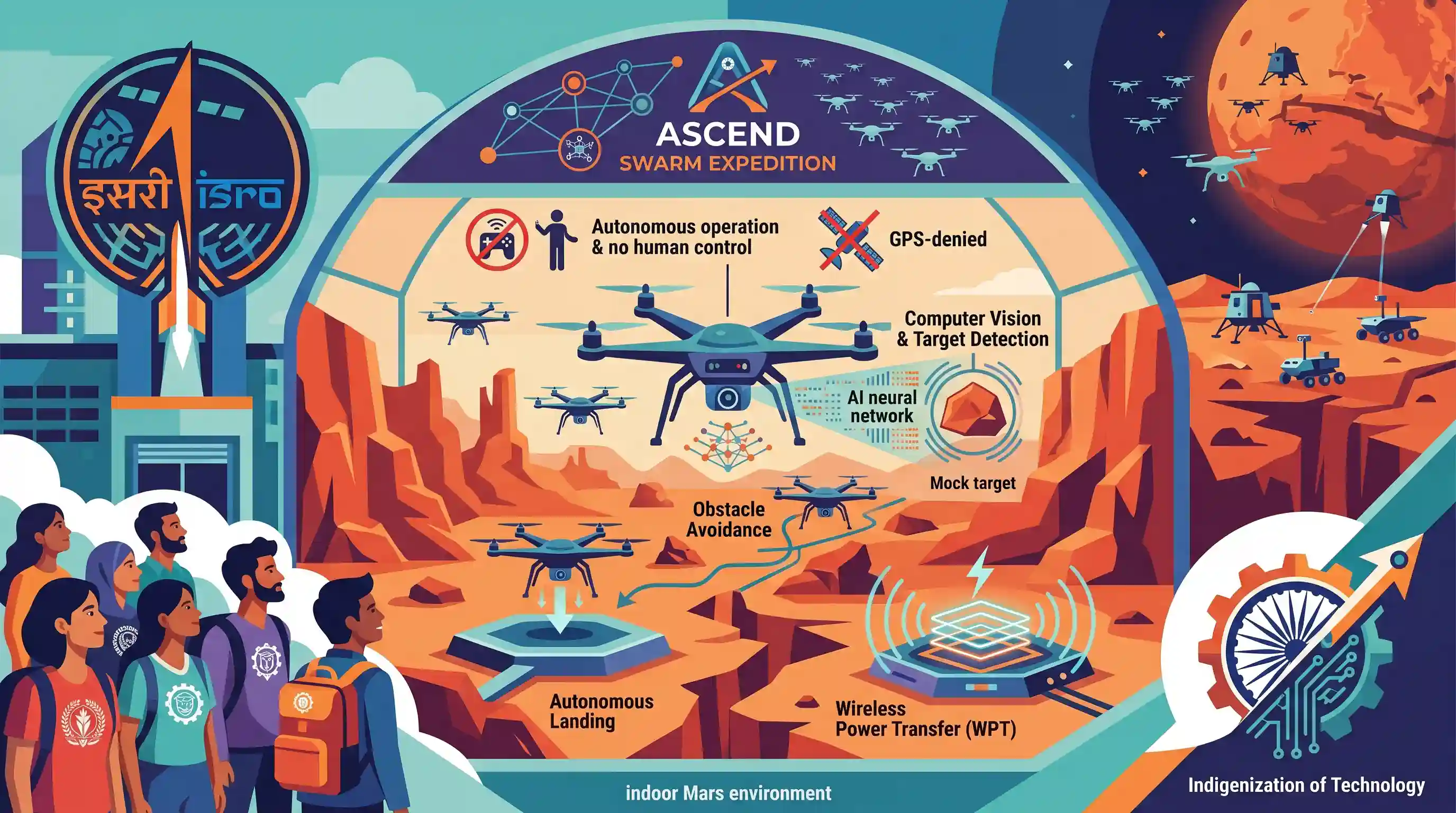
Highlights ISRO's future trajectory in space exploration—moving from orbital and lander missions to deploying autonomous swarm UAVs for deep-space planetary exploration (e.g., Mars). It emphasizes the indigenization of critical technologies like GPS-denied navigation and wireless power transfer through academia engagement.
Summary
The Indian Space Research Organisation (ISRO), through its UR Rao Satellite Centre (URSC), has announced the ISRO Robotics Challenge - URSC (IRoC-U 2026). The initiative invites the Indian student community to develop autonomous micro-Unmanned Aerial Vehicles (UAVs) for planetary exploration. The competition aligns with the "Towards Swarm Expedition: Autonomous Surveyor Challenge for Exploration, Navigation and Dynamics (ASCEND)", a forward-looking vision to explore the Martian surface using autonomous UAVs. The challenge requires the drones to operate in an indoor, GPS-denied environment resembling Mars, performing complex tasks such as obstacle avoidance, target detection using computer vision, autonomous landing, and wireless power transfer (WPT) without any human intervention or remote control. This effort aims to harness academic innovation to build self-reliance in advanced space robotics.
Key Points
- ISRO's UR Rao Satellite Centre (URSC) has launched the IRoC-U 2026 competition to engage the student community in space robotics.
- The challenge tasks students with developing a micro-UAV capable of autonomous navigation without GPS, telemetry, or external piloting aids.
- The long-term objective is linked to the ASCEND initiative, which aims to deploy a swarm of autonomous UAVs for future Martian surface exploration.
- Tasks for the UAV include navigating an indoor Martian-simulated arena, recognizing landing spots via computer vision, and successfully executing a wireless power transfer (WPT).
- The initiative fosters academia-industry collaboration and indigenous technology development in cutting-edge domains like swarm intelligence, autonomous systems, and space exploration.
Important Terms
ASCEND (Autonomous Surveyor Challenge for Exploration, Navigation and Dynamics)

The forward-looking vision to explore the Martian surface using swarms of autonomous Unmanned Aerial Vehicles (UAVs) that can navigate, survey, and recharge independently.
UPSC context
GS Paper III (S&T); relevant for future interplanetary missions and autonomous robotic exploration.
ISRO Robotics Challenge - URSC (IRoC-U 2026)
An ISRO-led national competition for students to develop autonomous micro-UAVs capable of planetary exploration tasks without external navigation aids like GPS.
UPSC context
GS Paper III (S&T); tests awareness of indigenization and academic-industry synergy in space technology.
UR Rao Satellite Centre (URSC)
The lead center of ISRO located in Bengaluru, responsible for the design, development, assembly, and integration of Indian satellite missions.
UPSC context
GS Paper III (S&T); essential for understanding India's space institutional framework and satellite manufacturing.
GPS-denied environment
An area where satellite-based navigation signals (like GPS or NavIC) are unavailable, requiring autonomous systems to rely on onboard sensors for orientation.
UPSC context
GS Paper III (S&T/Security); critical for planetary robotics, defense, and indoor navigation technology.
Wireless Power Transfer (WPT)
The transmission of electrical energy from a power source to a load without physical connectors, typically using electromagnetic induction or magnetic resonance.
UPSC context
GS Paper III (S&T); relevant for emerging energy solutions and self-sustaining autonomous systems.
Prelims Trap
UAVs deployed on Mars will utilize India's NavIC or global GPS constellations for precise swarm navigation.
Mars lacks a global navigation satellite system (like GPS or NavIC). Any drone or rover on Mars operates in a GPS-denied environment, relying entirely on onboard visual and inertial sensors.
Static Concepts Connected
Why is flying a UAV on Mars fundamentally different from flying one on Earth?
- Atmospheric density: Mars has roughly 1% of Earth's atmospheric density, drastically reducing aerodynamic lift. Rotor blades must spin significantly faster and be larger than on Earth.
- Surface gravity: Martian gravity is about 38% (one-third) of Earth's gravity. This partially offsets the lift challenge by reducing the effective weight of the UAV.
- Navigation constraints: Mars lacks a global satellite navigation network and a strong magnetic field, forcing UAVs to rely exclusively on autonomous optical and inertial navigation.
What is Swarm Intelligence in the context of Unmanned Aerial Vehicles (UAVs)?
- Decentralized control: Multiple drones coordinate autonomously using onboard AI and localized communication, mimicking biological swarms, rather than relying on a central human pilot.
- High redundancy: The system does not have a single point of failure. If one drone malfunctions or is destroyed, the rest of the swarm adapts to complete the mission.
Cross-Topic Patterns
Swarm UAVs: From Defence to Deep Space
While heavily tested by the Indian Armed Forces for tactical strikes and border surveillance, ISRO's ASCEND initiative signals the transition of swarm drone logic to deep-space planetary exploration.
Wireless Power Transfer (WPT) in Space
WPT is evolving beyond consumer electronics (like smartphone Qi charging). Autonomous drones recharging at a Martian base station mirrors the broader push for space-based solar power technologies.

Expect a 2026 prelims question contrasting Earth/Mars flight dynamics (1% atmosphere vs 1/3 gravity) and GPS-denied navigation concepts.
Linked PYQs · 4
Linked PYQs · 4
- 2025PrelimsGS1
With reference to Unmanned Aerial Vehicles (UAVs), consider the following statements : I. All types of UAVs can do vertical landing. II. All types of UAVs can do automated hovering. III. All types of UAVs can use battery only as a source of power supply. How many of the statements given above are correct?
- 2023MainsGS3
The use of unmanned aerial vehicles (UAVs) by our adversaries across the borders to ferry arms/ammunitions, drugs, etc., is a serious threat to the internal security. Comment on the measures being taken to tackle this threat.
- 2016PrelimsGS1
Consider the following statements: The Mangalyaan launched by ISRO 1. is also called the Mars Orbiter Mission 2. made India the second country to have a spacecraft orbit the Mars after USA 3. made India the only country to be successful in making its spacecraft orbit the Mars in its very first attempt Which of the statements given above is/are correct?
- 2017MainsGS3
India has achieved remarkable successes in unmanned space missions including the Chandrayaan and Mars Orbitter Mission, but has not ventured into manned space missions. What are the main obstacles to launching a manned space mission, both in terms of technology and logistics? Examine critically.
