ISRO Invites Proposals for Aditya L1 Solar Data Analysis
Source:The Hindu ↗
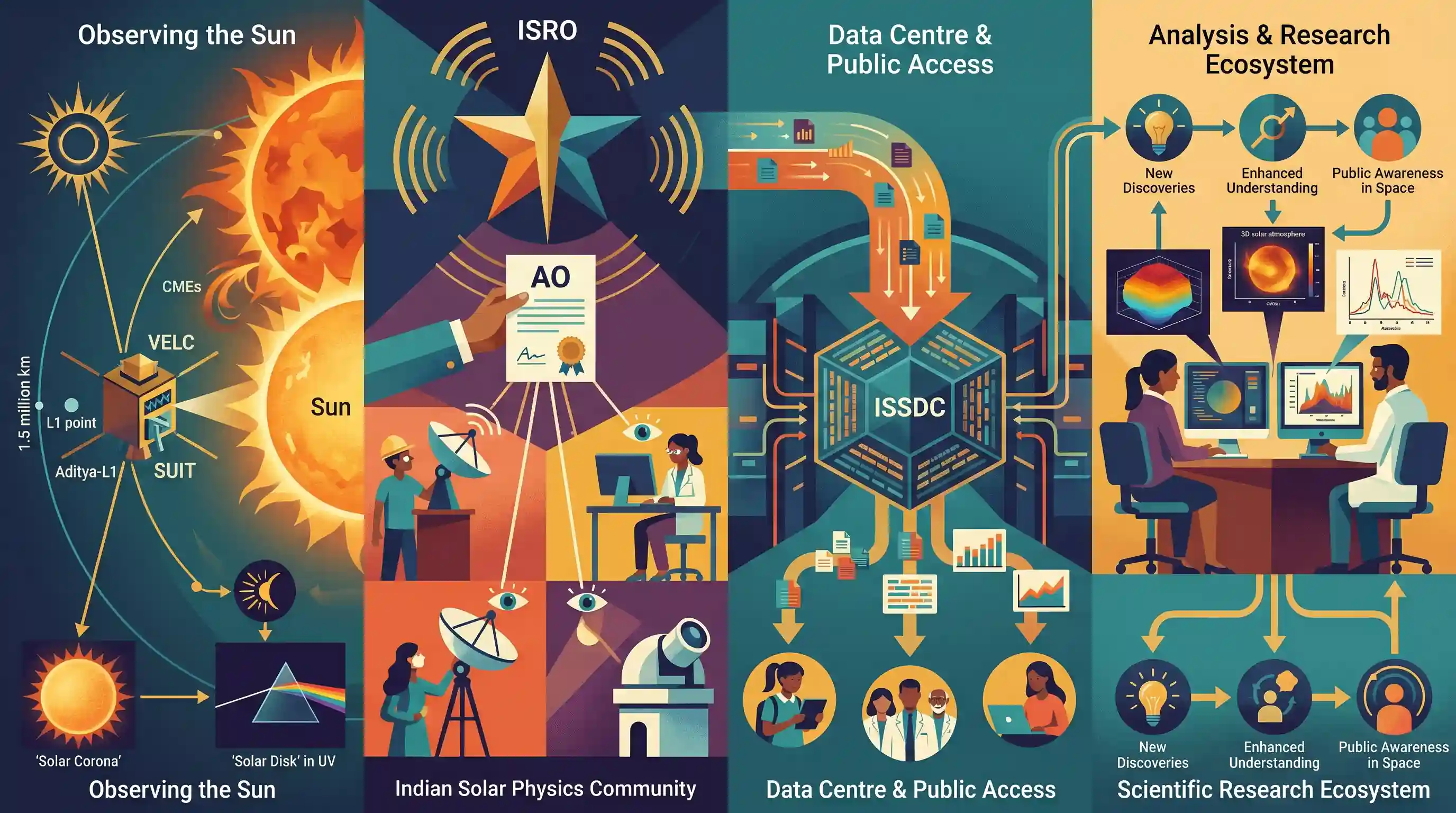
Why It Matters
Aditya-L1 is India's first dedicated solar observatory. Understanding its key payloads (VELC and SUIT) and the overarching phenomena they study (solar flares, coronal mass ejections) is crucial for Prelims. Furthermore, ISRO's efforts to democratize space data for the wider scientific community highlight the decentralization of research infrastructure, a relevant theme for Mains GS3.
Summary
ISRO has invited proposals from the Indian solar physics community to analyze observational data from the Aditya-L1 mission. This second Announcement of Opportunity (AO) focuses on utilizing data from the Visible Emission Line Coronagraph (VELC) and Solar Ultra-violet Imaging Telescope (SUIT) payloads, which are accessible to the public via the Indian Space Science Data Centre (ISSDC).
Key Points
- ISRO has issued its second Announcement of Opportunity (AO) inviting the Indian solar physics community to analyze data from the Aditya-L1 mission.
- The proposals specifically target the utilization of observation time from two major payloads: the Visible Emission Line Coronagraph (VELC) and the Solar Ultra-violet Imaging Telescope (SUIT).
- Data generated by the Aditya-L1 mission is regularly released into the public domain and hosted at the Indian Space Science Data Centre (ISSDC).
- This initiative represents ISRO's commitment to democratizing space data and fostering broader scientific research and capacity building within India's academic institutions.
Important Terms
Aditya-L1 mission

India's first dedicated space-based observatory launched by ISRO to study the Sun's atmosphere, including the corona, photosphere, and chromosphere, from a halo orbit around the L1 point.
UPSC context
GS Paper III (Science & Technology); focuses on indigenous technological achievements, space exploration, and understanding solar phenomena affecting Earth's space weather.
Lagrange Point 1 (L1)
A gravitationally stable position in space between the Earth and the Sun where a satellite can stay with minimal fuel, offering an uninterrupted view of the Sun.
UPSC context
GS Paper III (Space Technology); tests conceptual understanding of orbital mechanics and strategic placement of astronomical observatories.
Announcement of Opportunity (AO)
A formal call by ISRO inviting the scientific community to submit research proposals for analyzing data or developing instruments for space missions to maximize scientific outcomes.
UPSC context
GS Paper III (Science & Technology); relates to the scientific research ecosystem and institutional mechanisms for academic-industry-government collaboration.
Visible Emission Line Coronagraph (VELC)
The primary payload on Aditya-L1 designed to image the solar corona and study its dynamics, such as Coronal Mass Ejections (CMEs), in visible light.
UPSC context
GS Paper III (Space Technology); tests knowledge of specific mission payloads and their scientific objectives in studying solar activity.
Solar Ultra-violet Imaging Telescope (SUIT)
A payload on Aditya-L1 that captures images of the solar disk in near-ultraviolet wavelengths to study the photosphere and chromosphere and measure solar irradiance variations.
UPSC context
GS Paper III (Space Technology); relevant for understanding how multi-wavelength observations contribute to predicting space weather.
Indian Space Science Data Centre (ISSDC)
ISRO's primary ground-segment facility in Bangalore responsible for processing, archiving, and disseminating payload data from Indian space science missions to researchers and the public.
UPSC context
GS Paper III (Science & Technology); important for understanding India's space data infrastructure and open scientific research.
Prelims Trap
Data generated by the Aditya-L1 mission is highly classified and accessible exclusively to ISRO scientists for security reasons.
ISRO actively democratizes mission data through the Indian Space Science Data Centre (ISSDC) via the AO mechanism, allowing Indian academic and non-governmental researchers to analyze it.
Static Concepts Connected
Why are Lagrange Points, specifically L1, chosen for solar observation missions?
- Gravitational Equilibrium: Positions in space where the gravitational forces of a two-body system (like Sun-Earth) equal the centripetal force required for a small object to move with them, creating stable orbits.
- Uninterrupted View: A halo orbit around the L1 point (1.5 million km from Earth) allows continuous solar observation absolutely free from eclipses or planetary occultations.
What do the VELC and SUIT payloads on the Aditya-L1 mission observe?
- VELC (Coronagraph): Studies the solar corona (outermost layer) and the dynamics of Coronal Mass Ejections (CMEs) by artificially blocking the Sun's glaring disk.
- SUIT (Telescope): Captures high-resolution images of the solar photosphere and chromosphere in near Ultraviolet (UV) to measure solar irradiance variations.
Cross-Topic Patterns
Solar Storms & Critical Infrastructure
Solar observation data links directly to disaster management. Predicting Coronal Mass Ejections (CMEs) is vital to protect terrestrial power grids, GPS, and aviation from geomagnetic storms.
Space Policy & Data Democratisation
ISRO's Announcement of Opportunity (AO) reflects the Indian Space Policy 2023 mandate to transition ISRO toward core R&D while opening space assets and scientific data to academia and non-governmental entities.

Expect a 2026 prelims matching question pairing Aditya-L1 payloads (VELC, SUIT) with their target solar layers (Corona, Chromosphere).
Linked PYQs · 3
Linked PYQs · 3
- 2025PrelimsGS1
Consider the following statements : Statement I: Scientific studies suggest that a shift is taking place in the Earth's rotation and axis. Statement II: Solar flares and associated coronal mass ejections bombarded the Earth's outermost atmosphere with tremendous amount of energy. Statement III : As the Earth's polar ice melts, the water tends to move towards the equator. Which one of the following is correct in respect of the above statements?
- 2016MainsGS3
Discuss India's achievements in the field of Space Science and Technology. How the application of this technology has helped India in its socio-economic development?
- 2023MainsGS3
What is the main task of India's third moon mission which could not be achieved in its earlier mission? List the countries that have achieved this task. Introduce the subsystems in the spacecraft launched and explain the role of the Virtual Launch Control Centre' at the Vikram Sarabhai Space Centre which contributed to the successful launch from Sriharikota.
