ISRO Invites Proposals for Venus Orbiter Mission Archival Data
Source:The Hindu ↗
Why It Matters
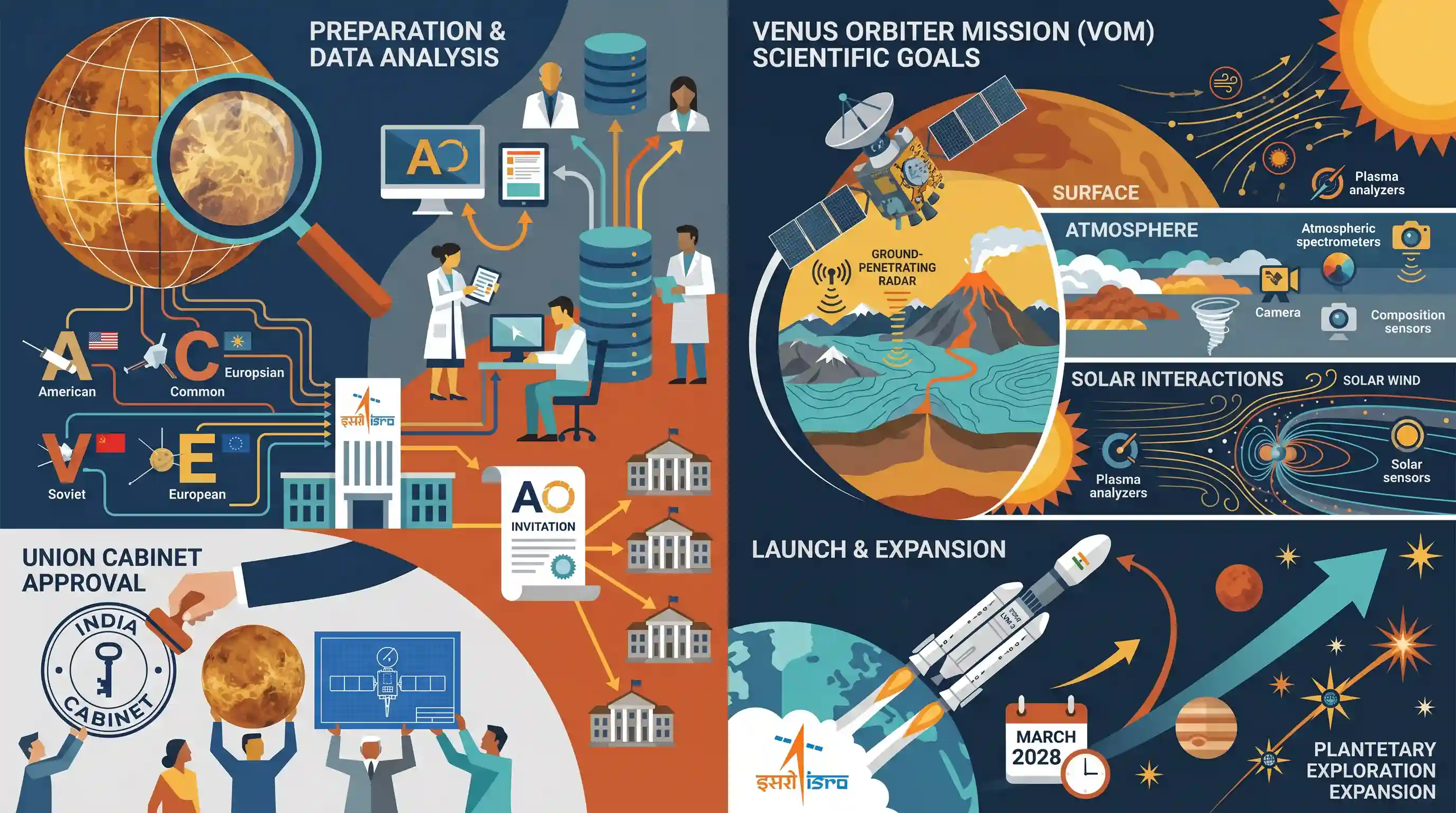
Understanding Venus, often called Earth's twin, helps scientists comprehend planetary evolution, extreme greenhouse effects, and atmospheric dynamics. The Venus Orbiter Mission will bolster India's position in global space exploration, following successes in lunar (Chandrayaan) and Martian (Mangalyaan) missions.
Summary
In preparation for India's upcoming Venus Orbiter Mission (VOM), ISRO has issued an Announcement of Opportunity (AO) inviting Indian scientists to analyze archival data from past international Venus missions. The VOM, approved by the Union Cabinet, aims to study the surface, atmosphere, and solar interactions of Venus. Scheduled for a March 2028 launch using the LVM-3 rocket, the mission represents ISRO's continued expansion into interplanetary exploration.
Key Points
- ISRO has invited Indian scientists to analyze archival data from past international Venus missions.
- This data analysis aims to build scientific expertise ahead of India's maiden Venus Orbiter Mission (VOM), approved by the Union Cabinet.
- VOM is targeted for launch in March 2028 using the Launch Vehicle Mark-3 (LVM-3) rocket.
- Research areas for VOM include Venusian morphology, surface composition, atmospheric dynamics, and the planet's interaction with solar winds.
Important Terms
Venus Orbiter Mission (VOM)

India's first interplanetary mission to Venus, scheduled for 2028. It aims to study the planet’s surface topography, atmospheric chemistry, and solar interactions using scientific payloads.
UPSC context
GS Paper 3: Science and Technology (Space); tests knowledge of India's planetary exploration roadmap and indigenous technological capabilities.
Announcement of Opportunity (AO)
A formal solicitation mechanism used by ISRO to invite researchers and institutions to propose scientific experiments, payloads, or data analysis projects for upcoming or past missions.
UPSC context
GS Paper 3: Science and Technology; relates to ISRO’s institutional framework and collaborative scientific research models.
LVM-3 (Launch Vehicle Mark-3)
India's most powerful three-stage heavy-lift rocket, formerly known as GSLV Mk III. It features two solid strap-on motors, a liquid core stage, and a cryogenic upper stage.
UPSC context
GS Paper 3: Science and Technology; crucial for understanding India's launch capabilities for heavy satellites and deep-space missions.
ISRO (Indian Space Research Organisation)
India’s premier space agency under the Department of Space. It designs and executes the national space programme, focusing on planetary exploration, satellite communication, and disaster management.
UPSC context
GS Paper 3: Science and Technology; primary agency for all space-related developments and institutional questions.
Union Cabinet
The highest executive body of the Indian government, chaired by the Prime Minister. It provides the final administrative and financial approval for major national projects like space missions.
UPSC context
GS Paper 2: Polity and Governance; tests understanding of the executive decision-making process for strategic sectors like space.
Prelims Trap
"Like India's Mars Orbiter Mission (Mangalyaan), the Venus Orbiter Mission will be launched using the PSLV."
Aspirants often assume ISRO relies on the PSLV for planetary slingshots due to Mangalyaan's success, but VOM requires the heavier LVM-3.
Static Concepts Connected
What makes Venus physically distinct from Earth despite being called its "twin"?
- Unique Rotation: It has a retrograde rotation (spins East to West). A single Venusian day (243 Earth days) is actually longer than its year (225 Earth days).
- Extreme Greenhouse: A dense atmosphere of ~96% carbon dioxide creates a "runaway greenhouse effect," making it the hottest planet in the solar system.
- Sulfuric Clouds: Thick, highly reflective clouds of sulfuric acid obscure the surface, meaning missions must rely on synthetic aperture radars rather than optical cameras.
What are the key technical features of ISRO's LVM-3 rocket?
- Three-Stage Design: It is India's heaviest operational three-stage launch vehicle, utilizing solid boosters, a liquid core stage, and a cryogenic upper stage.
- Payload Capacity: It can place up to 4,000 kg into a Geosynchronous Transfer Orbit (GTO) and 8,000 kg into a Low Earth Orbit (LEO).
Cross-Topic Patterns
Venusian greenhouse & Earth's climate models
Studying Venus's runaway greenhouse effect (96% CO2) provides critical extreme-scenario models for understanding Earth's long-term anthropogenic climate change and atmospheric dynamics.
Shift from PSLV to LVM-3 payloads
Moving interplanetary launches from PSLV (Mangalyaan) to LVM-3 (VOM) highlights ISRO's growing heavy-lift capacity, allowing for substantially heavier planetary scientific payloads.

A 2026 prelims question will likely contrast Venusian characteristics (retrograde rotation, day length, CO2) with Earth/Mars.
Linked PYQs · 2
Linked PYQs · 2
- 2014PrelimsGS1
Which of the following pairs is/are correctly matched? Spacecraft Purpose 1. Cassini-Huygens : Orbiting the Venus and transmitting data to the Earth 2. Messenger : Mapping and investigating the Mercury 3. Voyager 1 and 2 : Exploring the outer solar system Select the correct answer using the code given below.
- 2023MainsGS3
What is the main task of India's third moon mission which could not be achieved in its earlier mission? List the countries that have achieved this task. Introduce the subsystems in the spacecraft launched and explain the role of the Virtual Launch Control Centre' at the Vikram Sarabhai Space Centre which contributed to the successful launch from Sriharikota.
