ISRO Technology Transfer of SSLV to HAL and L&T Consortium
Source:The Hindu ↗
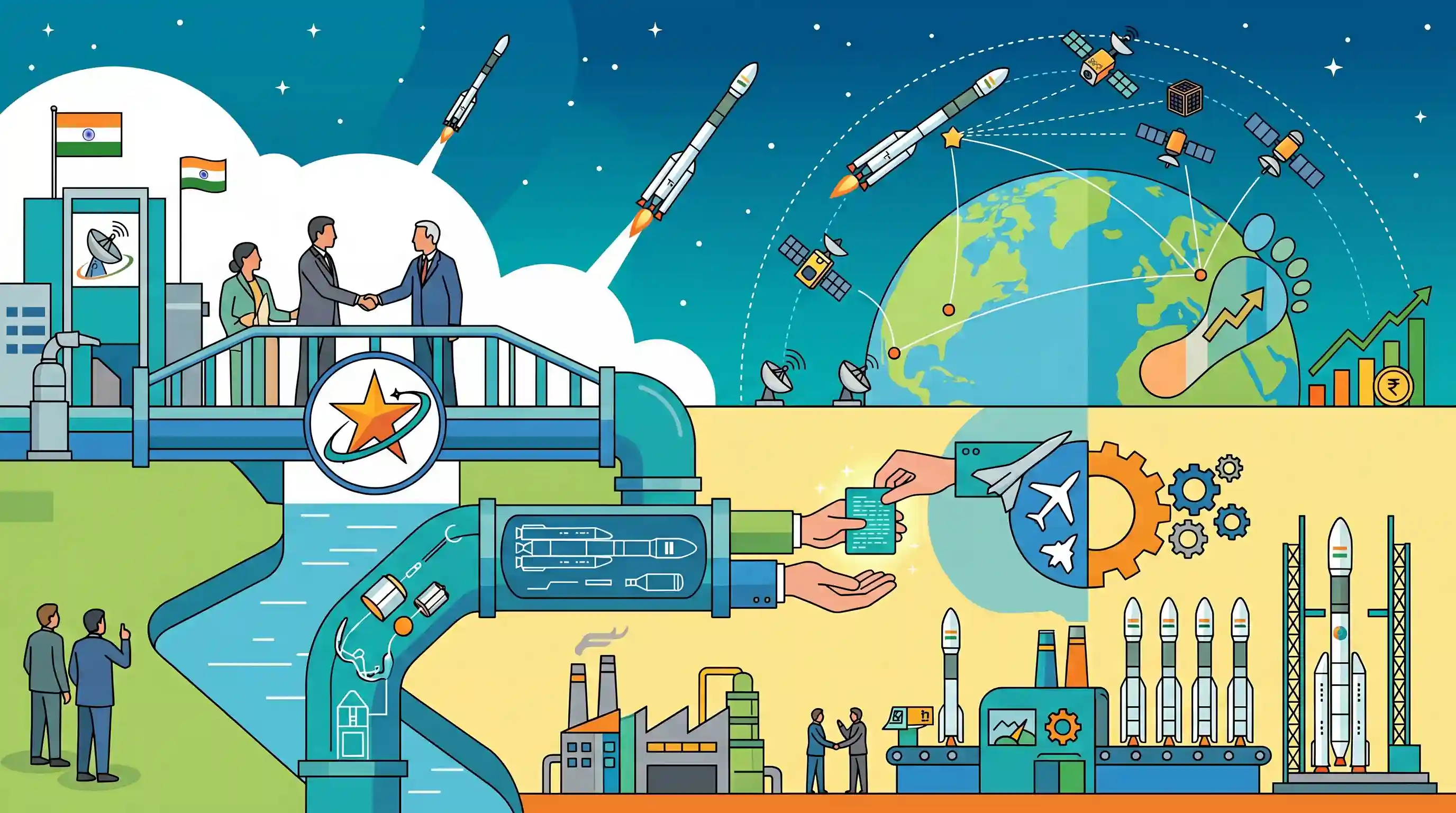
Why It Matters
This is a watershed moment for India's space sector reforms, demonstrating the transition from an ISRO-dominated ecosystem to robust private sector participation. It enhances India's launch-on-demand capability for the booming small satellite market, which is crucial for increasing the country's share in the global space economy.
Summary
The Indian Space Research Organisation (ISRO) has inked a landmark agreement with Hindustan Aeronautics Limited (HAL) and Larsen & Toubro (L&T) to transfer the technology for manufacturing the Small Satellite Launch Vehicle (SSLV). Mediated by IN-SPACe, this represents the first complete transfer of an Indian satellite launch vehicle to the private sector, signifying a major shift towards space commercialization. The HAL-L&T consortium won the rights over competitors like the Adani Group. This move will enable private mass production of the SSLV, which is tailored for launching small satellites into Low Earth Orbit quickly and economically, thereby expanding India's footprint in the global space economy.
Key Points
- ISRO has formally agreed to transfer the complete technology of the Small Satellite Launch Vehicle (SSLV) to a consortium led by Hindustan Aeronautics Limited (HAL) and Larsen & Toubro (L&T).
- Facilitated by the space sector regulator IN-SPACe, this marks the first instance of ISRO transferring an entire launch vehicle system to the private sector.
- The HAL-led consortium successfully outbid an Adani Group-backed consortium to secure the manufacturing rights.
- The technology transfer aligns with India's space sector reforms, aimed at encouraging private industry participation and capturing a larger share of the global commercial space market.
- The SSLV is designed to offer cost-effective and rapid launch-on-demand capabilities for small satellites (up to 500 kg into Low Earth Orbit), complementing India's existing PSLV and LVM3 fleets.
Important Terms
Small Satellite Launch Vehicle (SSLV)

A three-stage, all-solid launch vehicle designed by ISRO for rapid, cost-effective deployment of small satellites (up to 500 kg) into Low Earth Orbit.
UPSC context
GS Paper 3 (Space Technology); tests knowledge of indigenous launch systems and space commercialization efforts.
IN-SPACe
An autonomous, single-window nodal agency under the Department of Space that facilitates and regulates private sector participation in the Indian space industry.
UPSC context
GS Paper 2/3 (Governance/Space Reforms); tests understanding of regulatory bodies and private sector integration.
NewSpace India Limited (NSIL)
The commercial arm of ISRO tasked with productionizing launch vehicles through industry and marketing space-based services to global customers on a demand-driven basis.
UPSC context
GS Paper 3 (Economy/Space); tests awareness of institutional roles in the commercial exploitation of space technology.
Hindustan Aeronautics Limited (HAL)
A premier Indian state-owned aerospace and defense company responsible for designing and manufacturing aircraft, helicopters, and critical space mission components.
UPSC context
GS Paper 3 (Indigenization of Technology); highlights PSU roles in strategic technology absorption and Atmanirbharta.
ISRO
India’s primary space agency under the Department of Space, mandated with space research, planetary exploration, and the development of indigenous satellite and launch technologies.
UPSC context
GS Paper 3 (Science and Technology); the foundational entity for all space-related current affairs questions.
Technology Transfer (ToT)
The process of sharing technical know-how, manufacturing designs, and operational expertise from a research body (like ISRO) to an industrial partner for mass production.
UPSC context
GS Paper 3 (Technology Indigenization); essential for understanding how public R&D fuels industrial growth.
Low Earth Orbit (LEO)
An orbit around Earth at an altitude between 160 to 2,000 km, ideal for imaging, communication, and constellations like those launched by the SSLV.
UPSC context
GS Paper 3 (Space Science); tests basic scientific concepts of orbital dynamics and satellite applications.
Larsen & Toubro (L&T)
A major Indian private multinational conglomerate with a significant presence in high-tech engineering, manufacturing space hardware, and developing launch vehicle stages.
UPSC context
GS Paper 3 (PPP/Industry); represents private sector maturity in high-stakes strategic sectors.
Prelims Trap
"NSIL is the regulatory authority that authorized and facilitated the complete SSLV technology transfer."
IN-SPACe is the regulatory agency that facilitated this transfer. NSIL is ISRO's commercial arm. UPSC frequently swaps their distinct mandates in multi-statement questions.
Static Concepts Connected
What are the structural and operational differences between SSLV and PSLV?
- Propulsion Stages: SSLV features three solid stages and a liquid Velocity Trimming Module (VTM); PSLV has four alternating solid and liquid stages.
- Payload Capacity: SSLV can place up to 500 kg into a 500 km Low Earth Orbit (LEO), whereas PSLV can lift approximately 1,750 kg to Sun-Synchronous Orbit (SSO).
- Turnaround Time: SSLV is designed for 'launch-on-demand' with assembly taking just a few days, unlike PSLV which requires weeks or months to integrate.
What are the distinct roles of IN-SPACe and NSIL under India's space reform architecture?
- IN-SPACe: Autonomous single-window nodal agency under DoS that regulates, authorizes, and promotes non-governmental entities in space activities.
- NSIL: A CPSE functioning as ISRO's commercial arm, responsible for strategic activities, tech transfers, and demand-driven launch services.
- ISRO's New Mandate: Focuses strictly on advanced R&D, deep space exploration, and human spaceflight, delegating routine operations to private/commercial sectors.
Cross-Topic Patterns
Defense PSUs + Space Commercialization
HAL's leadership in this consortium highlights the growing synergy between defense public sector capabilities and private space commercialization, driven by the broader "Make in India" and self-reliance initiatives.
Space Policy 2023 & State Demobilization
This transfer operationalizes the Indian Space Policy 2023 framework, which transitions ISRO away from routine manufacturing towards pure R&D, leaving LEO exploitation to private entities.

Expect a Prelims question swapping the mandates of IN-SPACe and NSIL, paired with SSLV's 3-stage solid + liquid VTM propulsion specs.
Linked PYQs · 3
Linked PYQs · 3
- 2018PrelimsGS1
With reference to India's satellite launch vehicles, consider the following statements: 1. PSLVs launch the satellites useful for Earth resources monitoring whereas GSLVs are designed mainly to launch communication satellites. 2. Satellites launched by PSLV appear to remain permanently fixed in the same position in the sky, as viewed from a particular location on Earth. 3. GSLV Mk III is a four-staged launch vehicle with the first and third stages using solid rocket motors; and the second and fourth stages using liquid rocket engines. Which of the statements given above is/are correct?
- 2016MainsGS3
Discuss India's achievements in the field of Space Science and Technology. How the application of this technology has helped India in its socio-economic development?
- 2023MainsGS3
What is the main task of India's third moon mission which could not be achieved in its earlier mission? List the countries that have achieved this task. Introduce the subsystems in the spacecraft launched and explain the role of the Virtual Launch Control Centre' at the Vikram Sarabhai Space Centre which contributed to the successful launch from Sriharikota.
