ISRO SSLV Technology Transfer to HAL for Space Commerce
Source:The Hindu ↗
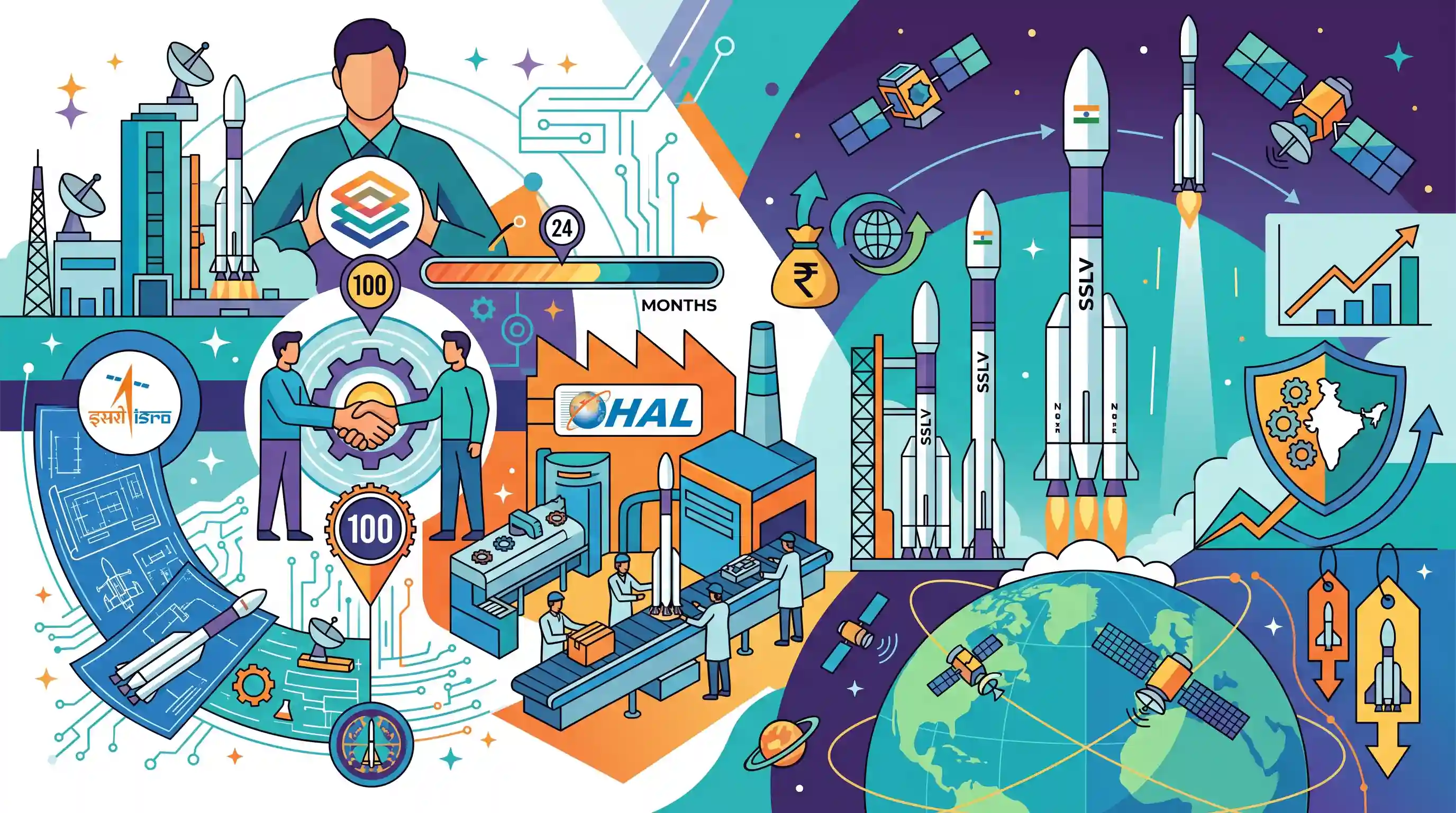
Why It Matters
The technology transfer of ISRO's SSLV to a defense PSU (HAL) marks a critical transition in India's space strategy, shifting routine launch vehicle manufacturing to the industry. It exemplifies the practical execution of India's space sector reforms aimed at boosting private and PSU participation, increasing global market share in commercial launches, and making India self-reliant in small satellite deployments.
Summary
The Indian Space Research Organisation (ISRO) has signed an agreement with Hindustan Aeronautics Limited (HAL) for the complete transfer of Small Satellite Launch Vehicle (SSLV) technology. Facilitated by IN-SPACe and NSIL, this pact aims to enable HAL to independently manufacture SSLVs over a 24-month period with ISRO's training and technical support. HAL secured the deal by outbidding an Adani Group-backed consortium. This milestone—the 100th technology transfer authorized by IN-SPACe—highlights India's push towards commercialising its space sector and establishing a self-reliant domestic ecosystem capable of offering affordable small-satellite launch services globally.
Key Points
- ISRO has signed a formal agreement to transfer the technology for its Small Satellite Launch Vehicle (SSLV) to Hindustan Aeronautics Limited (HAL).
- This represents the 100th technology transfer agreement facilitated by IN-SPACe, marking a milestone in India's space commercialisation efforts.
- HAL outbid a consortium led by Adani Group-backed Alpha Design Technologies to win this technology transfer contract.
- The complete transfer of technology, including training and technical support from ISRO to HAL, is expected to be completed within 24 months.
- The agreement aims to empower HAL to independently manufacture and offer cost-competitive, reliable SSLV launches for domestic and international markets, reinforcing India's position as a global space hub.
Important Terms
Small Satellite Launch Vehicle (SSLV)

A three-stage all-solid launch vehicle (with a liquid terminal stage) designed by ISRO for cost-effective, on-demand launching of small satellites (up to 500kg) into Low Earth Orbit.
UPSC context
GS-III: Science & Tech (Space awareness). Tests understanding of indigenous launch capabilities and small-satellite market dynamics.
IN-SPACe
An autonomous nodal agency under the Department of Space that acts as a single-window regulator and promoter for non-governmental entities in India's space sector.
UPSC context
GS-III: Science & Tech (Space Reforms). Vital for questions on private sector participation and regulatory frameworks.
NewSpace India Limited (NSIL)
A Central Public Sector Enterprise and ISRO's commercial arm responsible for transferring technologies to industry, building launch vehicles through Indian partners, and marketing space services globally.
UPSC context
GS-III: Science & Tech (Commercialisation). Relevant for space economy and industry-interface topics.
Hindustan Aeronautics Limited (HAL)
A premier Indian aerospace and defense PSU transitioning from a vendor to an end-to-end manufacturer of space launch vehicles like the SSLV.
UPSC context
GS-III: Science & Tech (Indigenization). Tests knowledge of Public Sector Undertakings' evolving role in high-tech sectors.
Alpha Design Technologies
A leading private aerospace firm that led the Adani-backed consortium in the SSLV bidding process, representing the growing competitive landscape of India's private space industry.
UPSC context
GS-III: Science & Tech. Highlights private sector competition and the shift toward fully privatized launch operations.
Prelims Trap
"NSIL is the single-window nodal agency mandated to authorize and supervise the space activities of private entities."
This mixes up the institutions. IN-SPACe is the regulatory/authorizing body for private space activities, while NSIL is the commercial arm handling technology transfers and manufacturing.
Static Concepts Connected
How does the SSLV differ from the PSLV in design and utility?
- Propulsion:: SSLV uses three solid stages and a liquid Velocity Trimming Module (VTM). PSLV uses four alternating solid and liquid stages.
- Payload & Orbit:: SSLV is designed to place up to 500 kg in Low Earth Orbit (LEO). PSLV carries heavier payloads (>1000 kg) to various orbits including Sun-Synchronous.
- Turnaround time:: SSLV offers 'launch-on-demand' within days requiring minimal infrastructure, unlike PSLV which requires months of integration and heavy ground infrastructure.
What are the distinct roles of NSIL and IN-SPACe under India's Space Policy?
- NSIL:: The commercial arm of the Department of Space. It focuses on commercializing ISRO's R&D, transferring technologies (like the SSLV) to industry, and undertaking satellite launches.
- IN-SPACe:: An autonomous, single-window nodal agency established to promote, hand-hold, authorize, and supervise the space activities of Non-Governmental Entities (NGEs) and private players.
Cross-Topic Patterns
Space commercialization + PSU resurgence
HAL outbidding a private conglomerate (Adani) highlights a trend where traditional defense PSUs are expanding capabilities and actively competing in commercial deep-tech markets under the Atmanirbhar Bharat framework.
SSLV mass production + 100% Space FDI
The push to mass-produce the SSLV via industry transfer directly synergizes with the 2024 FDI amendments, which permit up to 100% foreign investment in satellite manufacturing and launch vehicle operations.

Expect a 2026 Prelims question mixing the institutional mandates of IN-SPACe vs NSIL with the technical configuration of the SSLV.
Linked PYQs · 3
Linked PYQs · 3
- 2018PrelimsGS1
With reference to India's satellite launch vehicles, consider the following statements: 1. PSLVs launch the satellites useful for Earth resources monitoring whereas GSLVs are designed mainly to launch communication satellites. 2. Satellites launched by PSLV appear to remain permanently fixed in the same position in the sky, as viewed from a particular location on Earth. 3. GSLV Mk III is a four-staged launch vehicle with the first and third stages using solid rocket motors; and the second and fourth stages using liquid rocket engines. Which of the statements given above is/are correct?
- 2016MainsGS3
Discuss India's achievements in the field of Space Science and Technology. How the application of this technology has helped India in its socio-economic development?
- 2019MainsGS3
What is India's plan to have its own space station and how will it benefit our space programme?
