ISRO Transfers SSLV Technology to HAL for Commercialization
Source:The Hindu ↗
Why It Matters
This development highlights the practical implementation of India's space sector reforms aimed at privatization and commercialization. The roles of newly formed entities like IN-SPACe and NSIL in transferring critical launch vehicle technologies (like SSLV) to domestic industries are highly relevant for UPSC GS Paper 3 (Science & Technology and Indigenization of Technology).
Summary
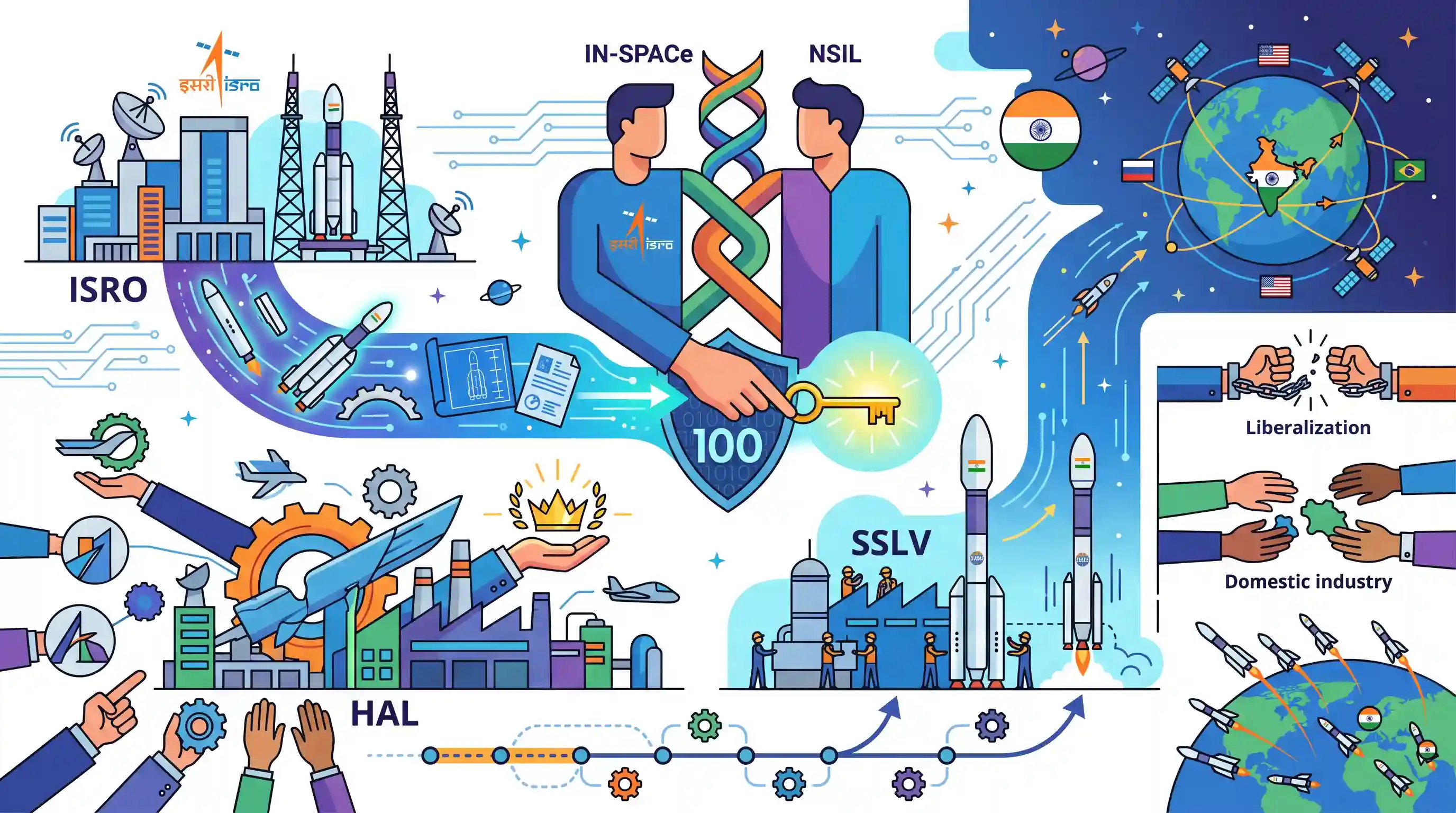
ISRO has signed a milestone agreement with Hindustan Aeronautics Limited (HAL) to transfer its Small Satellite Launch Vehicle (SSLV) technology. Facilitated by IN-SPACe and NSIL, this marks the 100th tech-transfer agreement under IN-SPACe's mandate. HAL won the bid against a private consortium and is expected to complete the technology absorption within 24 months. This transfer is a significant step in liberalizing India's space sector, empowering domestic industries to handle launch operations and positioning India as a cost-effective destination for global commercial space launches.
Key Points
- ISRO has formalized a pact with HAL for the complete transfer of Small Satellite Launch Vehicle (SSLV) technology.
- The agreement, signed by ISRO, NSIL, IN-SPACe, and HAL, represents the 100th technology transfer facilitated by IN-SPACe.
- HAL secured the contract by outbidding a consortium led by Adani Group-backed Alpha Design Technologies.
- The technology transfer is scheduled to be completed over a 24-month period, enabling HAL to independently manufacture the SSLV.
- This move accelerates the liberalization of India's commercial space sector and strengthens the nation's position as an affordable global hub for small satellite launches.
Important Terms
IN-SPACe

An autonomous nodal agency under the Department of Space that acts as a single-window regulator and facilitator for private sector participation in India's space activities.
UPSC context
GS Paper III (Science & Technology); critical for questions on space sector liberalization and the 'Space 2.0' regulatory framework.
NewSpace India Limited (NSIL)
The commercial arm of ISRO and a Central Public Sector Enterprise tasked with marketing space products, building satellites via industry, and handling technology transfers.
UPSC context
GS Paper III (Science & Technology); focuses on the commercialization of space and the role of PSUs in industrial scaling.
Small Satellite Launch Vehicle (SSLV)
A three-stage solid-fuel rocket designed by ISRO to carry satellites up to 500kg into Low Earth Orbit, featuring low cost and rapid turnaround.
UPSC context
GS Paper III (Science & Technology); significant for topics like 'launch-on-demand' capabilities and global commercial space market competition.
ISRO
India's primary space agency responsible for research, planetary exploration, and developing space infrastructure, currently shifting its focus toward R&D by transferring operational tech to industry.
UPSC context
GS Paper III (Science & Technology); fundamental body for all space-related developments and indigenization of technology.
Hindustan Aeronautics Limited (HAL)
A state-owned aerospace and defense giant that recently became the first entity to receive a complete launch vehicle technology transfer (SSLV) for commercial production.
UPSC context
GS Paper III (Internal Security/Economy); tests knowledge of Public Sector Undertakings (PSUs) and their role in strategic technological self-reliance.
Prelims Trap
"SSLV is a completely solid-propelled launch vehicle with no liquid stages."
Aspirants miss that while the SSLV's three main stages are solid, its terminal stage (Velocity Trimming Module) uses liquid propulsion.
Static Concepts Connected
What is the institutional architecture of India's commercial space sector?
- IN-SPACe: An autonomous, single-window nodal agency under the Department of Space to authorize, supervise, and regulate private space activities.
- NSIL: ISRO's commercial arm responsible for technology transfers, providing launch services, and overseeing industry production of vehicles like SSLV.
- ISRO: Under the 2023 Space Policy, ISRO shifts away from routine manufacturing to focus on advanced R&D and deep space exploration.
How does the Small Satellite Launch Vehicle (SSLV) differ from the PSLV?
- Payload Capacity: SSLV places up to 500 kg in 500 km LEO; PSLV handles up to 1,750 kg to Sun-Synchronous Polar Orbits.
- Turnaround Time: SSLV enables "launch-on-demand" within 72 hours with minimal infrastructure, compared to the months required for PSLV integration.
- Stage Configuration: SSLV uses three solid stages and a liquid terminal module (VTM), whereas PSLV relies on four alternating solid and liquid stages.
Cross-Topic Patterns
Dual-use tech and defense PSUs
HAL's acquisition of SSLV tech highlights the growing synergy between civilian space commercialization and defense manufacturing capabilities, aligning with India's broader push for aerospace indigenization.
LEO constellations and the space internet race
SSLV's rapid-turnaround model caters directly to the booming global demand for Low Earth Orbit (LEO) micro-satellites, which are crucial for broadband internet constellations and earth observation startups.

Expect a 2026 Prelims question contrasting SSLV's stage design with the distinct regulatory vs. commercial roles of IN-SPACe and NSIL.
Linked PYQs · 3
Linked PYQs · 3
- 2018PrelimsGS1
With reference to India's satellite launch vehicles, consider the following statements: 1. PSLVs launch the satellites useful for Earth resources monitoring whereas GSLVs are designed mainly to launch communication satellites. 2. Satellites launched by PSLV appear to remain permanently fixed in the same position in the sky, as viewed from a particular location on Earth. 3. GSLV Mk III is a four-staged launch vehicle with the first and third stages using solid rocket motors; and the second and fourth stages using liquid rocket engines. Which of the statements given above is/are correct?
- 2019MainsGS3
What is India's plan to have its own space station and how will it benefit our space programme?
- 2016MainsGS3
Discuss India's achievements in the field of Space Science and Technology. How the application of this technology has helped India in its socio-economic development?
