ISRO Identifies Mons Mouton Region for Chandrayaan 4 Landing Site
Source:The Hindu ↗
Why It Matters
Chandrayaan-4 marks India's transition from lunar exploration to sample-return capabilities, signifying a major leap in space technology. It demonstrates advanced multi-module spacecraft operations and solidifies ISRO's position in global space exploration.
Summary
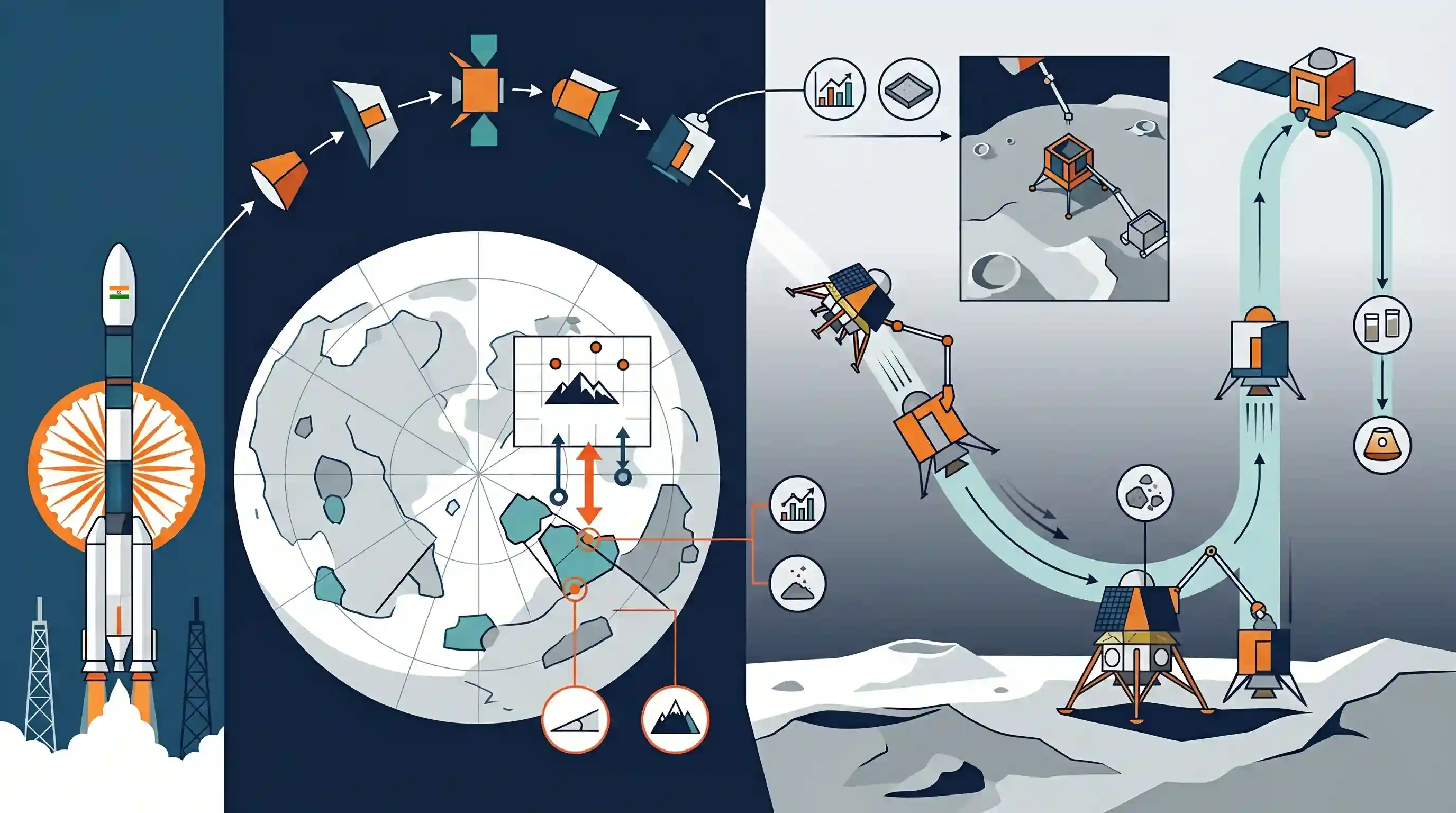
ISRO has identified the Mons Mouton (MM) region near the Moon's South Pole as the landing site for the Chandrayaan-4 mission, India's first lunar sample-return endeavor slated for 2028. After analyzing multiple potential sites using high-resolution imagery, scientists selected the MM-4 sub-region due to its minimal hazards, favorable slope (5 degrees), and high altitude. The mission will utilize a complex five-module architecture, with the Descender and Ascender modules handling the critical soft landing and sample extraction processes.
Key Points
- ISRO has finalized the Mons Mouton (MM) region near the lunar South Pole as the landing site for the upcoming Chandrayaan-4 sample-return mission.
- The specific site selected is MM-4, which was chosen using high-resolution Orbiter High Resolution Camera (OHRC) multi-view image datasets.
- MM-4 was deemed optimal because it has the least hazardous percentage, a mean slope of 5 degrees, and a mean height of 5,334 metres.
- Chandrayaan-4 is a complex mission slated for 2028, consisting of five modules: Propulsion Module (PM), Descender Module (DM), Ascender Module (AM), Transfer Module (TM), and Re-entry Module (RM).
- The combined Descender Module (DM) and Ascender Module (AM) stack is responsible for soft-landing on the Moon's surface to collect samples.
Important Terms
Chandrayaan-4

India's fourth lunar mission, planned for 2028 as a complex sample-return endeavor targeting the Moon's South Polar region.
UPSC context
GS Paper 3: Science & Tech; focuses on indigenous space milestones and mission architectures.
Sample-return mission
A mission designed to collect physical material (rocks/soil) from a celestial body and transport it back to Earth for advanced laboratory analysis.
UPSC context
GS Paper 3: Space Technology; tests understanding of complex orbital maneuvers and deep-space capabilities.
Mons Mouton
A large, flat-topped lunar mountain massif near the South Pole, selected as the landing site for Chandrayaan-4 due to favorable terrain.
UPSC context
Prelims: Current Events/Geography; tests awareness of specific lunar landing sites and topographic features.
Lunar South Pole
A strategic lunar region containing permanently shadowed craters likely harboring water ice, a critical resource for future human exploration.
UPSC context
GS Paper 3: Science & Tech; examines the strategic and scientific significance of lunar resource exploration.
Orbiter High Resolution Camera (OHRC)
A precision imaging instrument aboard the Chandrayaan-2 orbiter used to capture sub-metre resolution imagery for identifying safe landing zones.
UPSC context
Prelims: Science & Tech; tests knowledge of specific payloads and their roles in Indian space missions.
ISRO
The premier national space agency of India, mandated with planning and executing the country's space program and planetary research.
UPSC context
GS Paper 3: Science & Tech; foundational knowledge of India’s primary scientific institutions and technological autonomy.
Prelims Trap
All five modules of Chandrayaan-4 will soft-land on the lunar surface to collect samples.
Only the Descender Module (DM) and Ascender Module (AM) stack soft-lands. The Propulsion, Transfer, and Re-entry modules remain in orbit for transit and Earth-return.
Static Concepts Connected
What are the standard components of a lunar sample-return mission architecture?
- Descender (Lander): Safely navigates the descent and touches down on the lunar surface to perform drilling and sample collection.
- Ascender: Launches from the moon's surface back into lunar orbit, carrying the collected soil and rock samples.
- Transfer/Re-entry Module: Docks with the ascender in orbit, transfers the payload, and ferries the sample capsule back through Earth's atmosphere.
Why is the Moon's South Pole the primary target for modern space agencies?
- Water Ice: Permanently shadowed craters (cold traps) harbor ancient water ice, which is crucial for future life support and synthesizing rocket fuel.
- Unique Topography: Elevated peaks, such as Mons Mouton, receive near-constant sunlight, providing uninterrupted solar power for prolonged mission durations.
- Geological Record: The region preserves untouched material from the early solar system due to a lack of solar wind weathering in deep craters.
Cross-Topic Patterns
Artemis Accords vs ILRS geopolitics
India's independent lunar milestones bolster its leverage within the US-led Artemis Accords, acting as a strategic counterbalance to the China-Russia International Lunar Research Station (ILRS) in the new space race.
Autonomous robotics in space
The mission connects to broader AI and robotics themes, as the Ascender module requires autonomous orbital docking and precision robotic sample extraction without real-time human control due to communication delays.

Expect a 2026 Prelims question contrasting Chandrayaan-4's 5-module return architecture with Chandrayaan-3's lander-rover setup.
Linked PYQs · 3
Linked PYQs · 3
- 2023MainsGS3
What is the main task of India's third moon mission which could not be achieved in its earlier mission? List the countries that have achieved this task. Introduce the subsystems in the spacecraft launched and explain the role of the Virtual Launch Control Centre' at the Vikram Sarabhai Space Centre which contributed to the successful launch from Sriharikota.
- 2017MainsGS3
India has achieved remarkable successes in unmanned space missions including the Chandrayaan and Mars Orbitter Mission, but has not ventured into manned space missions. What are the main obstacles to launching a manned space mission, both in terms of technology and logistics? Examine critically.
- 2016PrelimsGS1
Consider the following statements: The Mangalyaan launched by ISRO 1. is also called the Mars Orbiter Mission 2. made India the second country to have a spacecraft orbit the Mars after USA 3. made India the only country to be successful in making its spacecraft orbit the Mars in its very first attempt Which of the statements given above is/are correct?
