ISRO identifies landing site for Chandrayaan four lunar mission
Source:The Hindu ↗
Why It Matters
Chandrayaan-4 represents a critical milestone in India's space program, transitioning from simple soft-landing capabilities (demonstrated in Chandrayaan-3) to executing a complex sample-return mission. This involves advanced technologies like precision descent, lunar surface ascent, and in-orbit docking, directly relevant to the GS-3 Science & Technology syllabus concerning indigenous technology development and achievements in space.
Summary
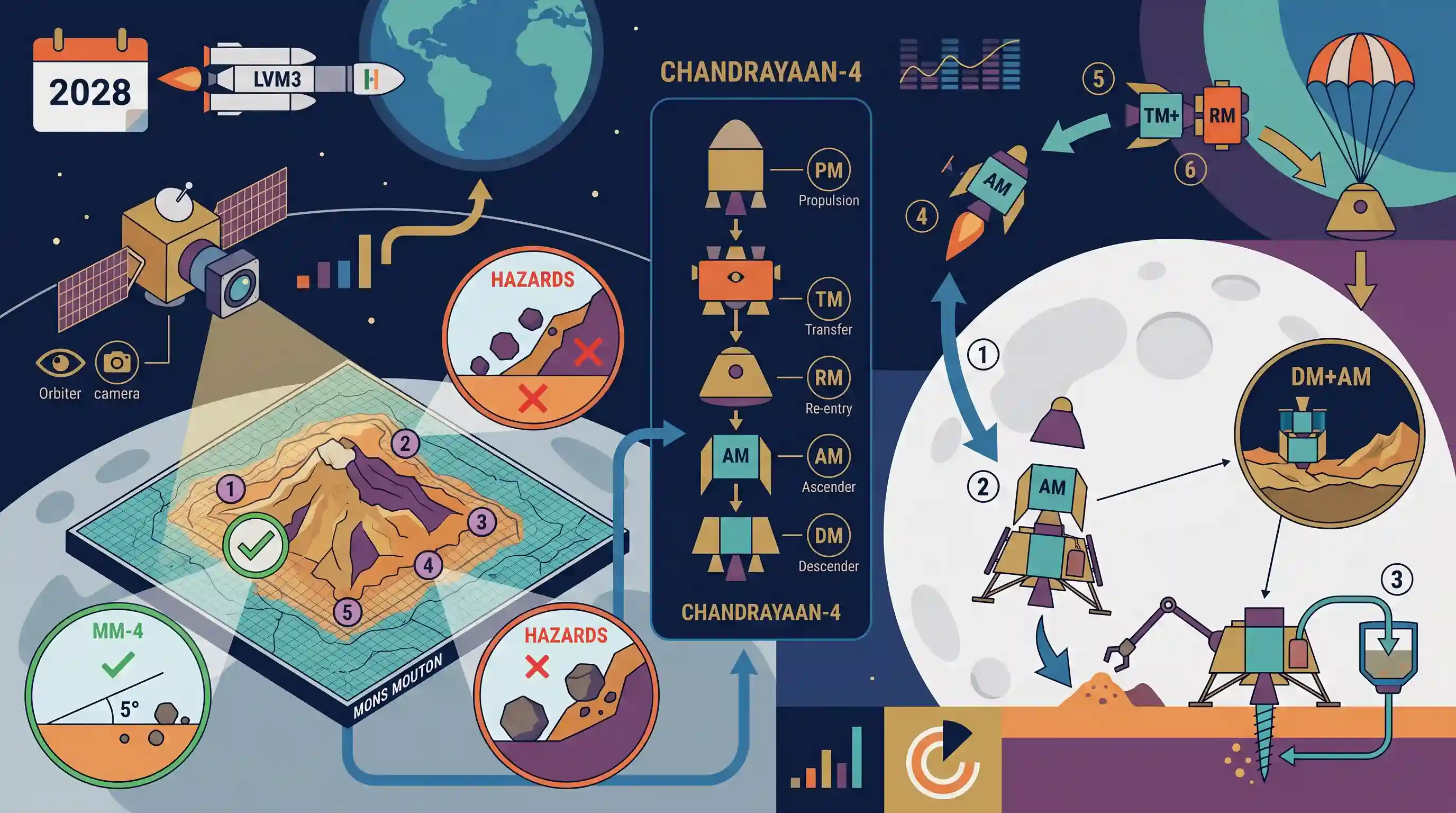
The Indian Space Research Organisation (ISRO) has pinpointed 'MM-4' in the Mons Mouton region near the Moon's South Pole as the designated landing site for the upcoming Chandrayaan-4 mission. Scheduled for 2028, this lunar sample-return mission will be India's most complex space endeavour to date. Using data from the Orbiter High Resolution Camera (OHRC), ISRO determined that MM-4 offers the safest terrain, featuring minimal hazards and an optimal slope. The spacecraft will employ a sophisticated five-module architecture, with a combined stack of Descender and Ascender modules responsible for executing the precise soft landing.
Key Points
- ISRO is targeting 2028 for the launch of Chandrayaan-4, which is designed as India's most complex lunar sample-return mission.
- The landing site has been identified as 'MM-4' in the Mons Mouton region near the Moon's South Pole, evaluated using data from the Orbiter High Resolution Camera (OHRC).
- MM-4 was selected because it features a low hazard percentage, a mean slope of 5 degrees, and the largest number of hazard-free grids (24m x 24m) for a safe landing.
- The spacecraft will feature five modules: Propulsion Module (PM), Descender Module (DM), Ascender Module (AM), Transfer Module (TM), and Re-entry Module (RM).
- The critical soft landing will be executed by a combined stack consisting of the Descender and Ascender Modules using advanced navigation, guidance, and control systems.
Important Terms
Chandrayaan-4

India’s fourth lunar mission and first sample-return venture, aiming to retrieve and return lunar regolith (soil) to Earth by 2028 using a modular architecture.
UPSC context
GS Paper III (Science & Tech); tests knowledge of India’s space program evolution and its global standing in deep-space exploration.
Mons Mouton
A high-altitude lunar massif near the South Pole, selected for Chandrayaan-4 due to its optimal sunlight, Earth-communication visibility, and 4-billion-year-old geological significance.
UPSC context
GS Paper III; tests knowledge of lunar geography and the strategic importance of the South Pole for resource and water-ice exploration.
Lunar Sample-Return Mission
A space mission designed to collect lunar surface material and return it to Earth. Only the US, Russia, and China have successfully achieved this feat.
UPSC context
GS Paper III; tests understanding of mission objectives and technical hurdles in interplanetary sample retrieval and atmospheric re-entry.
Orbiter High Resolution Camera (OHRC)
A high-precision imaging payload on Chandrayaan-2 providing 25cm-resolution imagery, used to identify hazard-free landing zones by mapping slopes and boulder distributions.
UPSC context
GS Paper III; tests awareness of indigenous payload technology and its role in ensuring the safety of robotic soft-landing missions.
In-orbit Docking
The complex maneuver of joining two spacecraft in space, essential for Chandrayaan-4 to transfer collected samples from the Ascender to the Re-entry module.
UPSC context
GS Paper III; tests technical understanding of advanced orbital mechanics required for sample return and the future Bharatiya Antariksh Station.
ISRO
India's premier space agency under the Department of Space, responsible for indigenous satellite launches, planetary exploration, and the Gaganyaan human spaceflight program.
UPSC context
GS Paper III; tests knowledge of the institutional framework driving India’s strategic and scientific advancement in global space technology.
Prelims Trap
Chandrayaan-4's entire five-module architecture will be launched simultaneously using a single heavy-lift LVM-3 rocket.
The heavy five-module payload (Propulsion, Descender, Ascender, Transfer, Re-entry) necessitates multiple rocket launches and complex Earth-orbit assembly before heading to the Moon.
Static Concepts Connected
Why is the Moon's South Pole-Aitken Basin highly targeted by global space agencies?
- Ancient Origins: It is the oldest, deepest lunar impact basin, exposing deep crustal and mantle materials that reveal the early history of the Earth-Moon system.
- Water Ice: Permanently shadowed craters at the poles trap ancient water ice, a critical resource for sustaining future crewed outposts and manufacturing rocket fuel.
What is the function of the Ascender and Re-entry modules in a sample-return mission?
- Ascender Module: Lifts off from the lunar surface against gravity, carrying the collected samples to successfully rendezvous and dock with the Transfer Module in lunar orbit.
- Re-entry Module: Protected by advanced heat shields, it separates near Earth and safely navigates extreme atmospheric friction to deliver the pristine payload to the surface.
Cross-Topic Patterns
Sample return & crewed mission tech
The orbital docking and atmospheric re-entry technologies developed for Chandrayaan-4 are direct stepping stones for the Gaganyaan crewed mission and the future Bharatiya Antariksha Station.
Lunar Geopolitics & Artemis Accords
Landing at the resource-rich South Pole aligns with India's commitments under the Artemis Accords, positioning it competitively alongside global powers in the emerging lunar resource space race.

Expect a Prelims statement testing Chandrayaan-4's unique 5-module multi-launch architecture against Chandrayaan-3's single-launch setup.
Linked PYQs · 4
Linked PYQs · 4
- 2017MainsGS3
India has achieved remarkable successes in unmanned space missions including the Chandrayaan and Mars Orbitter Mission, but has not ventured into manned space missions. What are the main obstacles to launching a manned space mission, both in terms of technology and logistics? Examine critically.
- 2023MainsGS3
What is the main task of India's third moon mission which could not be achieved in its earlier mission? List the countries that have achieved this task. Introduce the subsystems in the spacecraft launched and explain the role of the Virtual Launch Control Centre' at the Vikram Sarabhai Space Centre which contributed to the successful launch from Sriharikota.
- 2016PrelimsGS1
Consider the following statements: The Mangalyaan launched by ISRO 1. is also called the Mars Orbiter Mission 2. made India the second country to have a spacecraft orbit the Mars after USA 3. made India the only country to be successful in making its spacecraft orbit the Mars in its very first attempt Which of the statements given above is/are correct?
- 2009PrelimsGS1
India has recently landed its Moon Impact Probe on the Moon. Among the following countries, which one landed such probe on the Moon earlier?
