ISRO Launches EOS-05 Earth Observation Satellite via GSLV-F17
Source:The Hindu ↗
हे का महत्त्वाचे आहे
This mission reinforces India's indigenous space capabilities in earth observation and remote sensing, which are critical for governance, resource management, climate monitoring, and disaster resilience.
सारांश
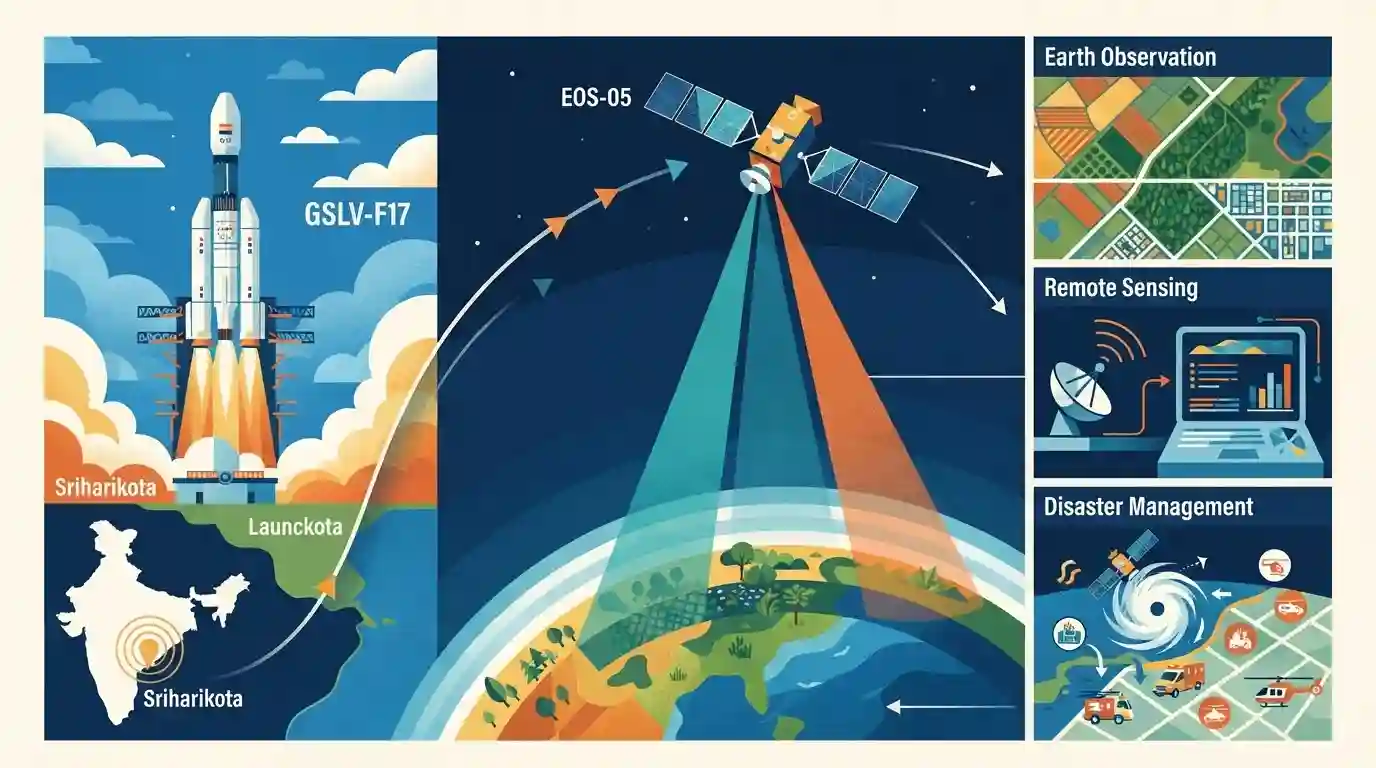
ISRO successfully launched the Earth Observation Satellite EOS-05 using the GSLV-F17 rocket from Sriharikota, further strengthening India's capabilities in earth observation, remote sensing, and disaster management.
मुख्य मुद्दे
- ISRO successfully launched the Earth Observation Satellite EOS-05 aboard the GSLV-F17 rocket from Satish Dhawan Space Centre, Sriharikota.
- EOS-05 is designed to enhance India's remote sensing, weather monitoring, disaster management, and earth observation capabilities.
- The mission highlights the reliability of India's Geosynchronous Satellite Launch Vehicle (GSLV) for deploying crucial operational payloads.
महत्त्वाच्या संज्ञा
EOS-05

India's first imaging satellite designed to operate from a geosynchronous orbit, providing near-real-time disaster monitoring and high-frequency Earth observation data.
UPSC context
Prelims/Mains: Important space missions, Earth observation satellites, remote sensing applications, and disaster management infrastructure.
GSLV-F17
The 19th flight of India's Geosynchronous Satellite Launch Vehicle, featuring an indigenous cryogenic upper stage, used to place the EOS-05 satellite into a sub-geosynchronous transfer orbit.
UPSC context
Prelims/Mains: Launch vehicle technology, cryogenic engine development, and achievements of ISRO in heavy-payload rocketry.
ISRO
India's national space agency responsible for planning, executing, and operating space exploration missions, satellite launches, and earth observation initiatives.
UPSC context
Mains GS-3 (Science & Technology): Achievements of Indians in science & technology; institutional framework of space research.
पूर्वपरीक्षा सापळा
All Earth Observation Satellites are deployed in Low Earth Orbit (LEO) for high-resolution imaging at fixed intervals.
Aspirants often assume all Earth Observation Satellites (EOS) are placed in Low Earth Orbit (LEO); however, specialized missions like EOS-05 operate from a geosynchronous orbit for continuous monitoring.
संबंधित स्थिर संकल्पना
What are the primary functional differences between Low Earth Orbit (LEO) and Geosynchronous Earth Orbit (GEO) satellites?
- LEO Characteristics: LEO satellites orbit between 160 km and 2,000 km, providing high-resolution imagery but pass over targets intermittently at fixed revisit times.
- GEO Characteristics: GEO satellites orbit at 35,786 km matching Earth's rotation speed, enabling continuous, real-time monitoring of a fixed geographic sector.
- Payload Trade-off: GEO payloads require much heavier launch vehicles and larger antennas to resolve ground features compared to LEO equivalents.
आंतर-विषय नमुने
Earth Observation + Agricultural Disaster Management
Geosynchronous Earth observation imaging provides continuous regional coverage that directly enhances meteorological inputs for agricultural drought early warning systems under the National Mission on Sustainable Agriculture.

GEO versus LEO imaging orbit trade-offs frequently appear in prelims statement-based questions. Know the distinct use cases.
संबंधित PYQ · 2
संबंधित PYQ · 2
- 2018PrelimsGS1
With reference to India's satellite launch vehicles, consider the following statements: 1. PSLVs launch the satellites useful for Earth resources monitoring whereas GSLVs are designed mainly to launch communication satellites. 2. Satellites launched by PSLV appear to remain permanently fixed in the same position in the sky, as viewed from a particular location on Earth. 3. GSLV Mk III is a four-staged launch vehicle with the first and third stages using solid rocket motors; and the second and fourth stages using liquid rocket engines. Which of the statements given above is/are correct?
- 2016MainsGS3
Discuss India's achievements in the field of Space Science and Technology. How the application of this technology has helped India in its socio-economic development?
