ISRO Outlines Gaganyaan Uncrewed Test Roadmap
Source:Indian Express ↗
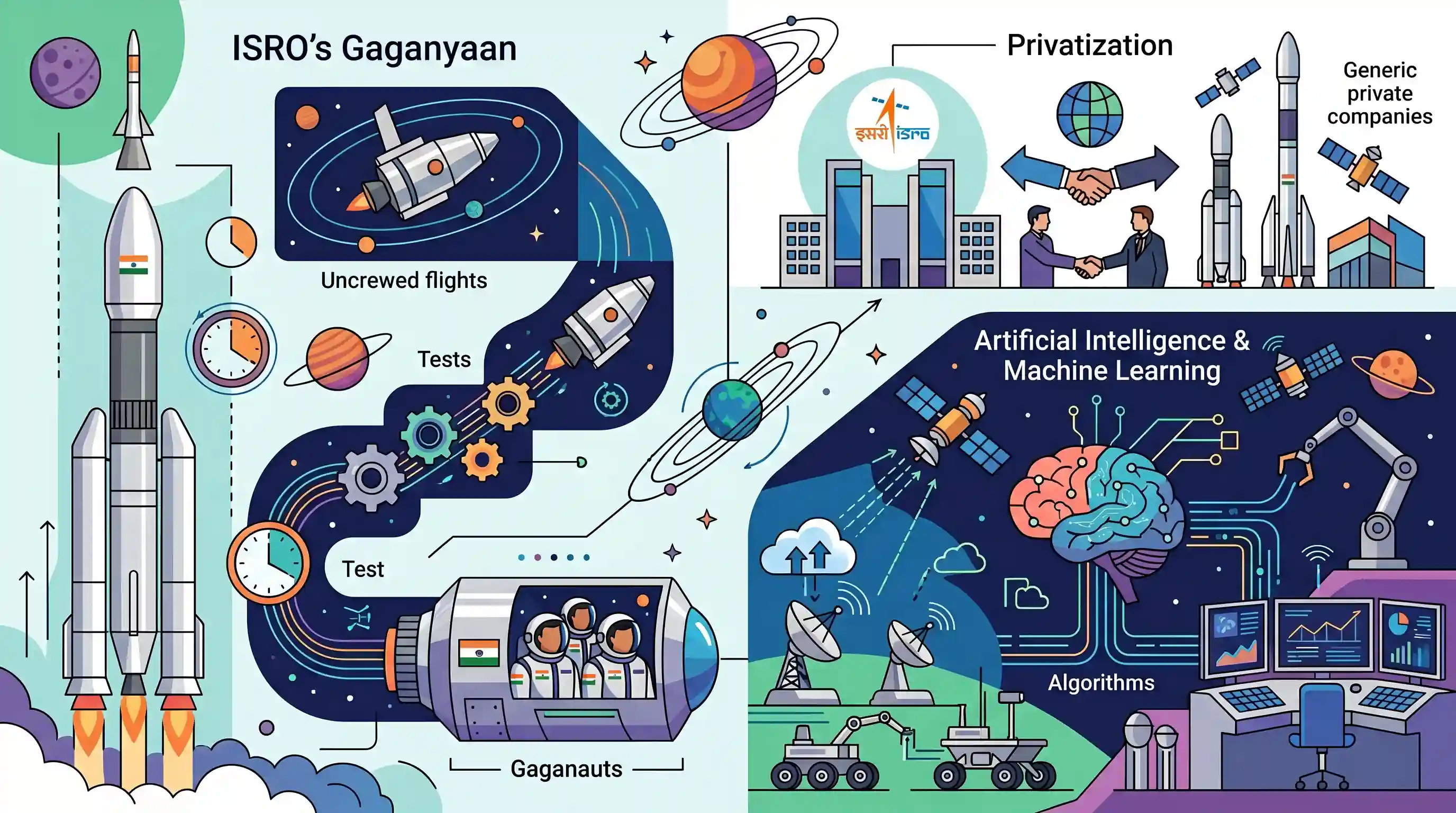
Why It Matters
The timeline and roadmap for the Gaganyaan mission are critical components of India's space ambitions, representing technological self-reliance in human spaceflight. Furthermore, the discussion points on private sector participation and the integration of AI/ML reflect key policy shifts and technological advancements that are highly relevant to the Science and Technology syllabus in GS-III.
Summary
ISRO is preparing to launch the first uncrewed flight of its Gaganyaan human spaceflight programme in the first quarter of 2026. According to V Narayanan, Director of ISRO’s Liquid Propulsion Systems Centre, the space agency plans to conduct three crucial uncrewed test missions to validate systems before sending Indian astronauts into space. Speaking at a conference on emerging technologies in Bengaluru, ISRO officials and former chiefs, including A S Kiran Kumar, emphasized that space is no longer a strictly state-centric activity and highlighted the need for private sector participation. Experts also stressed the growing reliance on Artificial Intelligence, Machine Learning, and cloud-based ground operations as space missions become more complex and transition from purely robotic endeavours to human-centric exploration.
Key Points
- ISRO confirmed that the first uncrewed Gaganyaan-I mission is scheduled to launch in the first quarter of 2026.
- A total of three critical uncrewed tests will be conducted before launching the final crewed mission with Indian astronauts.
- Space exploration has evolved beyond state monopolies, requiring increased participation from private, non-state entities for broader benefits.
- The transition from purely robotic flights to human-centric missions marks a major paradigm shift for ISRO.
- The integration of Artificial Intelligence (AI), Machine Learning (ML), and cloud-based ground systems is increasingly vital for modern space operations and spacecraft autonomy.
Important Terms
Gaganyaan

India's flagship human spaceflight mission aiming to launch a three-member crew into a 400 km Low Earth Orbit for three days and return them safely to Earth.
UPSC context
GS Paper-III (Science & Technology); focuses on indigenous technology development and India's emergence as a global space power.
Liquid Propulsion Systems Centre (LPSC)
The lead ISRO center responsible for the design, development, and realization of liquid and cryogenic propulsion stages for launch vehicles and spacecraft.
UPSC context
GS Paper-III (Science & Technology); tests knowledge of critical rocket propulsion technologies and institutional roles within ISRO.
U R Rao Satellite Centre (URSC)
ISRO's premier center for the design, development, assembly, and integration of all Indian satellites, including communication, navigation, and scientific missions.
UPSC context
GS Paper-III (Science & Technology); important for understanding India's satellite infrastructure and self-reliance in space applications.
IN-SPACe (Indian National Space Promotion and Authorization Center)
An autonomous nodal agency under the Department of Space created to authorize, promote, and supervise the space activities of private entities in India.
UPSC context
GS Paper-III (Economy/Science & Technology); relevant for space sector reforms and public-private partnerships.
AI and Machine Learning in Space
Computational tools used by ISRO for autonomous navigation, trajectory optimization, health monitoring of spacecraft, and large-scale satellite data analysis.
UPSC context
GS Paper-III (Science & Technology); emerging technology applications in strategic sectors and Fourth Industrial Revolution tools.
Prelims Trap
"Gaganyaan-I will be India's first crewed spaceflight, launching Indian astronauts into Low Earth Orbit in 2026."
Gaganyaan-I is strictly an *uncrewed* test flight. ISRO will conduct three such uncrewed missions to validate systems before launching the actual crewed mission.
Static Concepts Connected
What are the key architectural elements of the Gaganyaan mission?
- Launch Vehicle: Uses the Human-rated LVM3 (HLVM3), featuring modified solid, liquid, and cryogenic stages to ensure fail-safe crew safety.
- Target Orbit: Designed to safely place a crew of up to 3 members into a 400 km Low Earth Orbit (LEO) for a 3-day mission.
- Crew Escape System: Equipped with a specialized Crew Escape System (CES) with quick-acting solid motors for safe recovery during pad or ascent emergencies.
How is India institutionalizing private participation in the space sector?
- IN-SPACe: An independent nodal agency under the Department of Space acting as a single-window regulatory and clearing mechanism for private space activities.
- NSIL: The commercial arm of ISRO responsible for transferring space technologies to industry and scaling up manufacturing through private partnerships.
- Space Policy 2023: Transitions ISRO’s focus strictly to advanced R&D and deep-space missions, while empowering Non-Governmental Entities (NGEs) to handle routine commercial end-to-end space operations.
Cross-Topic Patterns
Gaganyaan vs. Samudrayaan extreme environments
Both India’s premier human spaceflight (Gaganyaan) and deep-sea exploration (Samudrayaan/MATSYA 6000) missions represent India's strategic shift toward human-centric extreme-environment exploration, both converging on a critical 2025-2026 testing timeline.
Spacecraft autonomy & Edge Computing
Moving away from purely ground-controlled robotics, ISRO's future flights increasingly rely on AI, Machine Learning, and edge computing for real-time onboard data processing and autonomous navigation without earth-link delays.

Expect a 2026 Prelims question linking Gaganyaan's uncrewed prerequisites (like the Vyommitra humanoid) to HLVM3 capabilities.
Linked PYQs · 2
Linked PYQs · 2
- 2017MainsGS3
India has achieved remarkable successes in unmanned space missions including the Chandrayaan and Mars Orbitter Mission, but has not ventured into manned space missions. What are the main obstacles to launching a manned space mission, both in terms of technology and logistics? Examine critically.
- 2025PrelimsGS1
Consider the following space missions : I. Axiom-4 II. SpaDeX III. Gaganyaan How many of the space missions given above encourage and support micro-gravity research?
