ISRO Space Docking Experiment for Orbital Missions
Source:Indian Express ↗
Why It Matters
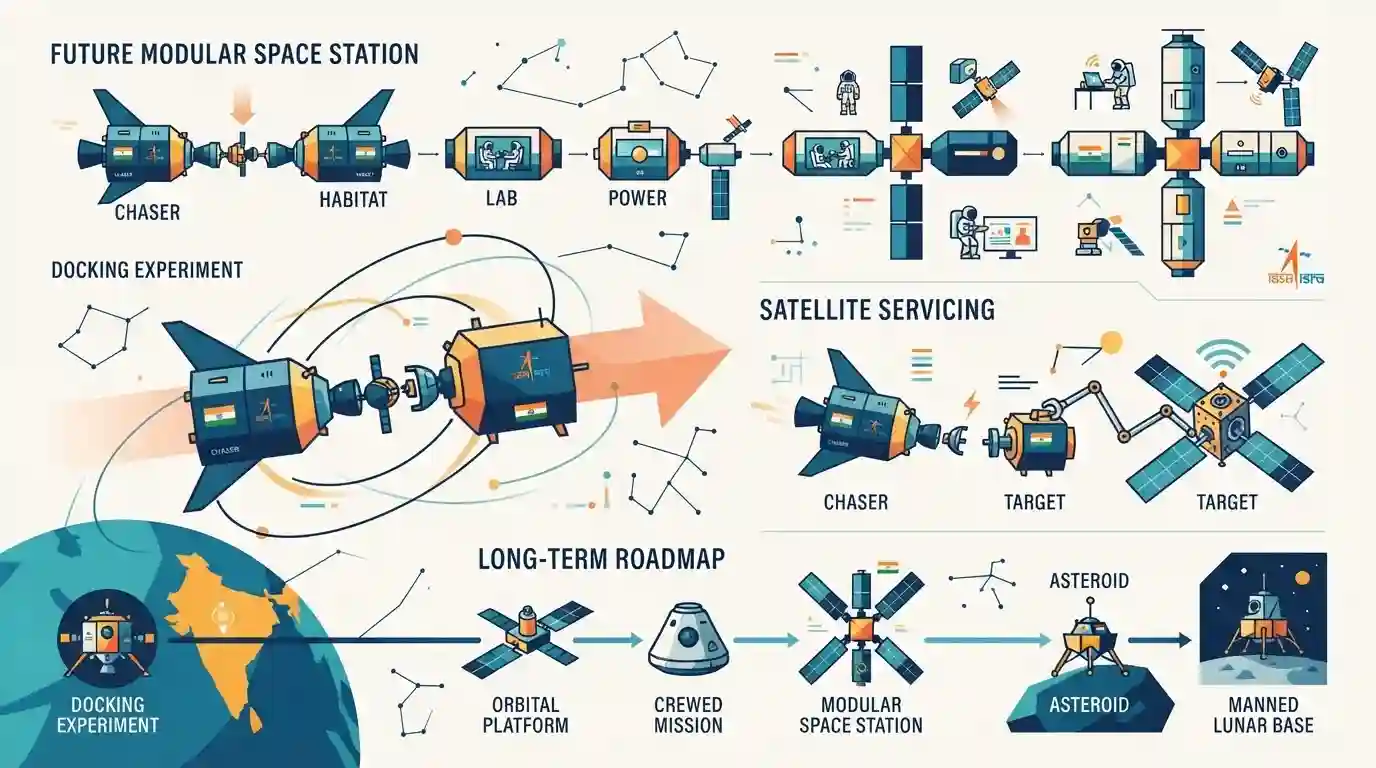
Space docking is a foundational technology required for advanced space exploration, including building a national space station, lunar sample return missions, and satellite maintenance, marking a major leap for India's space program.
Summary
An analysis of ISRO's technological endeavor to execute a space docking experiment, explaining its critical role in future modular space stations, satellite servicing, and India's long-term space exploration roadmap.
Key Points
- ISRO is attempting a complex space docking experiment to join two spacecraft in orbit, a crucial capability for future space stations and interplanetary missions.
- Space docking involves matching orbits, precise navigation, relative positioning, and mechanical locking of two autonomous modules.
- This technology is vital for building India's planned Bharatiya Space Station and executing crewed space missions like Gaganyaan.
- Only a few space-faring nations (like the US, Russia, and China) have mastered space docking technology.
Important Terms
ISRO

India's national space agency responsible for planning, developing, and executing space exploration, satellite launch vehicles, and advanced technology experiments like orbital docking and planetary missions.
UPSC context
GS Paper III (Science & Technology - Space). Evaluates India's achievements, indigenous space programs, and institutional capabilities in high-tech research.
Space Docking Experiment (SpaDeX)
ISRO's space docking experiment (SpaDeX) is a twin-satellite mission designed to demonstrate autonomous orbital rendezvous, docking, and undocking technologies in space.
UPSC context
GS Paper III (Science & Technology - Space). Tests technological milestones required for modular space stations and future sample-return missions.
Space Docking
The technological process where two independent spacecraft navigate, approach, and mechanically connect while traveling at high speeds in orbit.
UPSC context
GS Paper III (Science & Technology - Space). Crucial capability required for crewed space flight and constructing modular space stations.
Prelims Trap
India is the second nation globally to master autonomous space docking technology after the USA.
Aspirants often assume ISRO has previously demonstrated autonomous docking; however, SpaDeX is ISRO's maiden demonstration, making India the fourth nation globally to achieve this.
Static Concepts Connected
What are the core technical phases involved in autonomous space docking missions?
- Orbital Rendezvous: Exact orbit matching of chaser and target spacecraft using high-precision propulsion systems.
- Relative Navigation: Autonomous relative navigation using LiDAR, optical sensors, and computer vision without manual intervention.
- Soft/Hard Docking: Mechanical latching and structural locking mechanisms to safely couple two spacecraft modules.
Cross-Topic Patterns
Space Docking + Lunar Sample Return Missions
Mastery of space docking and orbital rendezvous enables complex deep-space sample return missions, directly linking ISRO's lunar roadmap (Chandrayaan-4) with autonomous navigation technologies.
Modular Space Stations + Indigenization of Tech
Transitioning from isolated satellite launches to modular space station construction requires advanced dual-spacecraft station-keeping, aligning space tech with diplomatic partnerships in low-Earth orbit.

Space docking mechanics, orbital rendezvous, and prerequisites for the Bharatiya Space Station will likely feature in prelims match-the-following.
Linked PYQs · 2
Linked PYQs · 2
- 2016MainsGS3
Discuss India's achievements in the field of Space Science and Technology. How the application of this technology has helped India in its socio-economic development?
- 2023MainsGS3
What is the main task of India's third moon mission which could not be achieved in its earlier mission? List the countries that have achieved this task. Introduce the subsystems in the spacecraft launched and explain the role of the Virtual Launch Control Centre' at the Vikram Sarabhai Space Centre which contributed to the successful launch from Sriharikota.
