ISRO Plans PSLV Relaunch and Maintains Gaganyaan Timeline
Source:The Hindu ↗
Why It Matters
Provides crucial updates on ISRO's flagship missions (Gaganyaan, PSLV recovery) and illustrates the government's strategic financial push (ANRF, ₹1 lakh crore fund) to cultivate a deep tech and climate-resilient startup ecosystem. Highly relevant for GS3 S&T and Economy sections.
Summary
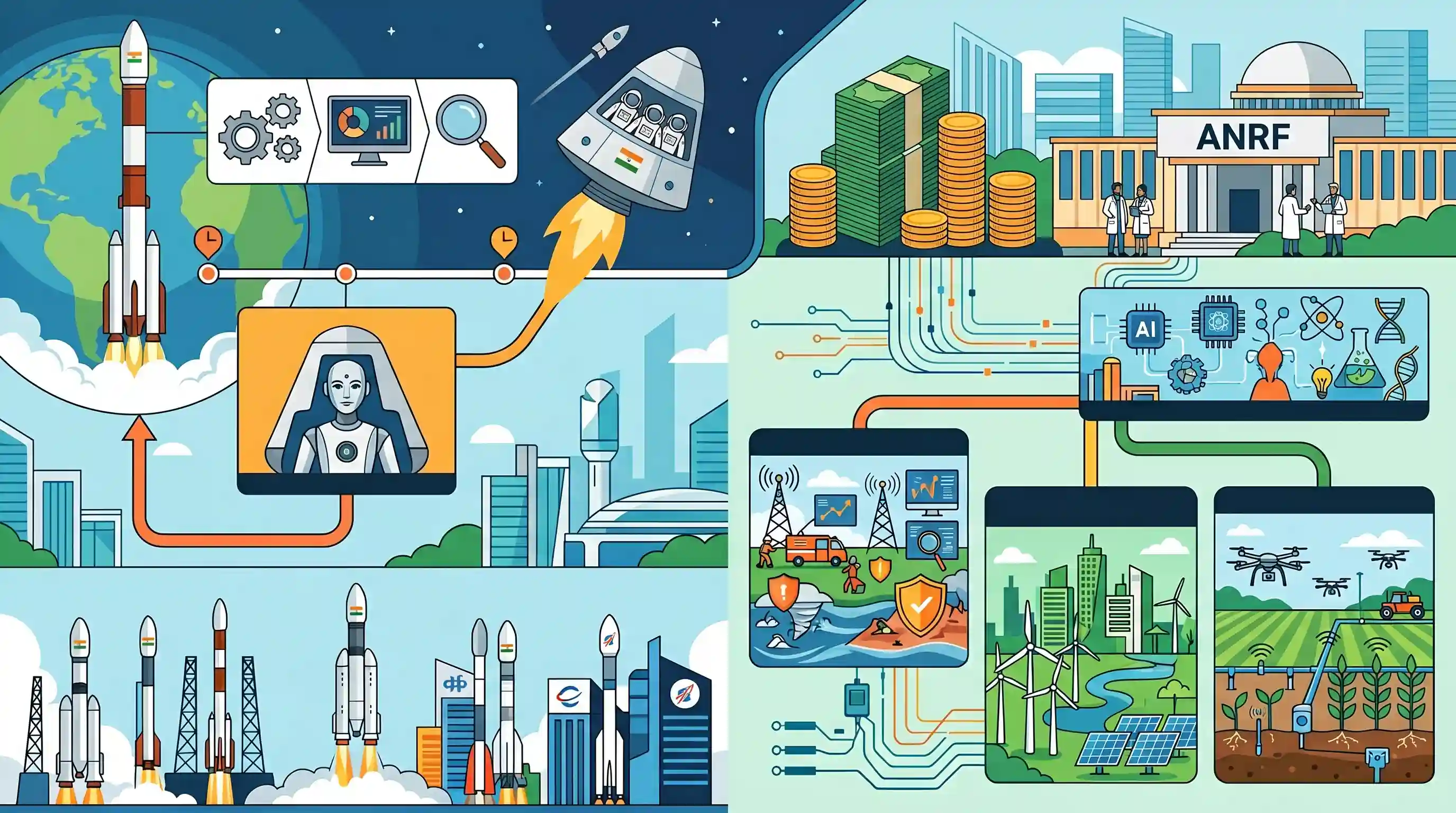
ISRO is preparing to resume the launches of its reliable workhorse, the Polar Satellite Launch Vehicle (PSLV), by June or July 2026, after conducting thorough technical assessments to rectify recent consecutive failures. Union Minister Jitendra Singh confirmed that despite these setbacks, ISRO's broader mission timeline remains largely unaffected. Crucially, India's inaugural human spaceflight mission, Gaganyaan, is firmly on track for its 2027 launch window. Preceding the crewed mission, uncrewed test flights featuring the humanoid robot Vyommitra are in their final stages and are expected to launch before the end of this year. Highlighting the growing role of private enterprise, out of the 18 launches scheduled for 2026, six will be executed by private companies. Concurrently, the government is intensifying its focus on deep tech and scientific innovation by operationalizing the Anusandhan National Research Foundation (ANRF) with a ₹1-lakh crore R&D fund, alongside a specialized ₹10,000-crore fund for deep tech startups. Furthermore, ministries are actively encouraging startups to focus on climate change adaptation, precision agriculture, and disaster mitigation tools.
Key Points
- ISRO aims to relaunch the Polar Satellite Launch Vehicle (PSLV) by June or July 2026, overcoming consecutive recent technical failures without losing confidence.
- The Gaganyaan crewed space mission remains on schedule for 2027, with preliminary test flights carrying the humanoid robot Vyommitra anticipated by the end of the year.
- ISRO has scheduled 18 launches in 2026, with a significant six being undertaken by private players, demonstrating the growing privatization in the space sector.
- The government is boosting deep tech and scientific innovation through a ₹1-lakh crore research and development fund under ANRF and a dedicated ₹10,000-crore fund for deep tech startups.
- Startups have emerging opportunities in climate resilience, specifically in precision agriculture, hyper-local weather forecasting, and carbon accounting, as highlighted by the Earth Sciences Ministry.
Important Terms
Gaganyaan mission

India's first human spaceflight mission designed to send a three-member crew to a 400 km orbit for a three-day mission and bring them back safely.
UPSC context
GS Paper III: Space Technology. Tests knowledge of indigenous human spaceflight capabilities and mission components (crew module, life support).
Polar Satellite Launch Vehicle (PSLV)
India's reliable third-generation launch vehicle, known as ISRO's 'workhorse,' capable of placing satellites into Sun-Synchronous Polar Orbits and Geostationary Transfer Orbits.
UPSC context
GS Paper III: Science & Tech. Crucial for understanding India's satellite launch capabilities and commercial space competitiveness.
Vyommitra
An AI-enabled female half-humanoid robot developed by ISRO to simulate human functions and monitor cabin parameters in uncrewed Gaganyaan test flights.
UPSC context
GS Paper III: Robotics and Space Tech. Tests awareness of human-machine interfaces and biological mission simulations.
Anusandhan National Research Foundation (ANRF)
An apex statutory body established under the ANRF Act 2023 to provide strategic direction for scientific research and foster industry-academia collaboration in India.
UPSC context
GS Paper II & III: Government Policies/S&T. Key for questions on research funding and the National Education Policy 2020.
Deep Tech
Advanced technologies based on significant scientific discoveries or engineering innovations that address complex global challenges, typically requiring substantial R&D and capital.
UPSC context
GS Paper III: Indian Economy/S&T. Tests knowledge of emerging technology sectors and startup-led innovation ecosystems.
ISRO
India's national space agency, responsible for space exploration, satellite communication, and the development of indigenous launch vehicles and planetary missions.
UPSC context
GS Paper III: Science & Technology. The primary institution for all space-related developments and indigenous technology.
Prelims Trap
"IN-SPACe is the commercial arm of ISRO handling private launches."
IN-SPACe is an autonomous regulatory body for non-governmental entities. NSIL (NewSpace India Limited) is the actual commercial arm of ISRO.
Static Concepts Connected
How does the PSLV structurally differ from the GSLV?
- Stage configuration: PSLV is a four-stage vehicle (solid, liquid, solid, liquid). GSLV is a three-stage vehicle featuring a cryogenic upper stage.
- Payload and Orbit: PSLV primarily places lighter Earth observation satellites into Sun-Synchronous Orbits. GSLV is designed for heavier communication satellites in Geosynchronous Orbits.
What are the core features of the Anusandhan National Research Foundation (ANRF)?
- Statutory basis: Established via the ANRF Act 2023, it subsumes the existing Science and Engineering Research Board (SERB).
- Leadership: The Prime Minister serves as the ex-officio President of its Governing Board.
- Private funding focus: It is mandated to raise a significant portion (~70% of its initial ₹50,000 crore outlay) from private sector and industry sources.
Cross-Topic Patterns
Space Privatization + Deep Tech financing
Space sector privatization via IN-SPACe intersects heavily with new deep-tech funding pools, shifting India's space economy from a state monopoly to venture-backed scientific innovation.
Space Tech + Climate Resilience
Startups utilizing Earth Observation data (from PSLV launches) for hyper-local forecasting and precision agriculture link GS3 Space Technology directly to GS3 Disaster Management and Climate Adaptation.

A mixed GS3 question comparing ANRF's statutory mandate, private funding ratios, and the ₹1-lakh crore deep-tech corpus is highly likely.
Linked PYQs · 5
Linked PYQs · 5
- 2023MainsGS3
What is the main task of India's third moon mission which could not be achieved in its earlier mission? List the countries that have achieved this task. Introduce the subsystems in the spacecraft launched and explain the role of the Virtual Launch Control Centre' at the Vikram Sarabhai Space Centre which contributed to the successful launch from Sriharikota.
- 2025PrelimsGS1
Consider the following space missions : I. Axiom-4 II. SpaDeX III. Gaganyaan How many of the space missions given above encourage and support micro-gravity research?
- 2018PrelimsGS1
With reference to India's satellite launch vehicles, consider the following statements: 1. PSLVs launch the satellites useful for Earth resources monitoring whereas GSLVs are designed mainly to launch communication satellites. 2. Satellites launched by PSLV appear to remain permanently fixed in the same position in the sky, as viewed from a particular location on Earth. 3. GSLV Mk III is a four-staged launch vehicle with the first and third stages using solid rocket motors; and the second and fourth stages using liquid rocket engines. Which of the statements given above is/are correct?
- 2024MainsGS3
Flooding in urban areas is an emerging climate-induced disaster. Discuss the causes of this disaster. Mention the features of two such major floods in the last two decades in India. Describe the policies and frameworks in India that aim at tackling such floods.
- 2021MainsGS3
“Investment in infrastructure is essential for more rapid and inclusive economic growth.” Discuss in the light of India's experience.
