ISRO PSLV resumption timeline and deep tech innovation funds
Source:The Hindu ↗
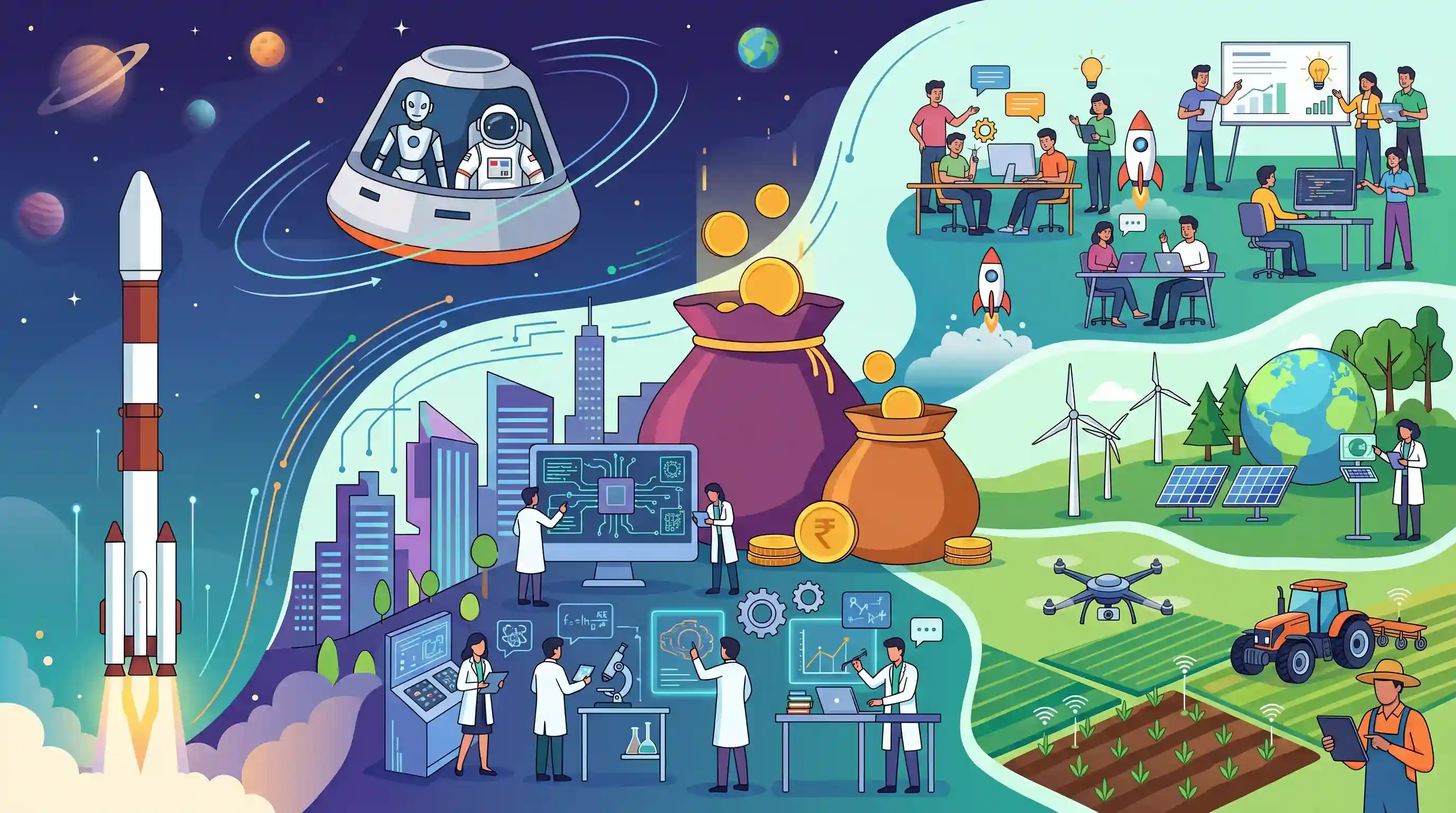
Why It Matters
Tracks the progress of India's crucial space missions (PSLV and Gaganyaan) while highlighting major government funding mechanisms (₹1-lakh crore innovation fund, ₹10,000-crore deep tech fund) designed to boost self-reliance in science, technology, and entrepreneurship.
Summary
The Indian Space Research Organisation (ISRO) is preparing to resume launches of its Polar Satellite Launch Vehicle (PSLV) by June or July 2026, overcoming recent setbacks. Union Minister Jitendra Singh confirmed that the Gaganyaan manned mission is scheduled for 2027, preceded by a test flight with the Vyommitra humanoid robot. To bolster the indigenous technology ecosystem, the government highlighted a ₹1-lakh crore innovation fund and a ₹10,000-crore deep tech start-up fund. These initiatives, discussed at a CSIR conclave in Chennai, aim to drive R&D and support start-ups in emerging fields like climate change research and precision agriculture.
Key Points
- ISRO aims to resume Polar Satellite Launch Vehicle (PSLV) launches by June or July 2026 following recent failures.
- Gaganyaan, India's first crewed space mission, remains on track for 2027, with a test flight featuring the humanoid robot Vyommitra expected by late 2026.
- The central government has introduced a ₹1-lakh crore research, development, and innovation fund, alongside a ₹10,000-crore fund specifically for deep tech start-ups.
- CSIR hosted the Research, Industry, Startup, and Entrepreneurship Conclave 2026 in Chennai to bridge gaps between industry, academia, and start-ups, particularly in climate change and disaster mitigation tech.
Important Terms
Gaganyaan

India's first human spaceflight mission aiming to send a crew to an orbit of 400 km for a 3-day mission and bring them safely back to Earth.
UPSC context
GS III: Space Technology. Tests knowledge of indigenous space capabilities and human-rated launch systems (LVM3).
PSLV (Polar Satellite Launch Vehicle)
ISRO's 'workhorse' launch vehicle, a four-stage rocket designed to deliver satellites into Sun-Synchronous Polar Orbits; it is currently undergoing relaunch preparations.
UPSC context
GS III: Space Tech. Tests understanding of different launch vehicle categories and India’s orbital delivery capabilities.
Vyommitra
A female-looking 'half-humanoid' robot developed by ISRO to simulate human functions and monitor module parameters during uncrewed Gaganyaan test flights.
UPSC context
GS III: Robotics and Space Tech. Tests knowledge of indigenization and safety protocols for human spaceflight.
CSIR (Council of Scientific and Industrial Research)
India's premier R&D organization focusing on industrial innovation, operating under the Ministry of Science and Technology with a network of 37 national laboratories.
UPSC context
GS III: Science & Technology Institutions. Tests awareness of the institutional framework driving indigenous research.
Deep Tech Startup Fund
A ₹10,000-crore dedicated corpus designed to provide long-term financing for startups working on complex, high-end technologies like AI and biotechnology.
UPSC context
GS III: Economy/Innovation. Tests knowledge of fiscal support for frontier technology and Atmanirbharta.
₹1-lakh crore Innovation Fund
A corpus aimed at providing long-term, low-interest loans to incentivize private sector-led research and innovation in high-potential technology sectors.
UPSC context
GS III: Science & Technology Policy. Tests understanding of strategies to boost Gross Expenditure on R&D.
Prelims Trap
"ISRO will utilize the PSLV to launch the Gaganyaan crew module into Low Earth Orbit."
While PSLV is frequently mentioned alongside ISRO's return to flight, the Gaganyaan crewed mission relies on the heavier LVM3 (formerly GSLV Mk III), not the PSLV.
Static Concepts Connected
How does PSLV fundamentally differ from LVM3?
- Stages: PSLV uses 4 stages (solid, liquid, solid, liquid). LVM3 is a 3-stage vehicle (solid, liquid core, cryogenic upper stage).
- Payload capacity: PSLV is optimized for Low/Sun-Synchronous Orbits. LVM3 handles heavy payloads (4-ton class) for Geosynchronous Transfer Orbits or heavy LEO missions like Gaganyaan.
- Historic missions: PSLV launched Chandrayaan-1 and Mangalyaan; LVM3 launched Chandrayaan-3 and is slated for the crewed Gaganyaan mission.
What is the mechanism of the ₹1-lakh crore R&D fund?
- Core objective: To catalyze private sector-led research and innovation in sunrise domains, moving beyond traditional government grants.
- Financing model: It provides 50-year interest-free loans, offering long-term financing with long tenors to support high-risk deep-tech ventures.
- Custodian framework: It operates in tandem with the Anusandhan National Research Foundation (ANRF) to bridge the academia-industry gap.
Cross-Topic Patterns
Deep Tech Funds & Space Indigenization
The ₹10,000-crore deep tech fund aligns with iDEX (defense) and IN-SPACe (space), showcasing a shift where the government acts as an anchor investor rather than just the primary developer.
Academia-Industry Linkages via CSIR
CSIR’s recent conclaves focusing on start-ups and climate tech reflect the broader National Education Policy and ANRF mandates to commercialize lab research into deployable market solutions.

Expect a multi-statement question interlinking ISRO's Gaganyaan/LVM3 technicals with the newly operationalized ₹1-lakh cr ANRF fund.
Linked PYQs · 2
Linked PYQs · 2
- 2018PrelimsGS1
With reference to India's satellite launch vehicles, consider the following statements: 1. PSLVs launch the satellites useful for Earth resources monitoring whereas GSLVs are designed mainly to launch communication satellites. 2. Satellites launched by PSLV appear to remain permanently fixed in the same position in the sky, as viewed from a particular location on Earth. 3. GSLV Mk III is a four-staged launch vehicle with the first and third stages using solid rocket motors; and the second and fourth stages using liquid rocket engines. Which of the statements given above is/are correct?
- 2025PrelimsGS1
Consider the following space missions : I. Axiom-4 II. SpaDeX III. Gaganyaan How many of the space missions given above encourage and support micro-gravity research?
