ISRO Conducts Parachute Drop Tests For Gaganyaan Crew Module Recovery
Source:Indian Express ↗
Why It Matters
The Gaganyaan mission is a landmark project for ISRO, and understanding its technical components (like crew module recovery) is highly relevant for GS-3 Space Technology.
Summary
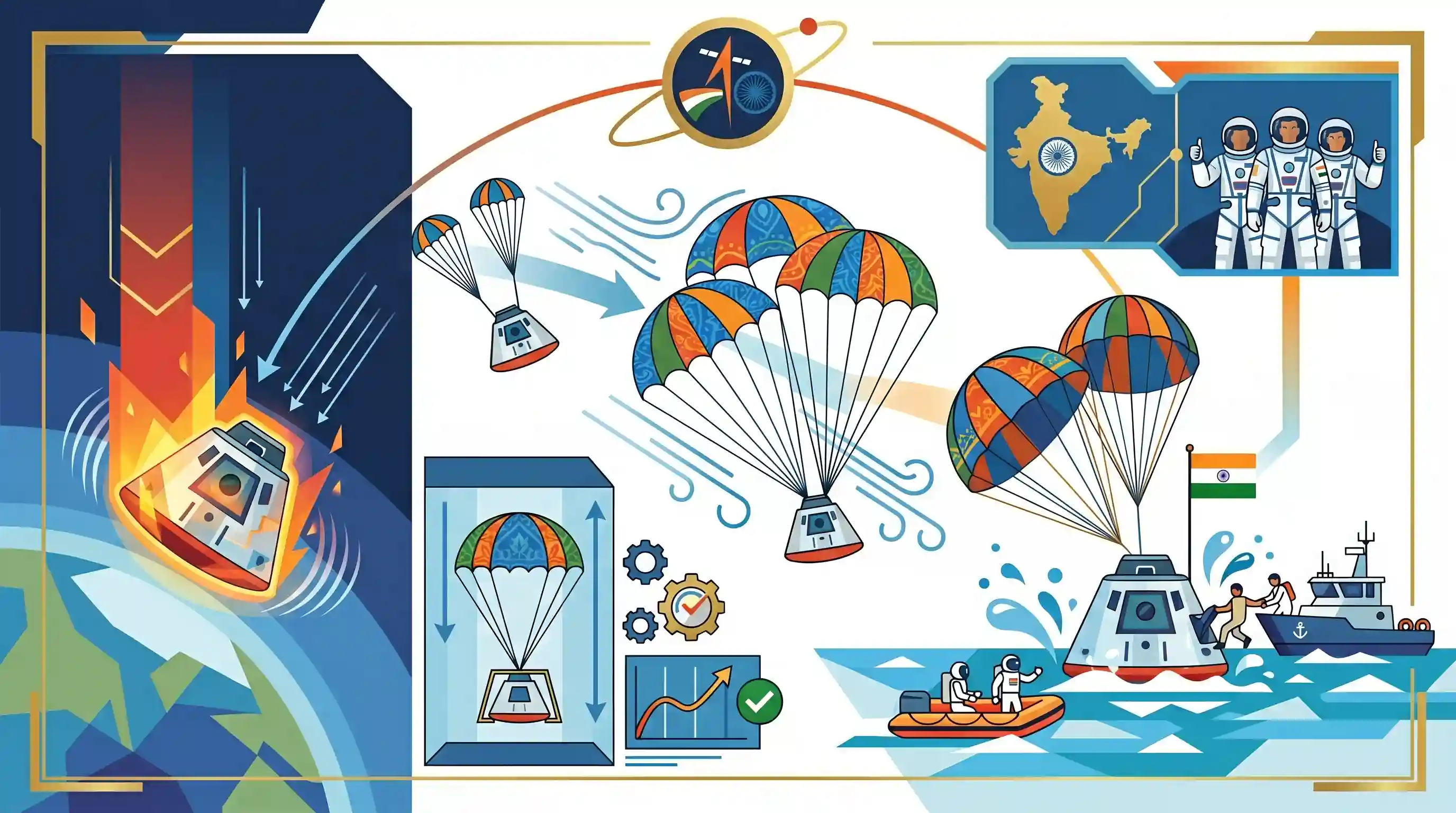
The Indian Space Research Organisation (ISRO) is conducting fresh drop tests to thoroughly validate the parachute deceleration systems designed for the Gaganyaan human spaceflight mission. These parachutes are essential for slowing down the Crew Module during atmospheric re-entry, ensuring a safe splashdown for the returning astronauts. Successfully qualifying these safety and recovery systems is a critical prerequisite for India's upcoming crewed space missions, highlighting the country's developing indigenous capabilities in human space exploration.
Key Points
- ISRO is conducting fresh tests to validate the parachute systems intended for the Gaganyaan mission's Crew Module.
- The parachute deceleration system is critical for safely bringing astronauts back to Earth, ensuring a controlled descent and safe splashdown.
- These drop tests simulate various re-entry and descent scenarios to test the deployment dynamics and load-bearing capability of the parachutes.
- Ensuring fail-proof crew safety mechanisms is a vital milestone in India's indigenously developed human spaceflight program.
Important Terms
Gaganyaan Mission

India's maiden human spaceflight mission by ISRO, aiming to send a three-member crew to a 400km orbit for three days and return them safely to Earth.
UPSC context
GS Paper III (S&T); central to India's indigenous space capabilities and human spaceflight milestones.
Indian Space Research Organisation (ISRO)
India's national space agency responsible for space-based applications, exploration, and the development of indigenous space technology, including the GSLV and LVM3 rockets.
UPSC context
GS Paper III; nodal agency for space developments, frequently tested in Prelims and Mains.
Parachute Deceleration System (PDS)
A sequence of 10 parachutes (Drogue, Pilot, and Main) designed to stabilize and slow the Gaganyaan Crew Module from orbital velocity to a safe splashdown speed.
UPSC context
GS Paper III (S&T); critical safety technology for "human-rating" space systems and ensuring astronaut recovery.
Crew Module (CM)
The habitable, pressurized segment of the Gaganyaan spacecraft where astronauts reside, equipped with life support and designed to withstand the thermal stress of atmospheric re-entry.
UPSC context
GS Paper III (S&T); core component of the Indian Human Spaceflight Programme (IHSP).
Low Earth Orbit (LEO)
An orbit ranging from 160 km to 2,000 km above Earth, used for Gaganyaan, the International Space Station, and most imaging satellites.
UPSC context
GS Paper III (S&T); fundamental concept for satellite placement and human mission trajectories.
Splashdown
The final recovery method for the Gaganyaan mission, where the Crew Module lands in the ocean (Bay of Bengal) using a parachute system.
UPSC context
GS Paper III (S&T); mission recovery protocol and inter-agency coordination (ISRO and Indian Navy).
Crew Escape System (CES)
A high-speed safety mechanism designed to pull the Crew Module away from the launch vehicle in case of an emergency during the ascent phase.
UPSC context
GS Paper III (S&T); critical technology for human-rated launch vehicles (HLVM3).
Prelims Trap
The Gaganyaan parachute deceleration system is indigenously developed entirely by ISRO.
While ISRO leads the mission, the 10-parachute sequential deceleration system is developed by DRDO's Aerial Delivery Research and Development Establishment (ADRDE).
Static Concepts Connected
What distinguishes the Human-Rated LVM3 (HLVM3) from the standard LVM3?
- Crew Escape System: Features a highly reliable CES at the apex to safely eject the Crew Module and pull astronauts away during any launch or pad anomalies.
- System Redundancy: Upgraded with dual or triple redundant systems for avionics, propulsion, and mechanics to ensure fail-safe human flights.
What are the core challenges of a spacecraft's atmospheric re-entry?
- Thermal Heating: Aerodynamic friction creates immense heat, requiring a robust thermal protection shield (TPS) to prevent module burn-up.
- Communication Blackout: Ionized plasma surrounds the spacecraft during peak heating, temporarily blocking all radio communication with Earth.
- Terminal Deceleration: Massive kinetic energy must be shed rapidly; Gaganyaan uses a 10-parachute sequence for safe ocean splashdown.
Cross-Topic Patterns
ISRO-DRDO synergy in space missions
Gaganyaan relies heavily on DRDO labs: ADRDE for parachutes, DFRL for space food, and DEBEL for crew healthcare systems, showcasing a whole-of-government approach to defense-space indigenization.
Evolution of ISRO re-entry technology
Current parachute tests build upon decades of sequential re-entry validation, starting with the Space Capsule Recovery Experiment (SRE-1) in 2007 and the Crew module Atmospheric Reentry Experiment (CARE) in 2014.

Expect a 2026 multi-statement question testing the specific roles of DRDO and the Indian Navy in Gaganyaan's recovery and life support.
Linked PYQs · 3
Linked PYQs · 3
- 2025PrelimsGS1
Consider the following space missions : I. Axiom-4 II. SpaDeX III. Gaganyaan How many of the space missions given above encourage and support micro-gravity research?
- 2016MainsGS3
Discuss India's achievements in the field of Space Science and Technology. How the application of this technology has helped India in its socio-economic development?
- 2016PrelimsGS1
Consider the following statements: The Mangalyaan launched by ISRO 1. is also called the Mars Orbiter Mission 2. made India the second country to have a spacecraft orbit the Mars after USA 3. made India the only country to be successful in making its spacecraft orbit the Mars in its very first attempt Which of the statements given above is/are correct?
