ISRO Successfully Tests Main Parachutes for Gaganyaan Mission
Source:The Hindu ↗
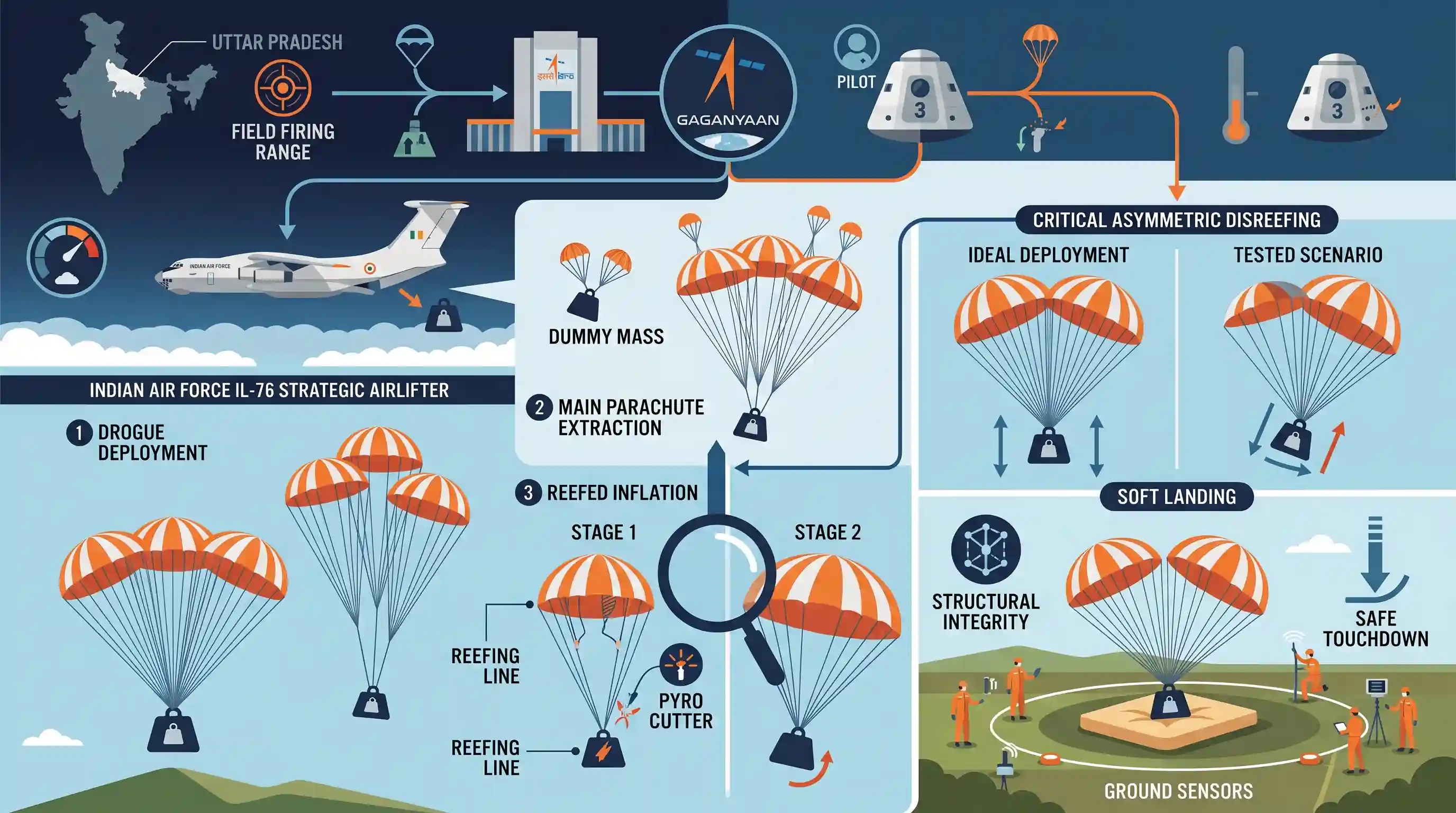
Why It Matters
Understanding the mechanics of India's first human spaceflight program (Gaganyaan) is highly relevant for UPSC Sci-Tech sections. Terms like 'reefed inflation', 'drogue parachutes', and the emphasis on technological redundancy highlight the complexity of crewed missions and safe re-entry mechanisms, forming prime material for Prelims MCQs and Mains questions on India's space achievements.
Summary
The Indian Space Research Organisation (ISRO) has successfully completed a critical Integrated Main Parachute Airdrop Test (IMAT) for the Gaganyaan Crew Module at the Babina Field Firing Range in Uttar Pradesh. The test validated the performance of the complex 10-parachute system, specifically assessing the critical 'reefed inflation' process where parachutes open in stages to manage aerodynamic loads. A simulated crew module mass was dropped from an IAF IL-76 aircraft at an altitude of 2.5 km, successfully demonstrating structural integrity and soft landing capabilities even under simulated extreme asymmetric disreefing conditions.
Key Points
- ISRO successfully conducted an Integrated Main Parachute Airdrop Test (IMAT) for the Gaganyaan Crew Module at Babina Field Firing Range, Jhansi.
- The Gaganyaan parachute system consists of 10 parachutes of four types, designed with redundancy (only two of the three main parachutes are needed for safe landing).
- The descent sequence involves apex cover separation parachutes, drogue parachutes (for stabilization and deceleration), pilot parachutes, and finally the main parachutes.
- The main parachutes deploy through 'reefed inflation'—opening partially (reefing) and then fully (disreefing) using a pyro device—to manage the structural load gracefully.
- The test evaluated a critical extreme scenario involving an intentional delay in disreefing (asymmetric disreefing) using an IAF IL-76 aircraft dropping a simulated Crew Module from 2.5 km altitude.
Important Terms
Gaganyaan mission

India's first human spaceflight program aiming to send a three-member crew to a 400 km Low Earth Orbit for three days and return them safely to Earth.
UPSC context
GS Paper 3 (Science & Technology); tests awareness of indigenous space capabilities and India's entry into the elite human spaceflight club.
ISRO (Indian Space Research Organisation)
India's premier space agency responsible for space research and planetary exploration; it leads the Gaganyaan mission including vehicle development and mission management.
UPSC context
GS Paper 3 (Science & Technology); essential for institutional knowledge and India's progress in indigenous aerospace technology.
Integrated Main Parachute Airdrop Test (IMAT)
A specialized test series validating the Gaganyaan crew module’s deceleration system by dropping a simulated module from aircraft to verify parachute performance and structural integrity.
UPSC context
GS Paper 3 (Science & Technology); focuses on critical technology development, safety protocols, and risk mitigation in human spaceflight.
Crew Module (CM)
The pressurized, habitable part of the Gaganyaan spacecraft designed to house astronauts in an Earth-like environment and ensure their safe re-entry and splashdown.
UPSC context
GS Paper 3 (Science & Technology); tests understanding of mission-specific hardware and life-support systems in space exploration.
Indian Air Force (IAF)
The air arm of the Indian Armed Forces, critical to Gaganyaan for astronaut selection, training, and providing logistical support like IL-76 aircraft for parachute tests.
UPSC context
GS Paper 3 (Security/Science); highlights inter-agency cooperation and the dual-use nature of aerospace infrastructure in national missions.
Reefed inflation
A technique where parachutes open in controlled stages (reefing) to manage high aerodynamic loads and prevent structural damage before full inflation.
UPSC context
GS Paper 3 (Science & Technology); tests technical understanding of aerospace engineering and safety mechanisms for spacecraft recovery.
Prelims Trap
A safe landing of the Gaganyaan crew module requires the successful deployment of all three of its main parachutes.
The 10-parachute deceleration system is designed with built-in redundancy. Only two of the three main parachutes are actually required to deploy for a safe touchdown.
Static Concepts Connected
How do re-entry deceleration systems function in human spaceflight?
- Drogue Parachutes: Deployed at higher altitudes and speeds to stabilize the rapidly falling module and provide initial deceleration before main extraction.
- Reefed Inflation: A technique where parachute canopies open partially before fully opening, minimizing structural shock from sudden aerodynamic loads.
- Main Parachutes: Deployed at lower altitudes to ensure the final slow descent for a safe oceanic splashdown or terrestrial landing.
What is the difference between Low Earth Orbit (LEO) and Geostationary Orbit (GEO)?
- Low Earth Orbit (LEO): Situated below 2,000 km altitude. It is the designated orbit for human spaceflights (like Gaganyaan at ~400 km) and the ISS.
- Geostationary Orbit (GEO): Situated at ~35,786 km above the equator. Satellites here match Earth's rotation, appearing stationary, making them ideal for communications.
Cross-Topic Patterns
Gaganyaan recovery + Indian Navy rescue protocols
The recovery of the Gaganyaan module after splashdown links to the Indian Navy's capabilities and ocean search-and-rescue protocols, creating a potential multi-statement Prelims crossover on space and maritime ops.
Re-entry mechanics + Advanced Materials science
Spacecraft deceleration systems often test candidates on materials science, specifically heat-resistant and high-tensile aramid/Kevlar fibers used in apex covers and drogue parachutes to withstand aerodynamic friction.

Questions on Gaganyaan will likely bypass basic mission goals and test specific sub-systems like reefed inflation or drogue chutes in 2026.
Linked PYQs · 3
Linked PYQs · 3
- 2016MainsGS3
Discuss India's achievements in the field of Space Science and Technology. How the application of this technology has helped India in its socio-economic development?
- 2023MainsGS3
What is the main task of India's third moon mission which could not be achieved in its earlier mission? List the countries that have achieved this task. Introduce the subsystems in the spacecraft launched and explain the role of the Virtual Launch Control Centre' at the Vikram Sarabhai Space Centre which contributed to the successful launch from Sriharikota.
- 2025PrelimsGS1
Consider the following space missions : I. Axiom-4 II. SpaDeX III. Gaganyaan How many of the space missions given above encourage and support micro-gravity research?
