ISRO and AIIMS Partner for Space Medicine
Source:The Hindu ↗
Why It Matters
This development highlights India's evolving capabilities in human spaceflight (Gaganyaan) and the necessary interdisciplinary approach required to tackle the biological obstacles of space exploration. It emphasizes the need for domestic capacity building in specialized fields like Space Medicine.
Summary
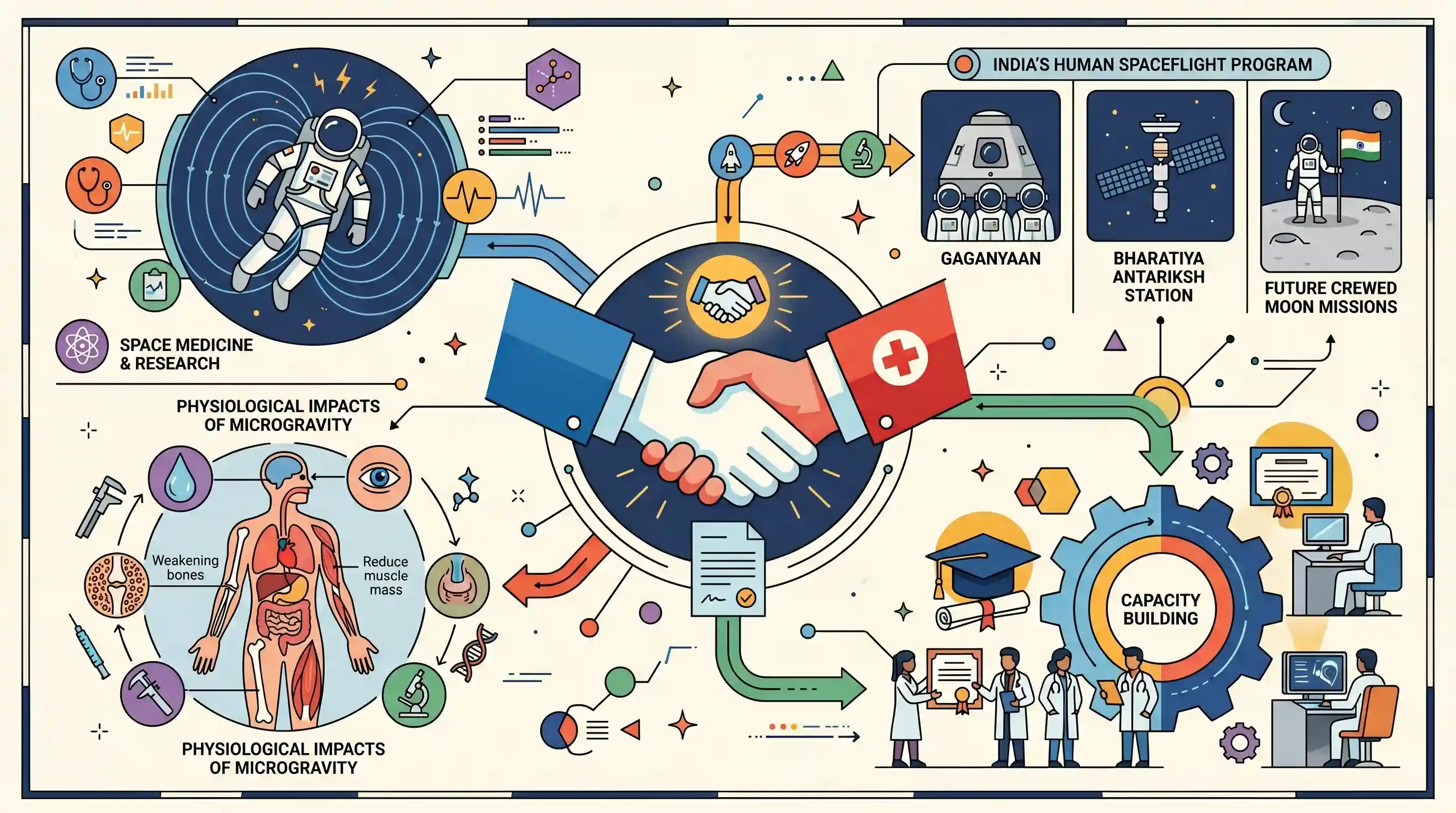
The Indian Space Research Organisation (ISRO) and the All India Institute of Medical Sciences (AIIMS) have signed an MoU to collaborate on space medicine and research. The partnership aims to enhance human health, performance, and safety during spaceflights by studying the physiological impacts of microgravity. This collaboration is crucial for the success of India's human spaceflight program, including the Gaganyaan mission, the establishment of the Bharatiya Antariksh Station, and future crewed missions to the Moon. It also emphasizes capacity building in space medicine through fellowships and academic programs.
Key Points
- ISRO and AIIMS signed a Memorandum of Understanding (MoU) to collaborate on space medicine and research to ensure astronaut safety during spaceflights.
- The partnership will focus on understanding the physiological effects of microgravity on the human body for upcoming long-duration missions like the Bharatiya Antariksh Station (BAS) and crewed lunar missions.
- The collaboration will support India's human spaceflight program, particularly the Gaganyaan mission, by developing countermeasures against health risks associated with space travel.
- The initiative includes capacity building in the nascent field of space medicine through joint fellowships and dual degree programs (MD-PhD).
Important Terms
Gaganyaan Mission

India’s first human spaceflight mission, aiming to send a three-member crew to Low Earth Orbit (400 km) for three days and return them safely.
UPSC context
GS III: Science & Technology; tests knowledge of indigenous space capabilities and mission-specific technical components like LVM3.
Bharatiya Antariksh Station (BAS)
India’s planned modular space station in Low Earth Orbit (400-450 km), with the first module expected in 2028 and full operationality by 2035.
UPSC context
GS III: Space Technology; relevant for long-term strategic goals and scientific research in microgravity.
Space Medicine
A specialized field of medicine addressing the physiological and psychological challenges of space travel, such as bone density loss and cardiovascular changes in microgravity.
UPSC context
GS III: Science & Technology/Health; tests understanding of multidisciplinary research and its terrestrial applications (spin-off technologies).
Human Space Flight Centre (HSFC)
An ISRO center established in Bengaluru in 2019 to coordinate the Human Spaceflight Programme, including mission planning, crew selection, and life support systems.
UPSC context
GS III: Institutional Framework; tests awareness of key organizations managing India’s flagship technological projects.
Microgravity Research
The condition of apparent weightlessness experienced in orbit, which is used as a laboratory environment for research in biology, physics, and materials science.
UPSC context
GS III: Science & Technology; fundamental for understanding the scientific utility of space stations and human missions.
Prelims Trap
AIIMS is the sole agency responsible for the medical selection and physical training of Gaganyaan astronauts.
The Institute of Aerospace Medicine (IAF) handles primary astronaut selection and baseline training. AIIMS is partnering for long-term physiological research and future capacity building.
Static Concepts Connected
What are the primary physiological impacts of microgravity on the human body?
- Bone and Muscle: Causes rapid muscle atrophy and bone density loss (osteopenia) at a rate of 1-2% per month due to the lack of mechanical weight-bearing.
- Fluid Shifts: Bodily fluids shift upward, causing facial puffiness, increased intracranial pressure, and Spaceflight-Associated Neuro-Ocular Syndrome (SANS).
- Cosmic Radiation: Outside Earth's protective magnetic field, astronauts face high cosmic radiation, significantly elevating risks of cancer and neurodegenerative cognitive decline.
What are the key milestones of India's upcoming human spaceflight roadmap?
- Gaganyaan (Immediate): India's maiden crewed mission designed to launch a crew of three astronauts into a 400 km Low Earth Orbit (LEO) for a 3-day mission.
- BAS (2028-2035): India's planned modular space station. The first module will launch by 2028, aiming for full operational capability as a microgravity lab by 2035.
- Crewed Lunar Mission (2040): Future deep space exploration target requiring advanced radiation shielding and space medicine countermeasures to sustain astronauts outside LEO.
Cross-Topic Patterns
Microgravity R&D for earthly medicine
Studying accelerated bone loss, fluid shifts, and cell aging in microgravity directly aids the development of osteoporosis treatments and advanced pharmaceuticals for patients on Earth.
Institutional synergies in deep tech
Similar to DRDO-academia defense tie-ups, the ISRO-AIIMS dual-degree program represents a strategic policy shift from pure tech demonstration to building foundational human capital in niche scientific domains.

Expect a Prelims multi-statement question matching physiological terms (SANS, osteopenia) with microgravity environments and BAS targets.
Linked PYQs · 3
Linked PYQs · 3
- 2017MainsGS3
India has achieved remarkable successes in unmanned space missions including the Chandrayaan and Mars Orbitter Mission, but has not ventured into manned space missions. What are the main obstacles to launching a manned space mission, both in terms of technology and logistics? Examine critically.
- 2018PrelimsGS1
With reference to India's satellite launch vehicles, consider the following statements: 1. PSLVs launch the satellites useful for Earth resources monitoring whereas GSLVs are designed mainly to launch communication satellites. 2. Satellites launched by PSLV appear to remain permanently fixed in the same position in the sky, as viewed from a particular location on Earth. 3. GSLV Mk III is a four-staged launch vehicle with the first and third stages using solid rocket motors; and the second and fourth stages using liquid rocket engines. Which of the statements given above is/are correct?
- 2023MainsGS3
What is the main task of India's third moon mission which could not be achieved in its earlier mission? List the countries that have achieved this task. Introduce the subsystems in the spacecraft launched and explain the role of the Virtual Launch Control Centre' at the Vikram Sarabhai Space Centre which contributed to the successful launch from Sriharikota.
