ISRO Outlines Roadmap for Manned Missions and Space Station
Source:The Hindu ↗
Why It Matters
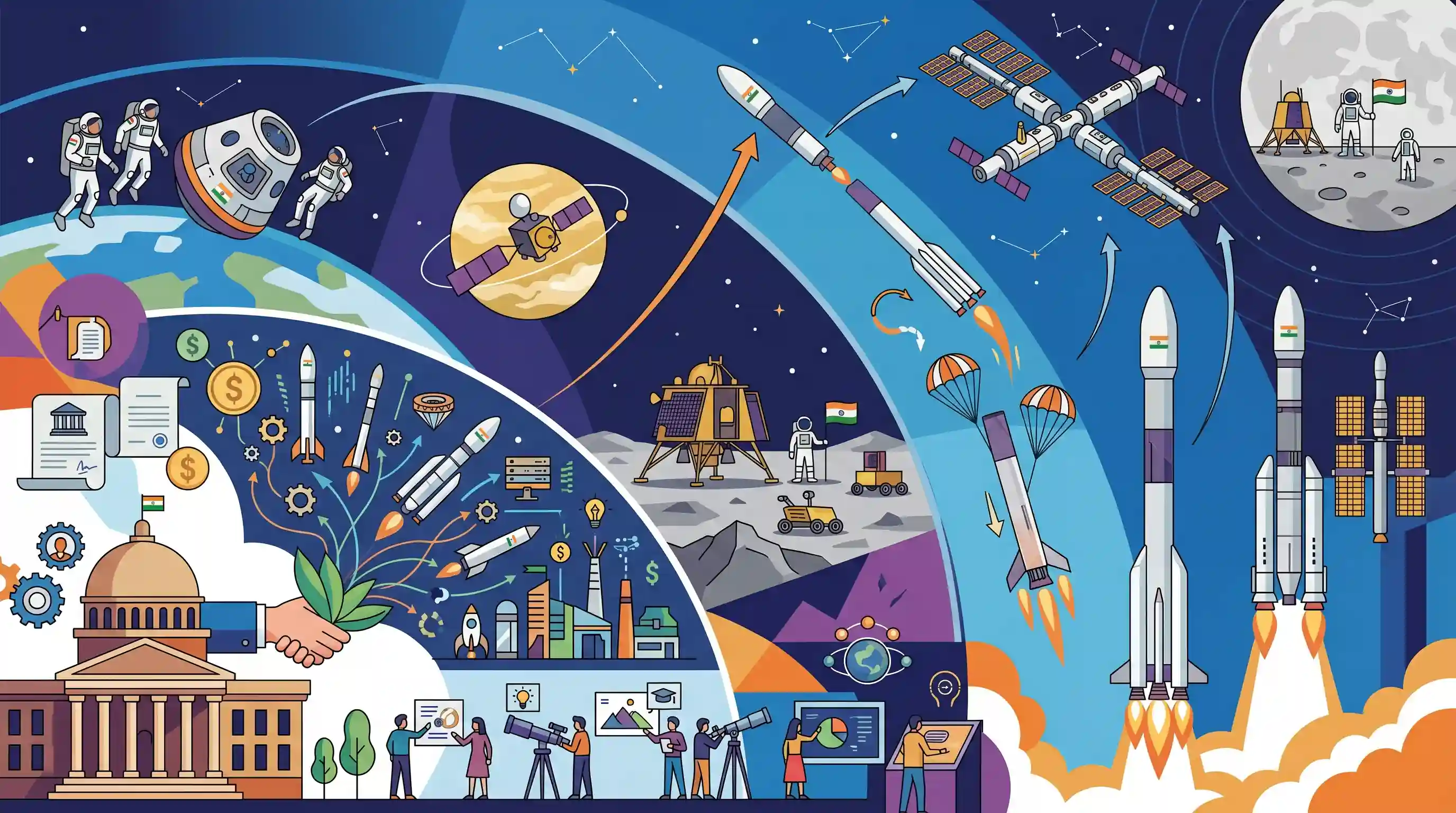
The article provides a comprehensive roadmap of India's future space endeavors, including heavy-lift launch vehicles, manned missions, interplanetary exploration, and a sovereign space station. These developments, along with recent space sector privatization reforms, are critical for GS-3 Science and Technology questions concerning indigenization of technology and advancements in space.
Summary
ISRO is rapidly accelerating India's space ambitions with a robust pipeline of upcoming projects, including the Gaganyaan manned mission, Chandrayaan-4, and the Venus Orbiter Mission. Key infrastructure developments include an advanced heavy-lift rocket and the Next Generation Launch Vehicle (NGLV) with a recoverable first stage. ISRO has also set targets for establishing the Bharathiya Anthariksh Station (BAS) by 2035 and achieving an indigenous manned lunar landing by 2040. These technological leaps are complemented by government space sector reforms designed to cultivate a thriving private space ecosystem.
Key Points
- ISRO is developing an advanced heavy-lift rocket capable of carrying a 75,000 kg payload, standing as tall as a 40-storey building.
- The first unmanned mission of the Gaganyaan program is planned very shortly, with the manned mission in advanced development stages.
- Major future missions approved include Chandrayaan-4, the Venus Orbiter Mission, and the Next Generation Launch Vehicle (NGLV) featuring a recoverable first stage.
- The Bharathiya Anthariksh Station (BAS) is expected to become a reality by 2035, with an indigenous manned Moon landing targeted for 2040.
- Recent space sector reforms by the Government of India aim to foster a vibrant space ecosystem with active private sector participation.
Important Terms
Gaganyaan

India's first human spaceflight mission aiming to send a three-member crew to Low Earth Orbit (400 km) for three days and safely return them. It tests indigenous life-support systems.
UPSC context
GS Paper III (Science & Tech); tests indigenization of technology and human spaceflight capabilities.
Bharathiya Anthariksh Station (BAS)
India's planned indigenous modular space station to be established in Low Earth Orbit by 2035. It will facilitate long-duration human presence and microgravity research.
UPSC context
GS Paper III; critical for long-term space exploration goals and strategic autonomy in orbit.
Chandrayaan-4
ISRO's first lunar sample-return mission designed to land on the Moon, collect samples, and return them safely to Earth. It demonstrates complex in-space docking and lunar lift-off technologies.
UPSC context
GS Paper III; validates technologies required for the planned 2040 indigenous manned lunar landing.
Next Generation Launch Vehicle (NGLV)
A family of cost-effective, heavy-lift rockets (Project Soorya) with a partially reusable first stage. Designed to carry up to 30 tonnes to Low Earth Orbit.
UPSC context
GS Paper III; focuses on low-cost access to space and modernizing India's launch fleet.
Venus Orbiter Mission
Also known as Shukrayaan, it is ISRO's first mission to Venus to study its atmosphere and surface. It will demonstrate 'aerobraking' for orbit adjustment.
UPSC context
GS Paper III; explores planetary evolution and greenhouse effects in interplanetary research.
Prelims Trap
The Gaganyaan manned space mission will be launched using ISRO's Next Generation Launch Vehicle (NGLV).
Gaganyaan relies on the Human-Rated LVM3 (HLVM3), not the NGLV. NGLV is a future heavy-lift rocket with a recoverable first stage, slated for post-Gaganyaan missions.
Static Concepts Connected
What distinguishes the Next Generation Launch Vehicle (NGLV) from the existing LVM3?
- Reusability: LVM3 is fully expendable, whereas the NGLV is being designed with a recoverable and reusable first stage to cut costs.
- Green Propulsion: NGLV will utilize green semi-cryogenic propulsion (such as LOX/Methane) to replace the hazardous, toxic liquid stages found in legacy vehicles.
- Payload & Cost: NGLV targets much higher payload capacities (up to 10-30 tonnes to LEO) at a significantly lower cost per kg compared to LVM3.
What is the institutional framework enabling private sector participation in India's space ecosystem?
- IN-SPACe: Acts as a single-window autonomous agency under DOS to authorize, promote, and regulate private space sector activities.
- NSIL: The commercial arm of DOS/ISRO, responsible for transferring ISRO's technologies, launching satellites, and building launch vehicles through industry consortia.
- Indian Space Policy 2023: Shifts ISRO's core focus to advanced R&D and deep-space missions, while officially empowering Non-Governmental Entities (NGEs) to undertake routine commercial space operations.
Cross-Topic Patterns
Artemis Accords & Lunar 2040 Target
India's indigenous 2040 manned lunar landing goal complements its recent signing of the US-led Artemis Accords, which establishes a framework for sustainable and cooperative lunar exploration.
100% FDI in Space Manufacturing
The development of scalable, commercial launch vehicles like NGLV synergizes perfectly with the 2024 FDI policy amendment, which now permits up to 100% foreign direct investment in launch vehicle manufacturing.

A Prelims multi-statement question contrasting NGLV (recoverable) with LVM3, or matching ISRO's 2035/2040 milestone targets is highly likely.
Linked PYQs · 4
Linked PYQs · 4
- 2023MainsGS3
What is the main task of India's third moon mission which could not be achieved in its earlier mission? List the countries that have achieved this task. Introduce the subsystems in the spacecraft launched and explain the role of the Virtual Launch Control Centre' at the Vikram Sarabhai Space Centre which contributed to the successful launch from Sriharikota.
- 2019MainsGS3
What is India's plan to have its own space station and how will it benefit our space programme?
- 2017MainsGS3
India has achieved remarkable successes in unmanned space missions including the Chandrayaan and Mars Orbitter Mission, but has not ventured into manned space missions. What are the main obstacles to launching a manned space mission, both in terms of technology and logistics? Examine critically.
- 2018PrelimsGS1
With reference to India's satellite launch vehicles, consider the following statements: 1. PSLVs launch the satellites useful for Earth resources monitoring whereas GSLVs are designed mainly to launch communication satellites. 2. Satellites launched by PSLV appear to remain permanently fixed in the same position in the sky, as viewed from a particular location on Earth. 3. GSLV Mk III is a four-staged launch vehicle with the first and third stages using solid rocket motors; and the second and fourth stages using liquid rocket engines. Which of the statements given above is/are correct?
