Growing Diplomatic Isolation of Israel Among Western Allies
Source:The Hindu ↗
Why It Matters
The shifting stance of traditional Western allies against Israel represents a significant geopolitical realignment in West Asia. For India, it underscores the complexities of maintaining 'strategic autonomy'—balancing close bilateral defense ties with Israel against the global consensus on human rights and the historical support for the Palestinian cause.
Summary
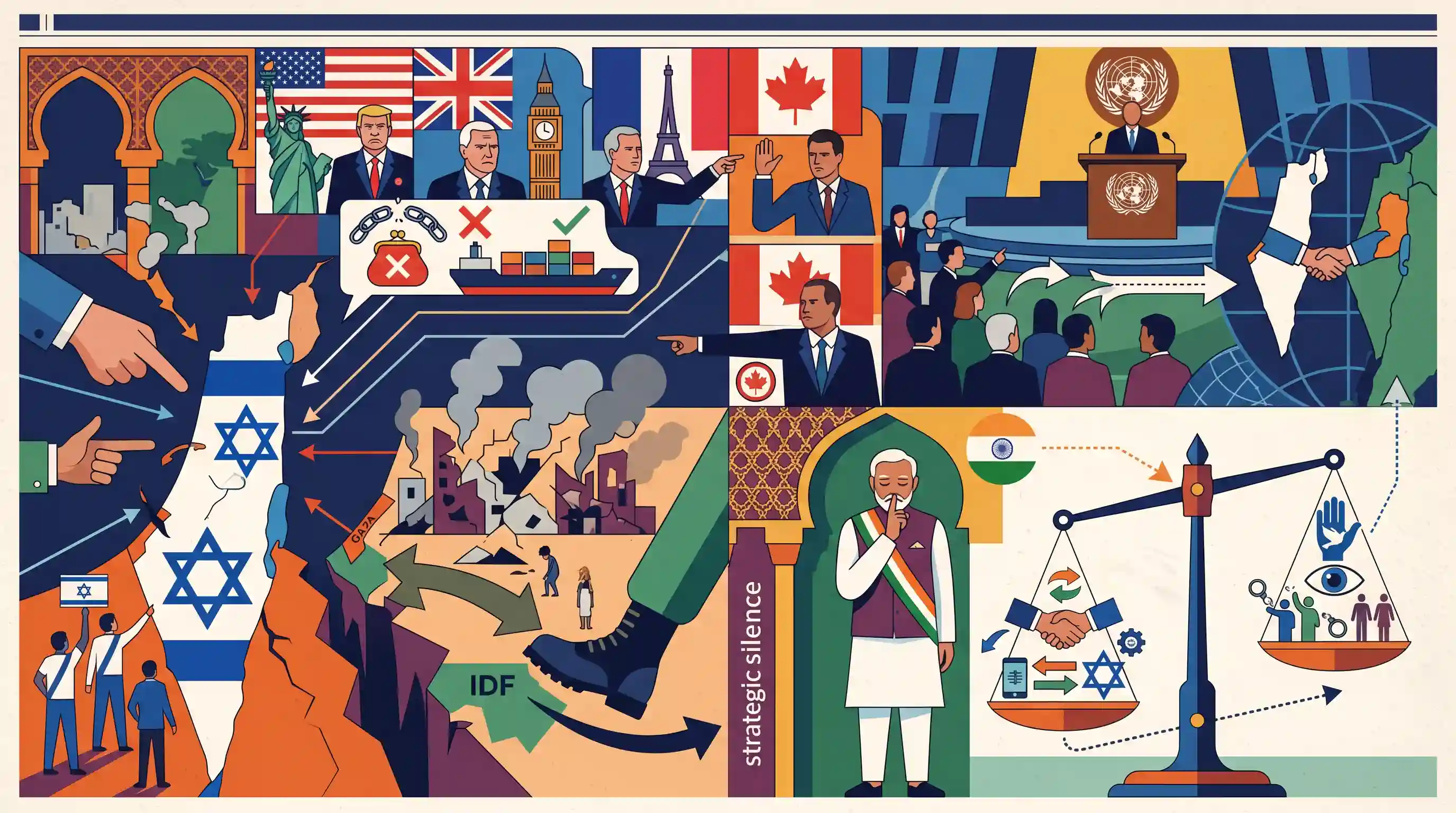
The editorial discusses Israel's increasing diplomatic isolation following its brutal and continuous military campaign in Gaza. Key Western allies—Canada, France, the UK, and the U.S.—have openly criticized the Netanyahu government, citing intolerable human suffering, starvation, and a lack of clear direction in the war. Some nations have threatened sanctions and paused trade talks, while renewing their commitment to a 'two-state solution' at the UN. Meanwhile, the IDF intends to resume full military control of Gaza. The piece also notes India's strategic silence on the issue, cautioning New Delhi against letting its bilateral ties with Israel overshadow human rights concerns.
Key Points
- Israel faces growing diplomatic isolation as key Western allies, including the U.S., Canada, France, and the UK, criticize its military actions in Gaza and threaten sanctions or pause trade talks.
- A severe humanitarian crisis is unfolding in Gaza, with widespread starvation and over 3,000 casualties reported since the March 18 ceasefire ended.
- The Israel Defense Forces (IDF) plan to re-establish full military control over the Gaza Strip, effectively reversing its 2005 disengagement.
- Western leaders are renewing their push for a two-state solution, proposing discussions at an upcoming UN conference to address the intolerable suffering of Palestinians.
- India has maintained a strategic silence, likely balancing its domestic preoccupations and strategic ties with Israel, though the editorial cautions against conflating this silence with tacit approval of human rights violations.
Important Terms
Two-state solution

A proposed diplomatic framework establishing an independent State of Palestine alongside Israel. It is the internationally endorsed baseline for resolving the decades-long regional conflict.
UPSC context
GS-2 (IR); vital for understanding India's historical support for Palestinian sovereignty while maintaining strategic ties with Israel.
Hamas
A Palestinian Sunni-Islamic militant group that has governed the Gaza Strip since 2007. Its 2023 attack on Israel triggered the current high-intensity war.
UPSC context
GS-2/3 (IR & Security); critical for analyzing non-state actors, terrorism, and their influence on West Asian geopolitics.
Operation Sindoor
Based on search results, a 2025 Indian military response to terror attacks in Pahalgam; it signifies a strategic pivot in India-Israel cooperation through shared defense technology.
UPSC context
GS-2 (IR); highlights the deepening India-Israel defense partnership and India's evolving 'proactive' counter-terrorism doctrine.
Israel Defense Forces (IDF)
The national military of Israel, currently conducting 'Operation Iron Swords' in Gaza to dismantle Hamas infrastructure following the October 7, 2023, attacks.
UPSC context
GS-2 (IR); relevant for studying modern urban warfare, international humanitarian law, and West Asian military dynamics.
United Nations (UN)
An international organization currently serving as the primary platform for debating Gaza’s humanitarian crisis, ceasefire resolutions, and the legality of Israel’s military conduct.
UPSC context
GS-2 (International Institutions); tests knowledge of multilateral diplomacy and the role of global bodies in conflict resolution.
Gaza Strip
A densely populated coastal territory on the Mediterranean, governed by Hamas and under blockade by Israel and Egypt, currently the main theater of conflict.
UPSC context
GS-1 (Geography) & GS-2 (IR); essential for mapping geopolitical flashpoints and understanding the humanitarian dimensions of the conflict.
Prelims Trap
"Following the 2005 Disengagement Plan, the UN ceased to recognize the Gaza Strip as an occupied territory."
False. Despite the 2005 troop withdrawal, the UN and international law consider Gaza occupied because Israel retains effective control over its borders, airspace, and coastline.
Static Concepts Connected
What is India's "De-hyphenation" policy regarding West Asia?
- Independent tracks: Treating relations with Israel and Palestine as mutually independent and exclusive, rather than linking one to the other in a zero-sum game.
- Ideological shift: Moving away from historically viewing bilateral ties with Israel purely through the ideological lens of the Palestinian cause.
- Strategic autonomy: Allows India to pursue advanced defense and tech ties with Israel while maintaining diplomatic and capacity-building support for Palestine.
Which frameworks form the historical basis of the Two-State Solution?
- UN Resolution 181: The 1947 UN General Assembly resolution that recommended partitioning Mandatory Palestine into independent Arab and Jewish States.
- UN Resolution 242: Passed after the 1967 Six-Day War, establishing the "land for peace" formula and calling for Israeli withdrawal from occupied territories.
- Oslo Accords: The 1990s agreements that created the Palestinian Authority with limited self-rule, originally intended as a stepping stone toward full statehood.
Cross-Topic Patterns
Gaza crisis impacts IMEC & I2U2
Israel's isolation threatens the viability of the India-Middle East-Europe Economic Corridor (IMEC) and I2U2, both of which heavily rely on Arab-Israeli normalization via the Abraham Accords.
Strategic Autonomy vs. Human Rights diplomacy
India’s "strategic silence" mirrors its stance on the Russia-Ukraine war, demonstrating a consistent foreign policy that prioritizes national defense and economic interests over Western-led moral posturing.

Expect a Mains question linking India's de-hyphenation policy in West Asia to the stalling of the Abraham Accords and IMEC project.
Linked PYQs · 2
Linked PYQs · 2
- 2018MainsGS2
“India’s relations with Israel have, of late, acquired a depth and diversity, which cannot be rolled back.” Discuss.
- 2022MainsGS2
How will I2U2 (India, Israel, UAE and USA) grouping transform India's position in global politics?
