Israeli Strikes in Lebanon Test Fragile Washington Ceasefire Agreement
Source:Indian Express ↗
Why It Matters
The Israel-Hezbollah conflict is central to understanding the shifting geopolitical dynamics of West Asia, involving major powers like the US and regional powers like Iran and Israel. It provides a contemporary case study of how proxy conflicts, non-state actors (Hezbollah), and violations of state sovereignty challenge international law and diplomatic ceasefire efforts, which is highly relevant for GS Paper 2 International Relations.
Summary
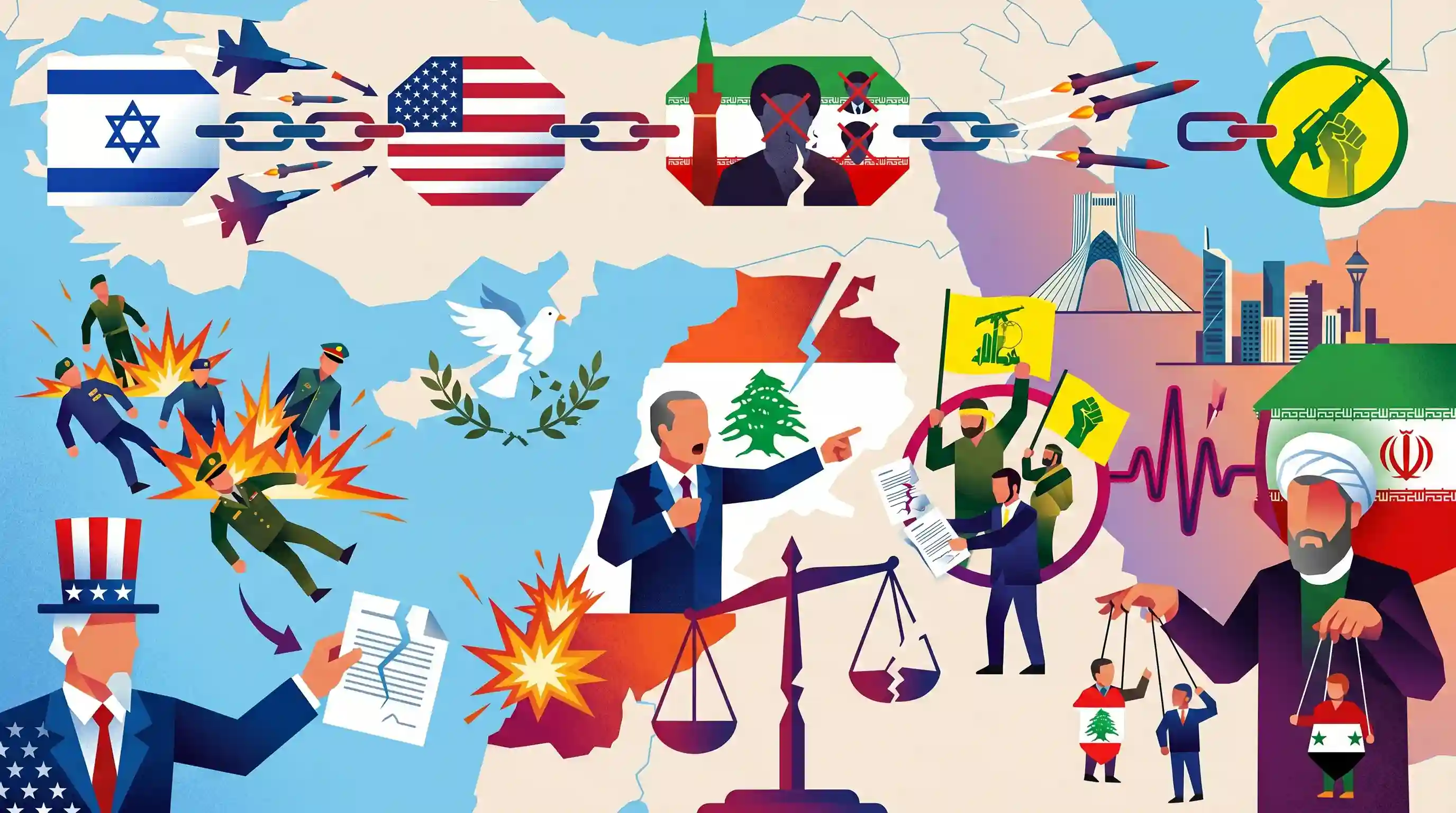
Israeli strikes in southern Lebanon have killed nine people, including three Lebanese army officers, just days after a US-brokered ceasefire was reached in Washington. The ceasefire sought to end a war that erupted in March 2026, which was triggered by Hezbollah's rocket attacks in retaliation for US and Israeli strikes on Iran following the assassination of Iran's Supreme Leader. Lebanese President Joseph Aoun strongly condemned the recent Israeli strikes as a violation of sovereignty and international law. Meanwhile, internal political friction is intensifying as Iran-aligned Hezbollah rejected the ceasefire agreement, prompting criticism from the Lebanese government over Iran using the nation as a bargaining chip. The breakdown highlights the volatile proxy dynamics and fragility of diplomatic resolutions in West Asia.
Key Points
- Israeli strikes in southern Lebanon killed nine individuals, including three Lebanese army officers, shortly after a US-brokered ceasefire was negotiated in Washington.
- The ceasefire intended to halt a war that ignited in March 2026 after Hezbollah fired rockets in response to US-Israeli attacks on Iran (which followed the killing of Iran's Supreme Leader).
- Lebanese President Joseph Aoun condemned the Israeli attack as a flagrant violation of Lebanon's sovereignty and international law.
- Hezbollah rejected the Washington ceasefire, exacerbating tensions with the Lebanese government, which accused Iran of using Lebanon as a bargaining chip in proxy conflicts.
- The conflict traces back to Hezbollah opening a front in October 2023, escalating repeatedly despite temporary ceasefires, with Israel having previously seized a fifth of Lebanese territory.
Important Terms
US-brokered ceasefire agreement

A diplomatic resolution mediated by the US to halt hostilities between Israel and Lebanon, aimed at restoring state authority and ending regional spillover.
UPSC context
GS Paper II: International Relations. Tests knowledge of diplomatic conflict resolution and the role of major powers in West Asia.
Hezbollah
A Lebanon-based Shia political and militant organization backed by Iran. It operates as a powerful non-state actor, often independent of the Lebanese state.
UPSC context
GS Paper II & III: Effect of non-state actors on security and India's regional interests.
Lebanese Armed Forces (LAF)
The national military of Lebanon, responsible for territorial integrity. It often faces challenges in asserting control over regions dominated by paramilitary groups like Hezbollah.
UPSC context
GS Paper II: International Relations. Relevant to state sovereignty and the challenges of dual-power structures in governance.
Proxy War
A conflict where opposing powers use third parties as substitutes for fighting each other directly, common in West Asia between Iran and its rivals.
UPSC context
GS Paper II: West Asia Geopolitics. Evaluates understanding of regional stability and external influence on sovereign states.
Sovereignty
The authority of a state to govern itself without external interference. Recent strikes in Lebanon highlight the fragility of sovereignty in conflict-prone regions.
UPSC context
GS Paper II: Fundamental political concept regarding territorial integrity and international law.
Prelims Trap
"The Blue Line is the permanent, internationally recognized sovereign border between Israel and Lebanon."
The Blue Line is actually a 'Line of Withdrawal' published by the UN in 2000 to verify Israeli troops leaving Lebanon. It is a temporary de facto boundary, not a formal international border.
Static Concepts Connected
What are the key geopolitical markers defining the Israel-Lebanon conflict zone?
- Blue Line: A UN-published line of withdrawal (2000) verifying Israeli retreat, acting as a highly volatile de facto boundary rather than an official border.
- Litani River: The longest river wholly inside Lebanon; it acts as the northern boundary for the southern demilitarized zone mandated by UNSC Resolution 1701.
- Shebaa Farms: A disputed territory at the Lebanon-Syria-Israel border intersection, frequently cited by Hezbollah to justify its continued armed resistance against Israel.
How does UNIFIL function and what is India's role in it?
- Peacekeeping Mandate: Established in 1978, it monitors hostilities and assists the Lebanese Armed Forces, operating under Chapter VI (consent-based peacekeeping) of the UN Charter.
- UNSC Res 1701: Tasked with ensuring the area between the Blue Line and the Litani river is free of unauthorized armed personnel, such as Hezbollah fighters.
- Indian Deployment: India remains one of the largest troop contributors. Managing a battalion in southern Lebanon makes troop safety a direct national interest for New Delhi during regional escalations.
Cross-Topic Patterns
Non-state militias and sovereign diplomacy
Hezbollah's veto of the Washington ceasefire mirrors Houthi actions in Yemen, demonstrating how Iran's "Axis of Resistance" overrides formal state structures and complicates traditional conflict resolution.
Map dynamics of West Asian conflicts
The UPSC frequently links current conflicts to physical geography. The Litani River's strategic role complements past questions on the Golan Heights, Gaza Strip, and Red Sea chokepoints.

Expect a 2026 Prelims pair-matching question linking regional rivers (Litani, Jordan) and border terms (Blue Line) to specific conflict zones.
Linked PYQs · 2
Linked PYQs · 2
- 2019MainsGS2
‘Too little cash, too much politics, leaves UNESCO fighting for life.’ Discuss the statement in the light of US' withdrawal and its accusation of the cultural body as being 'anti-Israel bias'.
- 2024MainsGS2
‘Terrorism has become a significant threat to global peace and security.’ Evaluate the effectiveness of the United Nations Security Council's Counter Terrorism Committee (CTC) and its associated bodies in addressing and mitigating this threat at the international level.
