Israeli Military Security Zone Expansion in Lebanon
Source:The Hindu ↗
Why It Matters
The continuing escalation of the Israel-Hezbollah conflict heavily impacts Middle East stability, affecting global energy markets, international shipping routes, and diplomatic alliances. The establishment of cross-border 'security zones' also poses critical questions regarding international law and territorial sovereignty. For UPSC aspirants, the Levant region is a highly recurrent theme for Prelims map-based questions.
Summary
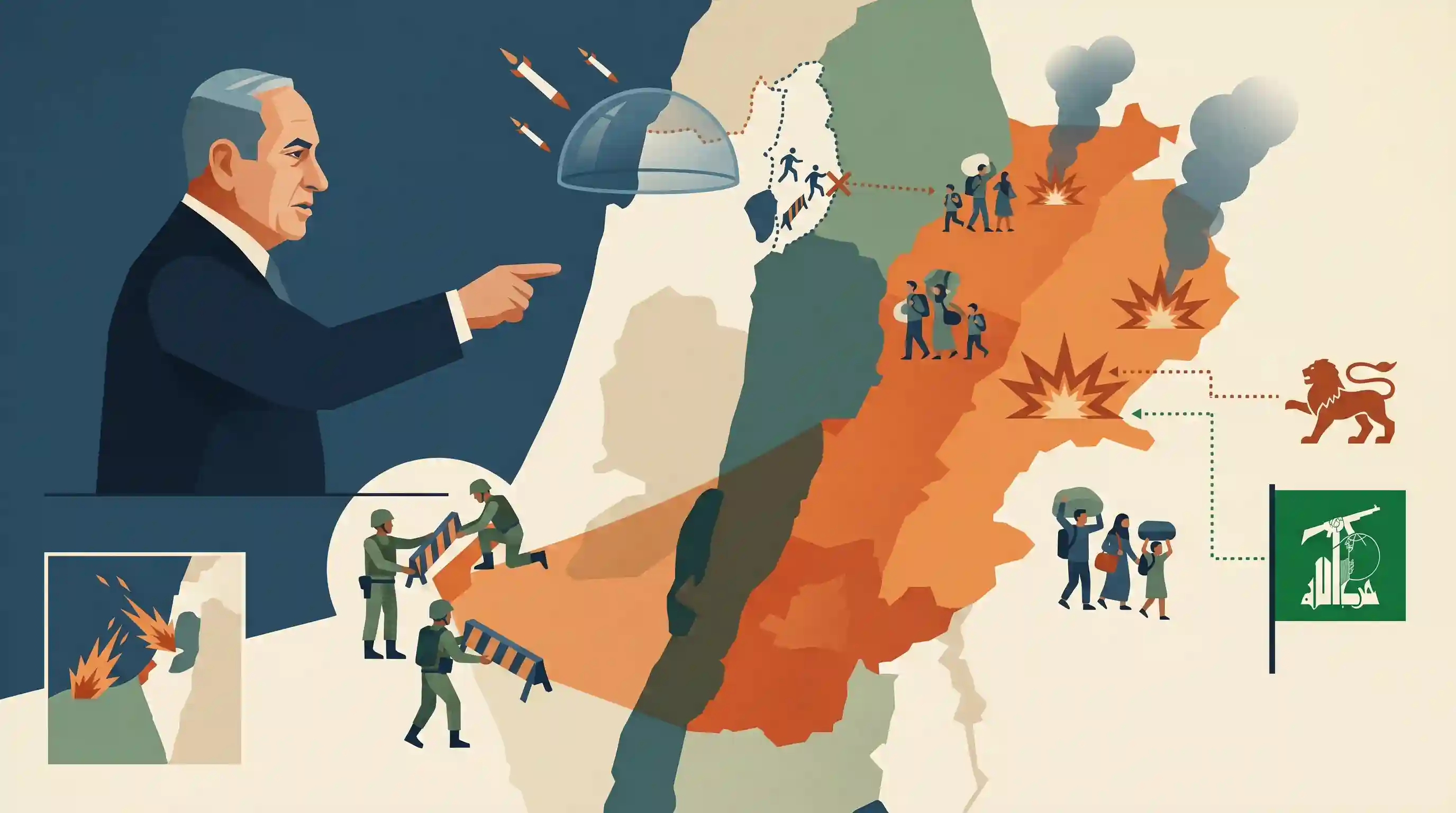
Israeli Prime Minister Benjamin Netanyahu announced orders for the military to further expand a "security zone" inside Lebanon as part of its ongoing campaign against the militant group Hezbollah. Asserting that Hezbollah, along with Hamas and Iran, are "defeated enemies" fighting for survival, Netanyahu stated the expanded zone aims to eliminate residual threats, particularly rocket fire and cross-border infiltrations. The escalation follows a year of border skirmishes linked to the Gaza war, leading to significant displacements in northern Israel and intense bombardments across Lebanon.
Key Points
- Israeli Prime Minister Benjamin Netanyahu has ordered the military to 'further expand' a security zone within Lebanon to counter Hezbollah.
- The expansion aims to neutralize Hezbollah's 'residual capabilities' and protect northern Israel from rocket fire and cross-border infiltrations.
- This development follows months of intensive Israeli bombardments targeting Hezbollah strongholds in southern and eastern Lebanon, as well as Beirut's suburbs.
- The conflict has escalated significantly since late September, evolving from a year of cross-border skirmishes triggered by the Gaza war.
Important Terms
Security Zone (Lebanon)

A buffer strip in southern Lebanon established by the Israeli military to neutralize threats from rocket fire and prevent cross-border incursions into northern Israel.
UPSC context
GS Paper II (International Relations). Tests understanding of border security mechanisms and the history of Arab-Israeli conflicts.
Litani River
Lebanon's longest river, flowing south through the Beqaa Valley before turning west to the Mediterranean; it serves as a critical strategic and security boundary in regional conflicts.
UPSC context
Prelims (Map-based Geography) and GS Paper II. Defines the northern limit for security buffer zones in South Lebanon.
Blue Line
A 120km demarcation line identified by the United Nations in 2000 to verify Israeli withdrawal from Lebanon; it is a 'line of withdrawal,' not an official border.
UPSC context
Prelims (Places in News) and GS II. It represents the de facto frontier and flashpoint between Israel and Lebanon.
Hezbollah
A Lebanon-based Shia militant group and political party supported by Iran. Founded in the 1980s, it is a major regional military power and key Iranian proxy.
UPSC context
GS II (West Asia) and GS III (Internal Security). Tests knowledge of non-state actors and regional power dynamics.
UNSC Resolution 1701
A 2006 United Nations resolution aiming to resolve the Israel-Hezbollah war, mandating a zone between the Blue Line and the Litani River free of unauthorized armed personnel.
UPSC context
GS II (International Institutions). Evaluates knowledge of UN peacekeeping frameworks and diplomatic resolutions in West Asia.
Hamas
A Palestinian Sunni militant organization governing the Gaza Strip. It triggered the current regional escalation through its October 2023 attacks on Israel.
UPSC context
GS II (International Relations). Essential for understanding the interconnected nature of security and diplomacy in the Middle East.
Prelims Trap
"The 'Blue Line' is the officially recognized international border separating Israel and Palestine."
The Blue Line is a UN-published demarcation line between Lebanon and Israel (established 2000), acting as a de facto boundary. It is not a permanent international border, nor does it involve Palestine.
Static Concepts Connected
Which countries and water bodies share borders with Israel and Lebanon?
- Israel's borders: Shares land borders with Lebanon (north), Syria (northeast), Jordan (east), and Egypt (southwest). It opens to the Mediterranean Sea to the west.
- Lebanon's borders: Situated on the Mediterranean coast, it shares land borders with only two nations: Syria (north and east) and Israel (south).
- No shared borders: Despite their proximity in the Levant region, Lebanon does not share any land border with Jordan or Egypt.
What are the strategic geographical markers in the Israel-Lebanon conflict?
- Blue Line: A boundary published by the UN in 2000 to confirm Israel's withdrawal from southern Lebanon. It acts as the de facto border.
- Litani River: The longest river flowing entirely within Lebanon. UN Security Council Resolution 1701 mandates the area south of it be a buffer zone.
Cross-Topic Patterns
Proxy actors and maritime security
Hezbollah's land conflict connects to Houthi naval disruptions. UPSC often links West Asian non-state actors (Axis of Resistance) with global supply chain impacts at critical maritime choke points.
UN Peacekeeping and Indian interests
Israel's incursions into southern Lebanon directly threaten the UNIFIL buffer zone. This links West Asian geopolitics to India's strategic interests as a major troop-contributing nation to UN missions.

Expect a matching-pair Prelims question linking West Asian markers: 'Blue Line - Israel/Lebanon', 'Litani River - Lebanon'.
Linked PYQs · 4
Linked PYQs · 4
- 2017PrelimsGS1
Mediterranean Sea is a border of which of the following countries? 1. Jordan 2. Iraq 3. Lebanon 4. Syria Select the correct answer using the code given below:
- 2022PrelimsGS1
The term "Levant" often heard in the news roughly corresponds to which of the following regions?
- 2003PrelimsGS1
Israel has common borders with
- 2018MainsGS2
“India’s relations with Israel have, of late, acquired a depth and diversity, which cannot be rolled back.” Discuss.
