Netanyahu orders Gaza strikes following ceasefire violations
Source:The Hindu ↗
Why It Matters
The Israel-Palestine conflict is a core topic in UPSC International Relations (GS2), affecting global geopolitics, energy security, and regional stability in the Middle East. Understanding ceasefire mechanics, mediator roles, and the humanitarian dimensions is critical for mains answers and prelims mapping.
Summary
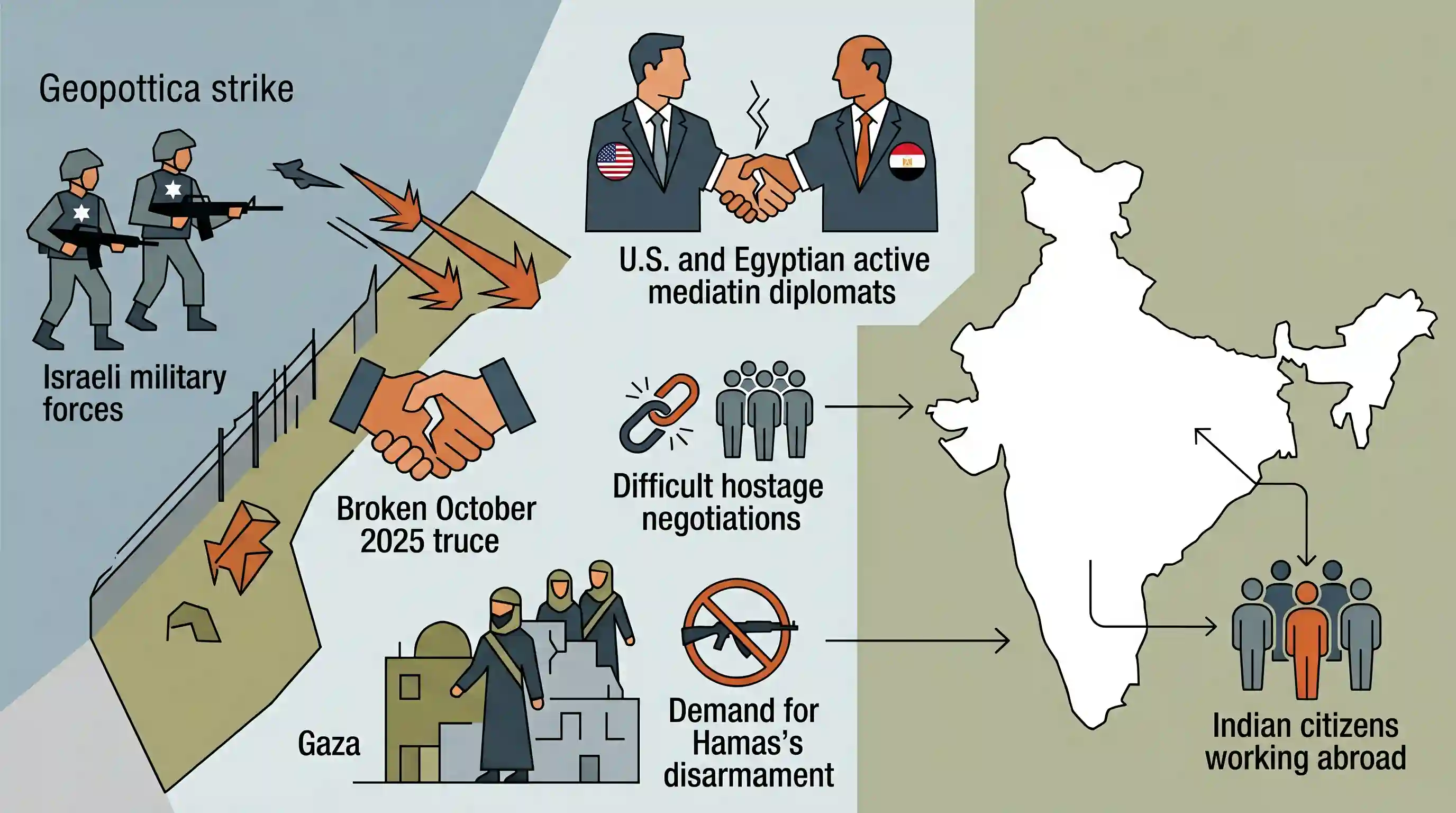
Israeli Prime Minister Benjamin Netanyahu has ordered immediate military strikes across Gaza following alleged ceasefire violations by Hamas, escalating tensions and threatening the fragile US-brokered October 2025 truce. The dispute centers on skirmishes in Rafah and the problematic handover of hostage remains, complicating the ceasefire\'s subsequent stages which demand Hamas\'s disarmament and the potential deployment of an international security force. Mediators from Egypt and the US are actively engaged to salvage the agreement amidst the widespread devastation in the Strip.
Key Points
- Israeli PM Benjamin Netanyahu ordered strikes in Gaza after accusing Hamas of violating a US-brokered ceasefire by firing at Israeli troops and returning incomplete/unidentified hostage remains.
- The ceasefire is under pressure due to disputes over the return of hostages' bodies, which Israel claims Hamas is purposely delaying, while Hamas cites challenges locating them amidst destruction.
- Egypt is assisting recovery efforts by deploying experts and equipment to Gaza (Khan Younis and Nuseirat).
- Implementation of the ceasefire's next stages is complicated, involving difficult issues such as the disarmament of Hamas, deploying an international security force, and determining Gaza\'s future governance.
- The two-year war has resulted in over 68,500 Palestinian fatalities and massive displacement, with the international community (U.S., Arab nations) mediating to prevent a complete collapse of the truce.
Important Terms
October 2025 Gaza Ceasefire Agreement

A US-brokered multilateral accord (Comprehensive Plan to End the Gaza Conflict) signed in October 2025. It stipulates a permanent ceasefire, phased hostage releases, and a transition to international security oversight.
UPSC context
GS Paper 2: International Relations. Tests knowledge of recent diplomatic milestones and peacekeeping frameworks in high-conflict regions.
Hamas
A Palestinian Sunni-Islamic militant and political group that has governed the Gaza Strip since 2007. It is a central non-state actor in the ongoing conflict with Israel.
UPSC context
GS Paper 2: International Relations. Tests understanding of regional actors and their role in West Asian stability.
Rafah
A strategic city in southern Gaza on the Egyptian border. It contains the Rafah Crossing, the only entry point to Gaza not directly controlled by Israel.
UPSC context
Geography/IR (Places in News). Tests awareness of strategic chokepoints and humanitarian corridors.
International Stabilization Force (ISF)
A peacekeeping body proposed under the 2025 peace plan to secure Gaza, train local police, and replace Hamas's military control during a transitional phase.
UPSC context
GS Paper 2: International Relations. Relates to global peacekeeping mechanisms and post-conflict reconstruction.
West Asia Geopolitics
The political and economic dynamics of the Middle East, critical to India for energy security, a 9-million-strong diaspora, and strategic maritime trade routes.
UPSC context
GS Paper 2: IR. Tests the "Effect of policies and politics of developed and developing countries on India’s interests."
Prelims Trap
"The Gaza Strip shares a maritime boundary with the Red Sea, and the Rafah crossing connects Gaza directly to Israel."
Aspirants often assume Gaza opens to the Red Sea or Jordan. Gaza borders only Israel, Egypt, and the Mediterranean Sea; Rafah crossing connects exclusively to Egypt.
Static Concepts Connected
What are the key geographical borders of the Gaza Strip?
- Land Borders: Gaza is bordered by Israel to the north and east, and Egypt to the southwest.
- Maritime Border: It forms a narrow enclave along the eastern coast of the Mediterranean Sea.
- Rafah Crossing: The sole civilian crossing into Egypt; acts as a critical chokepoint for humanitarian aid and is not directly controlled by Israel.
What is India's 'De-hyphenation' policy in West Asia?
- Independent Ties: Treating bilateral relations with Israel and Palestine as independent, rather than linking them together as a zero-sum game.
- Strategic Balance: It allows India to advance strategic, tech, and defense partnerships with Israel while maintaining historical diplomatic support for a two-state solution.
Cross-Topic Patterns
Gaza conflict delaying IMEC operationalization
Prolonged instability in Gaza directly threatens the viability of the India-Middle East-Europe Economic Corridor (IMEC), forcing reliance on traditional maritime routes and inflating energy security risks for India.
Non-state actors dictating geopolitics
The prominence of Hamas and Hezbollah in diplomatic negotiations underscores a growing UPSC trend: analyzing the geopolitical disruptions caused by armed non-state actors on global supply chains.

Map-matching questions linking Gaza crossings (Rafah, Erez) to bordering nations, alongside IMEC's geopolitical hurdles, are highly probable.
Linked PYQs · 3
Linked PYQs · 3
- 2018MainsGS2
“India’s relations with Israel have, of late, acquired a depth and diversity, which cannot be rolled back.” Discuss.
- 2025MainsGS2
"Energy security constitutes the dominant kingpin of India's foreign policy, and is linked with India's overarching influence in Middle Eastern countries.” How would you integrate energy security with India's foreign policy trajectories in the coming years?
- 2003PrelimsGS1
Israel has common borders with
