Red Sea Missile Attacks and Maritime Security Disruptions
Source:The Hindu ↗
Why It Matters
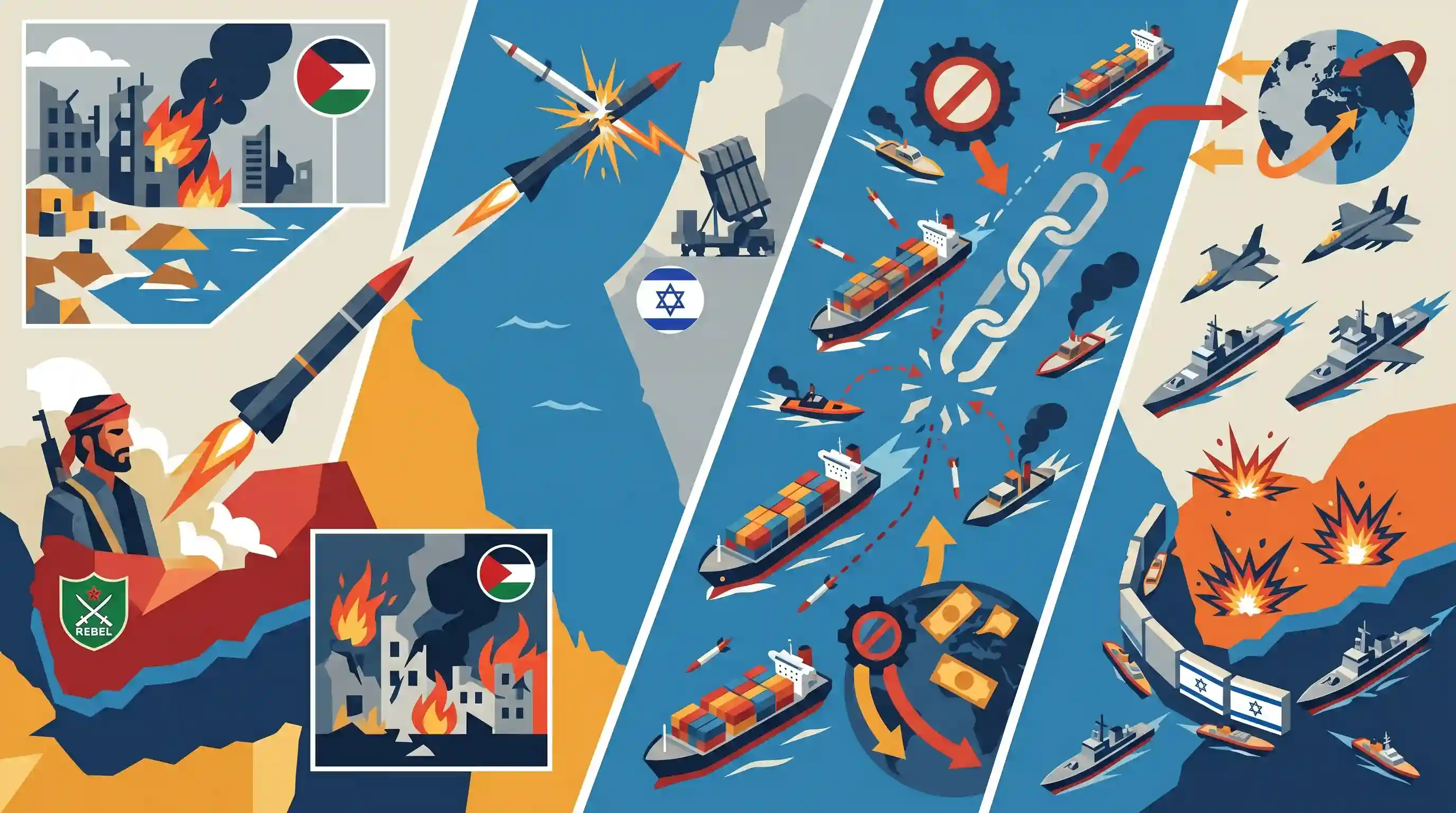
The Red Sea is a critical maritime chokepoint. Houthi attacks disrupt global shipping lanes, forcing vessels to reroute, which spikes global energy and freight costs. This poses a direct threat to India's energy security and international trade, underscoring the broader economic ripple effects of the ongoing Israel-Hamas conflict.
Summary
The Israeli military reported intercepting a missile launched from Yemen by the Iran-aligned Houthi movement. In response to ongoing hostilities, Israel has threatened to impose a naval and air blockade on Yemen if the attacks persist. Since the outbreak of the Gaza war in October 2023, the Houthis have consistently targeted both Israel and commercial shipping vessels in the Red Sea to show solidarity with Palestinians. These actions have triggered retaliatory strikes from Israel and caused severe disruptions to global maritime trade along one of the world's most critical shipping corridors.
Key Points
- The Israeli military successfully intercepted a missile fired from Yemen by the Iran-aligned Houthi movement.
- Israel has threatened the Houthis with a naval and air blockade if attacks continue.
- Since October 2023, Houthis have been targeting Israel and commercial shipping in the Red Sea, claiming solidarity with Palestinians in Gaza.
- The continuous missile and drone strikes have significantly disrupted global maritime trade routes passing through the Red Sea.
Important Terms
Houthi Movement (Ansar Allah)

An Iranian-backed Zaydi Shia rebel group in Yemen, officially known as Ansar Allah. They currently control northern Yemen and have targeted Red Sea shipping to show solidarity with Palestinians since late 2023.
UPSC context
GS Paper II: International Relations. Focuses on West Asia conflict, non-state actors, and impacts on India's energy and maritime security.
Bab-el-Mandeb Strait
A strategic maritime chokepoint between the Arabian Peninsula and the Horn of Africa, connecting the Red Sea to the Gulf of Aden. It is a vital artery for global trade and energy.
UPSC context
GS Paper I: World Geography. Tests knowledge of critical maritime passages, trade routes, and geographical chokepoints.
Red Sea Crisis
A period of maritime instability (2023-present) where Houthi rebels attacked commercial vessels in the Red Sea, forcing global shipping to reroute via the Cape of Good Hope, increasing costs and delays.
UPSC context
GS Paper III: Economy/Security. Relates to global supply chain disruptions, India's export vulnerabilities, and maritime security challenges.
Maritime Security
The protection of sea-based activities and infrastructure against threats like piracy and non-state aggression. For India, it involves safeguarding the Indian Ocean Region and sea lines of communication.
UPSC context
GS Paper III: Internal Security. Focuses on protecting the coastline, preventing sea-based terrorism, and ensuring freedom of navigation.
West Asia Geopolitics
The complex interplay of political and religious power between actors like Iran, Saudi Arabia, and Israel. It significantly influences global energy markets and India's 'Connect West' policy.
UPSC context
GS Paper II: International Relations. Examines bilateral relations, regional stability, and the impact of Middle East conflicts on global politics.
Axis of Resistance
An informal anti-Israel and anti-Western political and military coalition led by Iran, including groups like the Houthis, Hezbollah, and Hamas, aimed at exerting influence in the Middle East.
UPSC context
GS Paper II: International Relations. Contextualizes the alignment of non-state actors in regional conflicts and Iran’s strategic depth in West Asia.
Prelims Trap
Bab-el-Mandeb connects the Red Sea to the Persian Gulf and is bordered by Oman.
It actually connects the Red Sea to the Gulf of Aden and is bordered by Yemen, Djibouti, and Eritrea. The Persian Gulf is accessed via the Strait of Hormuz.
Static Concepts Connected
What are the key maritime chokepoints surrounding the Arabian Peninsula?
- Bab-el-Mandeb: Connects the Red Sea to the Gulf of Aden, acting as a chokepoint between the Horn of Africa and the Middle East.
- Strait of Hormuz: Connects the Persian Gulf to the Gulf of Oman and the Arabian Sea, bordered by Iran, Oman, and the UAE. Critical for global oil transit.
- Suez Canal: An artificial sea-level waterway in Egypt, connecting the Mediterranean Sea to the Red Sea, severing Africa from Asia.
How do Red Sea disruptions impact India's macroeconomic stability?
- Freight Costs: Rerouting via the Cape of Good Hope adds 12-15 days to transit, severely increasing freight, logistics, and marine insurance costs.
- Current Account Deficit: Higher imported crude prices and delayed exports widen the Current Account Deficit (CAD) and introduce imported inflation into the domestic economy.
- Agricultural Inputs: Delays in importing essential inputs like potash and fertilizers from the Middle East threaten domestic agricultural sowing cycles.
Cross-Topic Patterns
Indian Navy as Net Security Provider
The Red Sea crisis underscores the Indian Navy's strategic importance via the deployment of guided-missile destroyers and 'Operation Sankalp' to protect merchant vessels in the Western Indian Ocean.
Geopolitics triggering Imported Inflation
Rerouting global trade via the Cape of Good Hope surges freight and insurance rates, directly spilling over into India's Current Account Deficit (CAD) and exacerbating imported inflation.

Map questions pairing West Asian chokepoints (Bab-el-Mandeb, Hormuz) with regional actors (Houthis) or bordering nations are highly likely.
Linked PYQs · 3
Linked PYQs · 3
- 2025MainsGS2
"Energy security constitutes the dominant kingpin of India's foreign policy, and is linked with India's overarching influence in Middle Eastern countries.” How would you integrate energy security with India's foreign policy trajectories in the coming years?
- 2018MainsGS2
“India’s relations with Israel have, of late, acquired a depth and diversity, which cannot be rolled back.” Discuss.
- 2021MainsGS3
How is S-400 air defence system technically superior to any other system presently available in the world?
