Israel Gaza Airstrikes and Humanitarian Aid Border Closures
Source:The Hindu ↗
Why It Matters
The ongoing Israel-Hamas conflict and repeated ceasefire violations have profound implications for Middle Eastern stability, global energy markets, and international trade routes. For UPSC aspirants, understanding the geographical nuances (like the Rafah crossing), the humanitarian role of the UN, and the geopolitical complexities of the two-state solution is essential for International Relations and Geography questions.
Summary
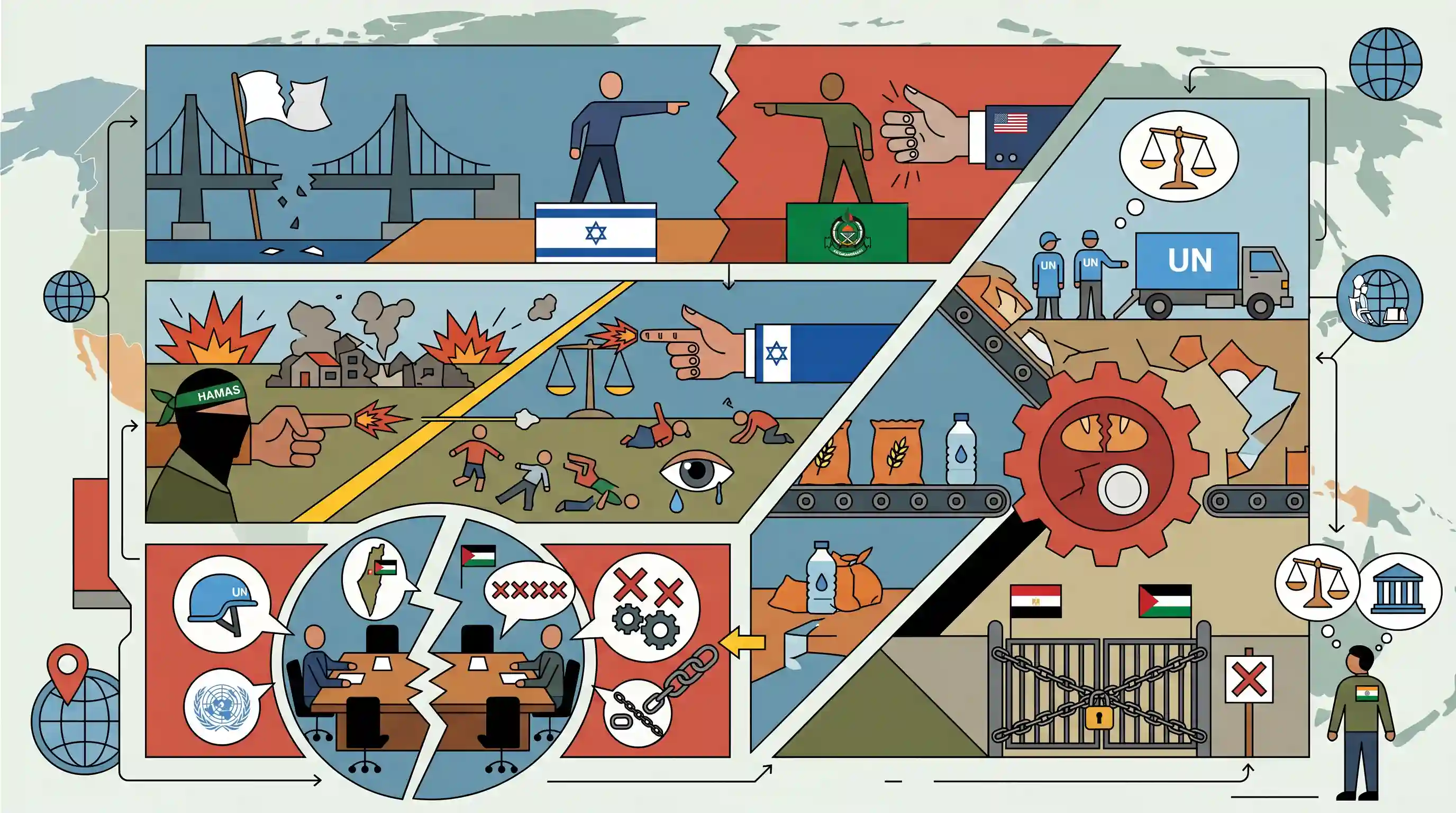
A U.S.-brokered ceasefire in Gaza faces potential collapse as Israel and Hamas accuse each other of violating the agreement. Israeli airstrikes targeted areas across Gaza following allegations that Hamas militants fired on Israeli soldiers operating behind the designated "yellow line." The Gaza government reported multiple Israeli violations causing civilian casualties. The renewed violence has halted the entry of humanitarian aid, severely undermining UN efforts to address the widespread famine in the enclave, while the Rafah border crossing with Egypt remains closed. Broader diplomatic efforts, including negotiations for a second ceasefire phase and long-term stabilization plans involving an international force and discussions around a Palestinian state, remain highly contentious.
Key Points
- Renewed hostilities erupted in Gaza after the Israeli military launched airstrikes and artillery fire, blaming Hamas for shooting at Israeli troops from behind the designated 'yellow line'.
- Hamas and the Gaza government accused Israel of widespread ceasefire violations, including 47 separate incidents that resulted in civilian casualties, arrests, and the destruction of infrastructure.
- The volatile security situation has forced a halt to humanitarian aid entry into Gaza, exacerbating the famine and severely challenging UN relief efforts.
- The Rafah border crossing between Gaza and Egypt remains closed, cutting off a critical route for the movement of goods and people.
- Geopolitical tensions persist as stakeholders grapple with post-war scenarios, such as the potential deployment of an international stabilization force, the disarmament of militant groups, and debates surrounding the creation of a Palestinian state.
Important Terms
Two-state solution

A proposed diplomatic framework where independent Israeli and Palestinian states coexist. It aims to resolve the conflict by addressing sovereignty, borders, and the status of Jerusalem.
UPSC context
GS Paper II: International Relations. Tests understanding of West Asia peace processes and India's long-standing diplomatic position supporting a sovereign Palestine.
Hamas
A Palestinian Islamist political and militant organization that has governed the Gaza Strip since 2007. It is designated as a terrorist group by several countries and international entities.
UPSC context
GS Paper II: International Relations. Crucial for understanding non-state actors in regional conflicts and their impact on global security and Indian interests.
U.S.-proposed ceasefire plan
A three-phase diplomatic framework (e.g., Biden/Trump plans) involving a temporary truce, hostage-prisoner exchange, Israeli military withdrawal from populated areas, and a permanent end to hostilities.
UPSC context
GS Paper II: International Relations. Relevant for studying the role of major powers (USA) in mediating regional conflicts and West Asian stability.
United Nations (UN)
The primary international organization facilitating global security and humanitarian aid. In Gaza, it operates through UNRWA and OCHA to provide relief and mediate through the Security Council.
UPSC context
GS Paper II: Important International institutions. Tests knowledge of the UN's mandate, humanitarian role, and the effectiveness of Security Council resolutions.
Israeli military
Also known as the Israel Defense Forces (IDF), it is the national military responsible for Israel's security and recent operations in Gaza aimed at dismantling Hamas infrastructure.
UPSC context
GS Paper II: West Asia conflict. Understanding state-actor military objectives, international humanitarian law, and the strategic landscape of the Levant region.
Rafah border crossing
The sole crossing point between Egypt and the Gaza Strip not controlled by Israel. It is vital for the movement of people and the entry of humanitarian aid.
UPSC context
GS Paper I: World Geography and GS Paper II: Humanitarian crises. Tests knowledge of strategic chokepoints and their role in regional geopolitics.
Prelims Trap
"The Rafah border crossing connects the Gaza Strip directly to Israel for the transit of humanitarian aid."
Rafah connects Gaza to Egypt's Sinai Peninsula, not Israel. It is the only Gaza border crossing not directly controlled by Israel.
Static Concepts Connected
What are the primary border crossings of the Gaza Strip?
- Rafah Crossing: Located on the southern border with Egypt's Sinai Peninsula; it is the sole crossing not directly controlled by Israel.
- Erez Crossing: Located on the northern border with Israel; traditionally serving as the main crossing for pedestrian and passenger transit.
- Kerem Shalom: Located near the junction of Gaza, Israel, and Egypt; primarily operated by Israel for the transit of commercial goods.
How does UNRWA differ from the UNHCR?
- Target demographic: UNRWA exclusively serves Palestinian refugees from the 1948 conflict and their descendants. UNHCR is responsible for all other refugees globally.
- Geographic scope: UNRWA operates in distinct geographical zones: the Gaza Strip, the West Bank, Jordan, Lebanon, and Syria. UNHCR operates worldwide.
Cross-Topic Patterns
Middle East instability stalls IMEC progress
The prolonged Gaza conflict threatens Arab-Israeli normalization efforts (Abraham Accords), directly delaying the India-Middle East-Europe Economic Corridor (IMEC) and challenging India's geo-economic outreach.
De-hyphenation in India's West Asia policy
India's approach highlights independent tracks: balancing robust defense and tech ties with Israel alongside continued humanitarian aid and historical support for a sovereign Palestinian state (two-state solution).

Expect a Prelims matching-pair question in 2026 linking West Asian border crossings (Rafah, Erez) to their respective bordering nations.
Linked PYQs · 3
Linked PYQs · 3
- 2018MainsGS2
“India’s relations with Israel have, of late, acquired a depth and diversity, which cannot be rolled back.” Discuss.
- 2022PrelimsGS1
The term "Levant" often heard in the news roughly corresponds to which of the following regions?
- 2017PrelimsGS1
Mediterranean Sea is a border of which of the following countries? 1. Jordan 2. Iraq 3. Lebanon 4. Syria Select the correct answer using the code given below:
