Israel Lebanon Border Conflict and Fragile Ceasefire Violations
Source:The Hindu ↗
Why It Matters
The volatile situation in the Middle East directly affects global energy security and supply chains, which are critical to India's interests. Furthermore, the use of advanced technologies like fibre-optic drones by non-state actors provides crucial case studies for India's own border and internal security preparedness against emerging asymmetrical threats.
Summary
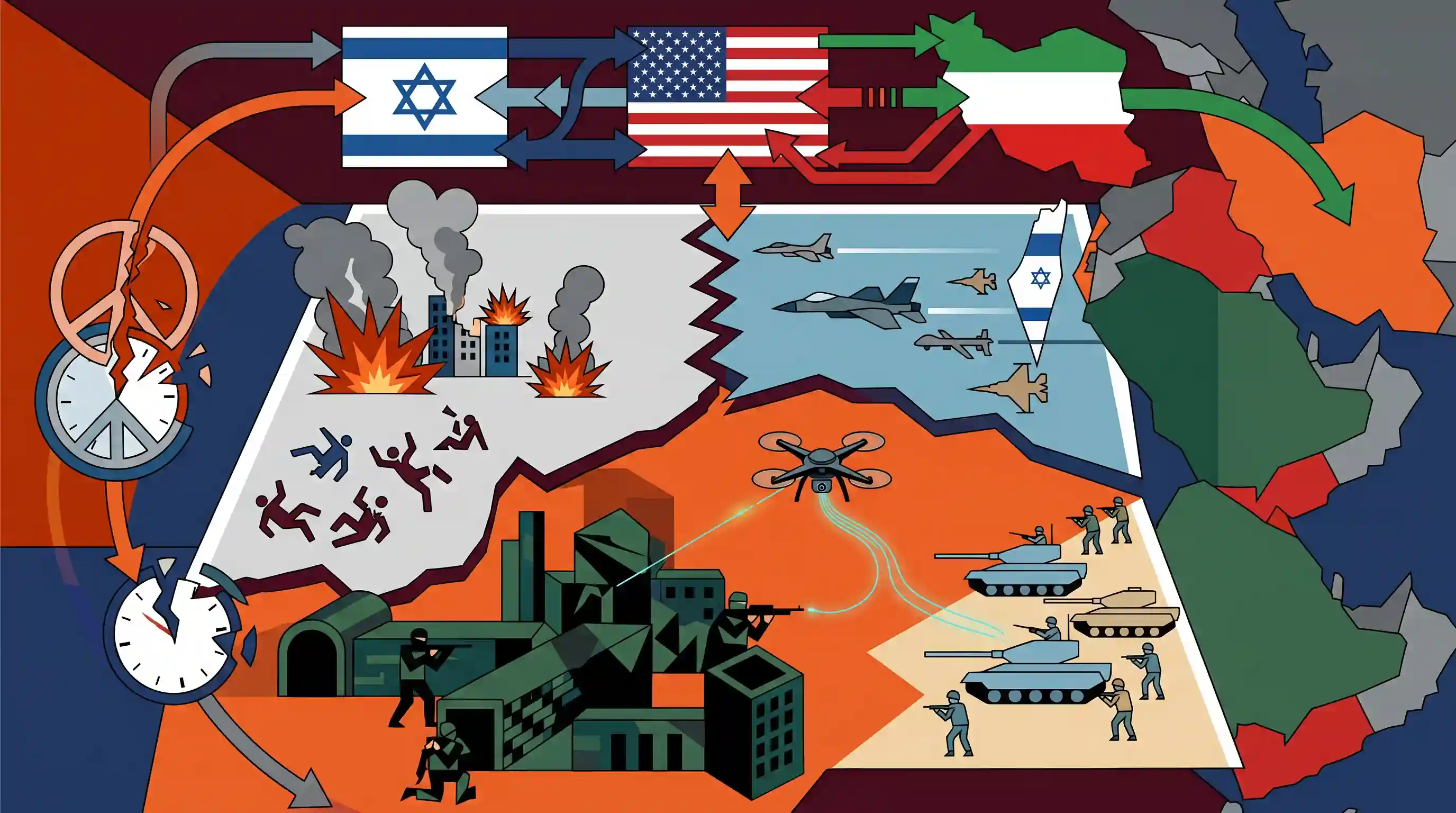
Despite a recently extended ceasefire, Israeli airstrikes in southern Lebanon have killed at least seven people, underscoring the extreme fragility of peace efforts in the Middle East. The conflict involves ongoing Israeli ground operations and advanced asymmetric warfare by Hezbollah, which recently deployed fibre-optic drones against Israeli troops. This localized violence is deeply intertwined with the broader geopolitical struggle involving Israel, the US, and Iran, posing continuous risks to regional stability.
Key Points
- Israeli airstrikes in southern Lebanon killed at least seven people, breaching a fragile ceasefire that had recently been extended by three weeks.
- Israel issued evacuation orders for residents of nine southern Lebanese villages amid its ongoing ground invasion.
- Hezbollah employed advanced asymmetric warfare tactics, notably using fibre-optic drones to strike Israeli troops in the village of Bayed.
- The current escalation is rooted in broader regional tensions, sparked when Hezbollah fired rockets into Israel in response to a US and Israeli campaign against Iran.
Important Terms
Hezbollah

A Lebanon-based Shiite political and militant group founded in 1982. Supported by Iran, it operates as a 'state within a state' and is a major player in West Asian geopolitics.
UPSC context
GS Paper II (IR); tests knowledge of non-state actors and regional security dynamics in the Middle East.
Blue Line
A 120km UN-demarcated 'line of withdrawal' established in 2000 to verify the pullout of Israeli forces from Lebanon; it serves as a de facto boundary, not a border.
UPSC context
GS Paper II (IR); important for understanding border disputes and UN peacekeeping (UNIFIL) roles in West Asia.
UN Security Council Resolution 1701
A 2006 UN resolution mandating a weapons-free zone between the Blue Line and the Litani River, intended to be occupied only by the Lebanese Army and UNIFIL peacekeepers.
UPSC context
GS Paper II (IR); a key legal framework for ceasefire and stability in the Israel-Lebanon conflict.
Litani River
Lebanon’s longest river, flowing through the Beqaa Valley. It acts as a strategic security boundary; UN Resolution 1701 requires Hezbollah to withdraw all military assets north of it.
UPSC context
GS Paper I (Geography) and GS II (IR); critical geographic marker in Middle Eastern conflict zones.
Asymmetric Warfare
Conflict where a non-state actor uses unconventional tactics, such as guerrilla warfare or low-cost technology, to exploit the vulnerabilities of a technologically superior conventional military force.
UPSC context
GS Paper III (Security); tests understanding of evolving modern threats and unconventional defense strategies.
Fibre-optic Drones
UAVs tethered by a physical fiber-optic cable that transmits unjammable, high-definition data. They allow for precise targeting without emitting radio frequencies, bypassing conventional electronic warfare defenses.
UPSC context
GS Paper III (S&T/Defense); relevant for emerging military technology and its impact on traditional air defense systems.
Prelims Trap
"The Blue Line serves as the finalized, internationally recognized border between Israel and Lebanon."
It is not a formalized international border. It is a "withdrawal line" demarcated by the UN in 2000 solely to confirm the retreat of Israeli forces from southern Lebanon.
Static Concepts Connected
What are the key geopolitical markers of the Israel-Lebanon conflict zone?
- Litani River: A crucial river in southern Lebanon. UNSC Resolution 1701 designates the area south of it down to the Israeli border as a demilitarized zone.
- Blue Line: A UN-demarcated withdrawal line separating Lebanon and Israel. It is not a formal border but a practical boundary monitored by UN peacekeepers.
- UNIFIL: The UN Interim Force in Lebanon, established in 1978 to confirm Israeli withdrawal and restore international peace. India remains a major troop contributor.
How do fibre-optic drones evade conventional electronic warfare (EW)?
- Physical Data Link: They rely on an unspooling physical cable to transmit real-time high-bandwidth video and command signals back to the operator, rather than wireless connections.
- Jamming Immunity: Because they do not depend on Radio Frequency (RF) telemetry or GPS signals, conventional electronic jammers and spoofing systems cannot disrupt their flight.
Cross-Topic Patterns
UNIFIL & India's Peacekeeping Footprint
India is a major troop contributor to UNIFIL. Escalations threatening peacekeepers directly intersect with India's longstanding diplomatic investment in UN missions and international law.
Asymmetric Tech & India's Border Security
The use of jam-proof tethered drones by non-state actors flags a critical vulnerability for conventional armies, making it highly relevant for India's own border management against asymmetric threats.

Expect a 2026 prelims map question pairing West Asian rivers (Litani, Jordan) or demarcation lines (Blue Line, Green Line) with conflicts.
Linked PYQs · 5
Linked PYQs · 5
- 2018MainsGS2
“India’s relations with Israel have, of late, acquired a depth and diversity, which cannot be rolled back.” Discuss.
- 2023MainsGS3
The use of unmanned aerial vehicles (UAVs) by our adversaries across the borders to ferry arms/ammunitions, drugs, etc., is a serious threat to the internal security. Comment on the measures being taken to tackle this threat.
- 2023PrelimsGS1
Consider the following statements: Statement-I: Israel has established diplomatic relations with some Arab States. Statement-II: The 'Arab Peace Initiative' mediated by Saudi Arabia was signed by Israel and Arab League. Which one of the following is correct in respect of the above statements?
- 2018PrelimsGS1
The term "two-state solution" is sometimes mentioned in the news in the context of the affairs of
- 2023PrelimsGS1
Consider the following pairs: Area of conflict mentioned in news Country where it is located 1. Donbas : Syria 2. Kachin : Ethiopia 3. Tigray : North Yemen How many of the above pairs are correctly matched?
