Ongoing Israeli Airstrikes in Gaza Deepen Regional Humanitarian Crisis
Source:The Hindu ↗
Why It Matters
The Israel-Palestine conflict is a cornerstone issue in West Asian geopolitics. It impacts global energy security, regional stability, and diplomatic alignments. Understanding the geography of the conflict (Gaza, West Bank, Rafah, Levant) and its political frameworks (Two-State Solution, Arab Peace Initiative) is crucial for both UPSC Prelims and Mains.
Summary
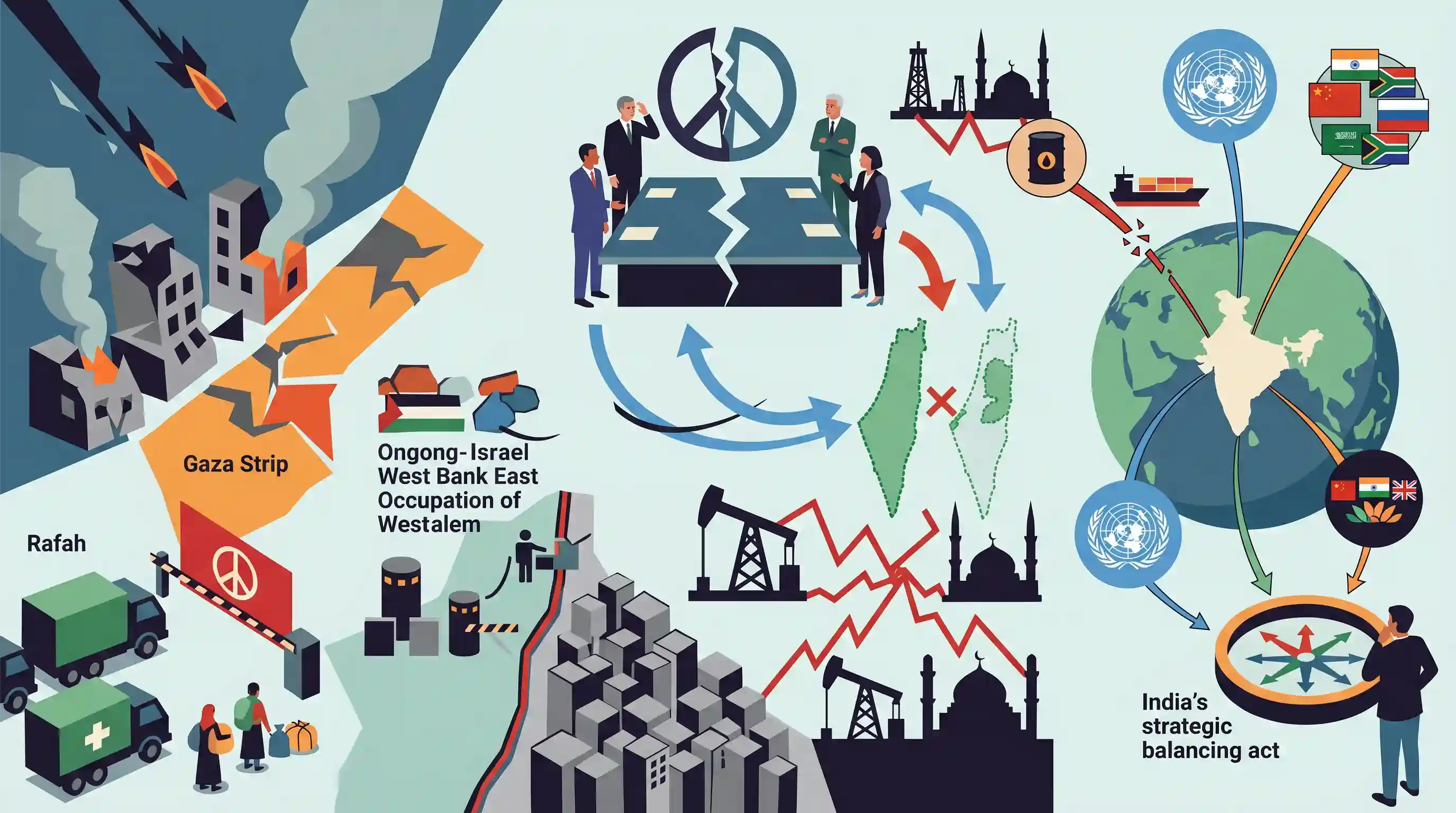
Recent Israeli airstrikes in the Gaza Strip have led to further casualties, continuing the protracted Israel-Hamas conflict. The violence persists despite a previously proposed U.S.-brokered ceasefire agreement. The situation highlights the worsening humanitarian crisis, exacerbated by restricted access at the Rafah border crossing, and underlines the stalled progress toward a two-state solution amid the ongoing occupation of Palestinian territories including the West Bank and East Jerusalem.
Key Points
- Israeli airstrikes in Gaza recently resulted in multiple fatalities amidst the ongoing conflict.
- The escalation persists despite a months-old ceasefire framework proposed by the U.S. administration.
- Humanitarian assistance and medical evacuations remain severely hindered, particularly concerning the operations at the Rafah border crossing with Egypt.
- The ongoing military campaign further complicates international efforts toward a two-state solution and highlights issues surrounding the continued occupation of Palestinian territories.
Important Terms
Two-State Solution

A proposed framework to resolve the conflict by establishing two independent, sovereign states—Israel and Palestine—existing side-by-side within secure and recognized borders.
UPSC context
GS Paper II: International Relations. Essential for understanding West Asia stability and India's long-standing diplomatic support for Palestinian statehood.
Hamas
A Palestinian Islamist political and militant organization that has governed the Gaza Strip since 2007; designated a terrorist group by several nations.
UPSC context
GS Paper II/III: International Relations and Security. Tests knowledge of non-state actors and their role in regional geopolitical volatility.
Rafah Border Crossing
The southernmost transit point between the Gaza Strip and Egypt; the only Gaza border crossing not directly controlled by Israel.
UPSC context
GS Paper II: Places in News. Critical for questions on humanitarian corridors and Egypt's strategic role in the conflict.
West Bank and East Jerusalem
Palestinian territories occupied by Israel since 1967, central to statehood claims but subject to ongoing settlement expansion and de facto annexation.
UPSC context
GS Paper II: International Relations. Key territorial disputes affecting global peace and India’s interests in the Middle East.
National Committee for the Administration of Gaza (NCAG)
A transitional Palestinian administrative body created under the 2025 ceasefire to manage Gaza's civil affairs and post-war reconstruction.
UPSC context
GS Paper II: International Relations. Represents the shift toward technocratic governance and international oversight in post-conflict Gaza.
Prelims Trap
"Under its de-hyphenation policy, India has officially abandoned its support for the Two-State Solution."
De-hyphenation means India manages relations with Israel and Palestine independently. However, India continues to officially support the Two-State Solution and a sovereign Palestine.
Static Concepts Connected
What are the key geographical boundaries of the Gaza Strip and West Bank?
- Gaza Strip: Bordered by the Mediterranean Sea to the west, Israel to the north and east, and Egypt's Sinai Peninsula to the southwest.
- West Bank: A landlocked territory bordered by Jordan and the Dead Sea to the east, and enveloped by Israel to the north, west, and south.
- Rafah Crossing: The sole civilian transit point between the Gaza Strip and Egypt, crucial for humanitarian aid delivery bypassing direct Israeli territory.
What defines India's 'De-hyphenation Policy' regarding the Israel-Palestine conflict?
- Independent Tracks: India manages bilateral relations with Israel and Palestine independently, ensuring ties with one do not constrain or dictate engagement with the other.
- Balanced Stance: Enables strategic defense and tech partnerships with Israel while simultaneously providing developmental assistance and political support for an independent Palestine.
Cross-Topic Patterns
IMEC Corridor vs. Regional Instability
The protracted Israel-Hamas war presents a significant geopolitical hurdle for the India-Middle East-Europe Economic Corridor (IMEC), stalling key infrastructure and port integration plans in West Asia.
Red Sea Crisis & Global Trade
The Gaza conflict catalyzed Houthi maritime attacks in the Red Sea, directly threatening India's energy security, supply chains, and freight costs via the critical Suez Canal route.

Levant mapping (Rafah, Philadelphi Corridor, Gaza) + the war's disruption of the IMEC trade corridor are prime 2026 Prelims/Mains targets.
Linked PYQs · 3
Linked PYQs · 3
- 2018PrelimsGS1
The term "two-state solution" is sometimes mentioned in the news in the context of the affairs of
- 2023PrelimsGS1
Consider the following statements: Statement-I: Israel has established diplomatic relations with some Arab States. Statement-II: The 'Arab Peace Initiative' mediated by Saudi Arabia was signed by Israel and Arab League. Which one of the following is correct in respect of the above statements?
- 2022PrelimsGS1
The term "Levant" often heard in the news roughly corresponds to which of the following regions?
