Israeli Airstrikes Target Houthi Sites in Yemen
Source:Indian Express ↗
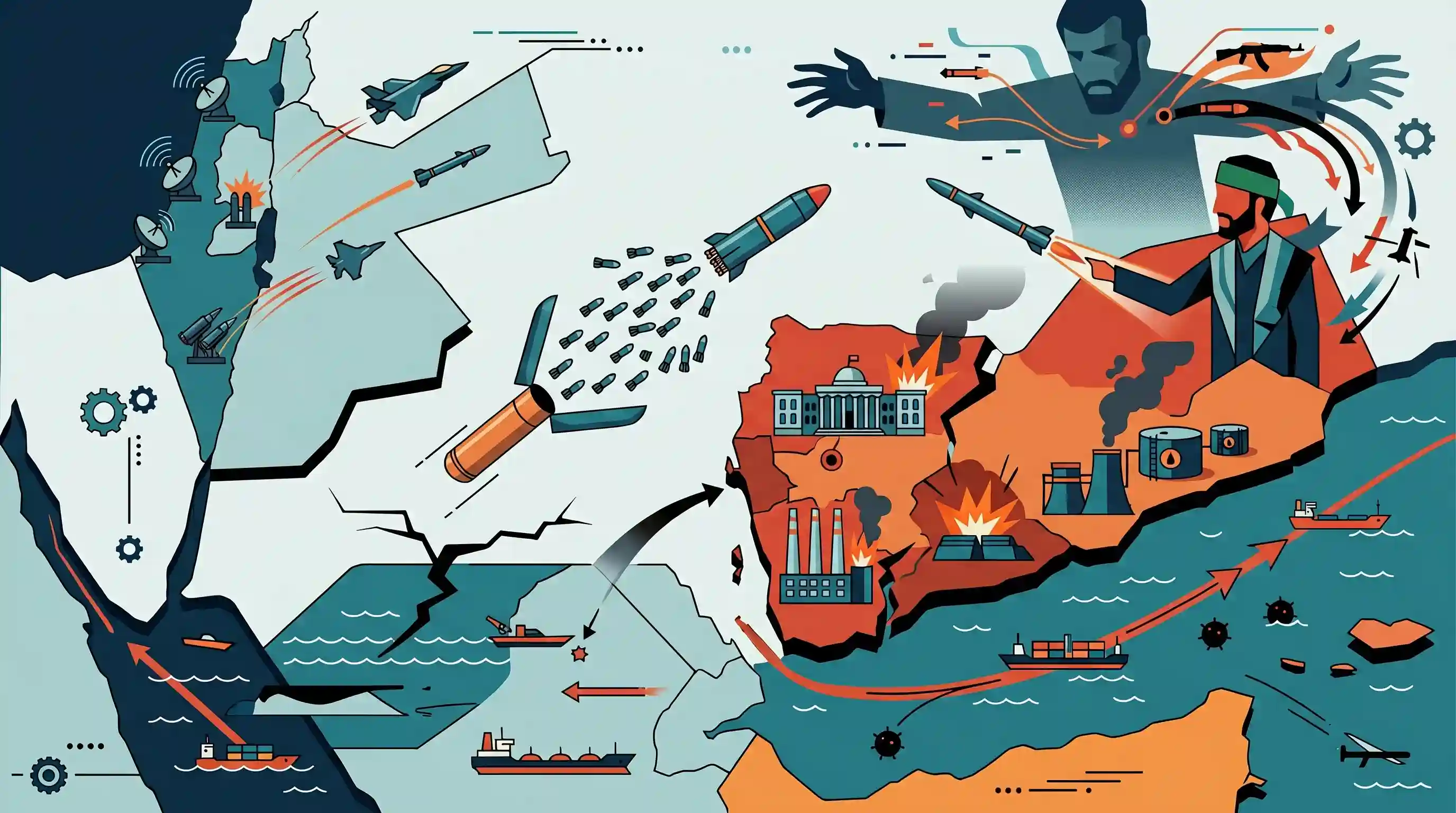
Why It Matters
The expansion of the Israel-Hamas conflict to include Iranian proxies like the Houthis destabilizes the Middle East and threatens critical global shipping lanes in the Red Sea. This directly impacts India's energy security, global supply chains, and broader strategic interests in the region.
Summary
Israeli airstrikes targeted Houthi-controlled sites in Yemen's capital, Sanaa, including the presidential palace and energy infrastructure, in retaliation for ongoing Houthi attacks. A recent Houthi strike on Israel reportedly involved a cluster munition, signaling a dangerous transfer of advanced weaponry from Iran to its proxies. The escalating conflict highlights growing regional instability, threatening both Middle Eastern security and global maritime trade routes in the Red Sea.
Key Points
- Israeli forces launched airstrikes on Yemen's capital, Sanaa, targeting a military compound, power stations, and fuel storage infrastructure.
- The airstrikes were retaliation for persistent Houthi drone and missile attacks on Israel and international shipping in the Red Sea.
- An Israeli official highlighted that a recent Houthi attack involved a cluster munition, marking the first time the group has used this weapon against Israel since the current conflict began.
- The use of cluster munitions suggests advanced military technology transfers from Iran to its regional proxies.
- The continued involvement of the Houthis, who claim to act in solidarity with Palestinians, underscores a widening Middle East proxy conflict that threatens global maritime trade routes.
Important Terms
Houthis (Ansar Allah)

An Iran-aligned Zaydi Shia militant movement in Yemen. Formally known as Ansar Allah, they control Sanaa and have targeted international shipping in the Red Sea.
UPSC context
GS Paper II (International Relations); understanding West Asia instability and its impact on India's energy and maritime trade security.
Axis of Resistance
An informal anti-Western and anti-Israel alliance led by Tehran, comprising the Syrian government, Hezbollah, Hamas, and the Houthi movement to project Iranian influence.
UPSC context
GS Paper II (International Relations); analyzing regional power dynamics and the role of proxy networks in Middle Eastern conflicts.
Bab-el-Mandeb Strait
A strategic maritime chokepoint connecting the Red Sea to the Gulf of Aden. It is a vital artery for global trade between Asia and Europe.
UPSC context
GS Paper I (Geography) & II (IR); critical for mapping global trade routes and understanding 'Look West' geopolitics.
Cluster Munitions
Weapons that scatter multiple smaller submunitions over a broad area. They are often criticized under international law for causing indiscriminate civilian harm.
UPSC context
GS Paper II/III (International Law/Security); relates to disarmament treaties and the ethics of modern warfare technology.
Non-State Actors
Entities that exert significant political or military influence but are not affiliated with any sovereign state, such as insurgent groups or extremist organizations.
UPSC context
GS Paper III (Security); challenges posed by unconventional forces to regional stability and national sovereignty.
Maritime Security
The protection of oceans and sea lanes from threats like piracy and terrorism to ensure the safe passage of global commercial vessels.
UPSC context
GS Paper III (Internal Security); critical for India's strategy as a 'Net Security Provider' in the Indian Ocean Region.
Prelims Trap
"India is a signatory to the UN Convention on Cluster Munitions (CCM)."
India, along with the US, Russia, China, Pakistan, and Israel, has NOT signed the CCM, citing legitimate national security and defense needs.
Static Concepts Connected
What is the Convention on Cluster Munitions (CCM)?
- Core Mandate: A 2008 UN treaty that prohibits the use, production, transfer, and stockpiling of cluster bombs due to their indiscriminate damage.
- Non-Signatories: Major military powers including India, the US, Russia, China, Pakistan, and Israel have refused to sign the convention.
- Civilian Threat: Cluster bombs leave unexploded ordnance (UXO) over wide areas, which act like landmines and threaten civilians long after conflicts end.
What is the geographical significance of the Bab-el-Mandeb Strait?
- Location: A narrow maritime chokepoint connecting the Red Sea to the Gulf of Aden and the Arabian Sea.
- Bordering Nations: Bordered by Yemen on the Arabian Peninsula, and Djibouti and Eritrea in the Horn of Africa.
- Trade Artery: It acts as the southern gateway to the Suez Canal, handling roughly 10-12% of global seaborne trade.
Cross-Topic Patterns
Proxy warfare disrupts global SLOCs
The Houthi attacks in the Red Sea connect non-state armed groups directly to global inflation and energy security, forcing Indian shipping to detour via the Cape of Good Hope.
Proliferation of indiscriminate weapons
The transfer of cluster munitions to non-state actors highlights the limitations of disarmament treaties (like CCM) when state sponsors bypass international norms to arm proxies.

Mapping the Bab-el-Mandeb, Red Sea bordering nations, and India's stance on weapons treaties (CCM, Ottawa) is highly probable for 2026.
Linked PYQs · 4
Linked PYQs · 4
- 2025MainsGS2
"Energy security constitutes the dominant kingpin of India's foreign policy, and is linked with India's overarching influence in Middle Eastern countries.” How would you integrate energy security with India's foreign policy trajectories in the coming years?
- 2018MainsGS2
“India’s relations with Israel have, of late, acquired a depth and diversity, which cannot be rolled back.” Discuss.
- 2023MainsGS3
The use of unmanned aerial vehicles (UAVs) by our adversaries across the borders to ferry arms/ammunitions, drugs, etc., is a serious threat to the internal security. Comment on the measures being taken to tackle this threat.
- 2022MainsGS2
How will I2U2 (India, Israel, UAE and USA) grouping transform India's position in global politics?
