Israel Strikes Hodeida Port Amid Escalating Red Sea Conflict
Source:Indian Express ↗
Why It Matters
The expanding conflict involving Israel, Iran-backed proxies (Houthis), and its spillover into the Red Sea directly threatens global maritime trade and supply chains, heavily impacting India's economic and energy security interests. It underscores the fragility of Middle Eastern geopolitics.
Summary
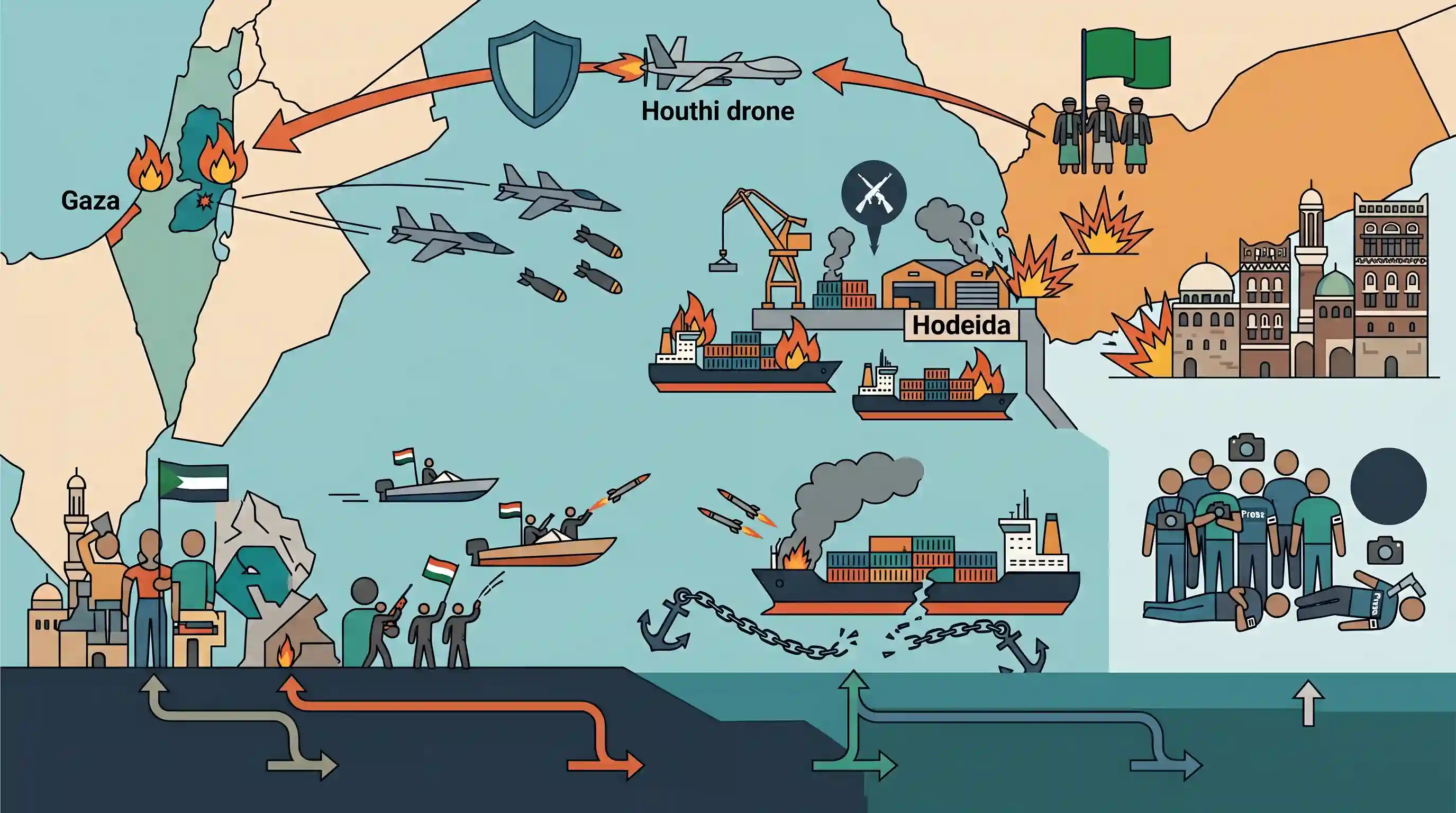
Israel has intensified its military operations against the Iran-backed Houthi rebels in Yemen by launching airstrikes on the Hodeida port and the capital city of Sanaa. The Israeli military stated that the strikes targeted military infrastructure, including a weapons transfer hub at Hodeida. This escalation follows a Houthi drone attack that breached Israeli air defenses. The conflict has raised serious human rights concerns, particularly after reports of 31 journalists being killed in Sanaa. The Houthis continue to threaten Red Sea maritime security and attack Israeli targets in professed solidarity with Palestinians in the Gaza Strip, highlighting the expanding regional dimensions of the Middle East conflict.
Key Points
- Israel launched airstrikes on the Yemeni port city of Hodeida, targeting military infrastructure used by the Iranian-backed Houthi rebels.
- The Hodeida port is allegedly used for transferring weapons from Iran to the Houthis for attacks against Israel and its allies.
- Earlier Israeli strikes on the Yemeni capital, Sanaa, reportedly killed 31 journalists and hit residential areas, military HQs, and a fuel station.
- The Houthis have been firing missiles and drones at Israel and targeting ships in the Red Sea for over 22 months, citing solidarity with Palestinians in Gaza.
- International human rights groups have raised alarms about the severe threats faced by journalists in Yemen from both domestic authorities and external warring parties.
Important Terms
Houthis

A Zaydi Shia Islamist military and political group in Yemen, officially known as Ansar Allah. They control northern Yemen and are part of the Iran-led 'Axis of Resistance.'
UPSC context
GS Paper II (IR); Essential for understanding Middle East geopolitics, proxy warfare, and threats to Indian maritime trade.
Hodeida Port
Yemen's primary Red Sea seaport and a strategic hub. It is the principal entry point for humanitarian aid, fuel, and commercial imports to northern Yemen.
UPSC context
GS Paper I & II (Geography/IR); A key location for mapping and studying the humanitarian/strategic aspects of the Yemeni conflict.
Bab-el-Mandeb Strait
A strategic maritime chokepoint ('Gate of Tears') connecting the Red Sea to the Gulf of Aden, separating Yemen from the Horn of Africa.
UPSC context
GS Paper I & II (Geography/IR); A critical global trade artery impacting India's energy security and Suez Canal access.
Committee to Protect Journalists (CPJ)
An independent, New York-based non-profit organization that promotes global press freedom and defends journalists' rights through annual reports and advocacy.
UPSC context
GS Paper II (Governance); Relevant for press freedom indices and Indian constitutional provisions under Article 19(1)(a).
Human Rights Watch (HRW)
An international non-governmental organization that investigates and documents human rights violations worldwide, known for its annual 'World Report.'
UPSC context
GS Paper II (IR/Rights); Important for studying global human rights monitoring frameworks and their influence on international relations.
Prelims Trap
The Yemeni port of Hodeida is located on the Gulf of Aden, controlling direct maritime access to the Arabian Sea.
Hodeida is situated on the Red Sea coast, not the Gulf of Aden. The Bab el-Mandeb strait separates these two crucial water bodies.
Static Concepts Connected
What are the key maritime chokepoints connecting the Red Sea to global trade routes?
- Bab el-Mandeb: Connects the Red Sea to the Gulf of Aden and Arabian Sea; lies between Yemen (Asia) and Djibouti/Eritrea (Africa).
- Suez Canal: An artificial waterway in Egypt connecting the northern end of the Red Sea to the Mediterranean Sea, bypassing the African continent.
How are journalists protected during armed conflicts under international law?
- Geneva Conventions: Article 79 of Additional Protocol I to the Conventions explicitly protects civilian journalists engaged in dangerous professional missions in conflict zones.
- War Crimes: Deliberate targeting of journalists who are not taking a direct part in hostilities constitutes a serious breach of international humanitarian law.
Cross-Topic Patterns
Red Sea Crisis & India's Export Costs
Rerouting via the Cape of Good Hope to avoid the Red Sea bypasses the Suez Canal, driving up freight costs and impacting India's agricultural and textile export competitiveness.
Non-State Actors & Asymmetric Drone Warfare
The Houthi use of cheap drones to breach advanced Israeli air defenses highlights how non-state actors leverage asymmetric warfare to disrupt traditional military superiority and global trade.

Expect a Prelims match-the-following question pairing strategic Middle Eastern ports (Hodeida, Haifa, Bandar Abbas) with their water bodies.
Linked PYQs · 3
Linked PYQs · 3
- 2024PrelimsGS1
Consider the following statements : Statement-I : Sumed pipeline is a strategic route for Persian Gulf oil and natural gas shipments to Europe. Statement-II : Sumed pipeline connects the Red Sea with the Mediterranean Sea. Which one of the following is correct in respect of the above statements?
- 2018MainsGS2
“India’s relations with Israel have, of late, acquired a depth and diversity, which cannot be rolled back.” Discuss.
- 2025MainsGS2
"Energy security constitutes the dominant kingpin of India's foreign policy, and is linked with India's overarching influence in Middle Eastern countries.” How would you integrate energy security with India's foreign policy trajectories in the coming years?
